Jade vine is a flower with an ultra-dreamy color.
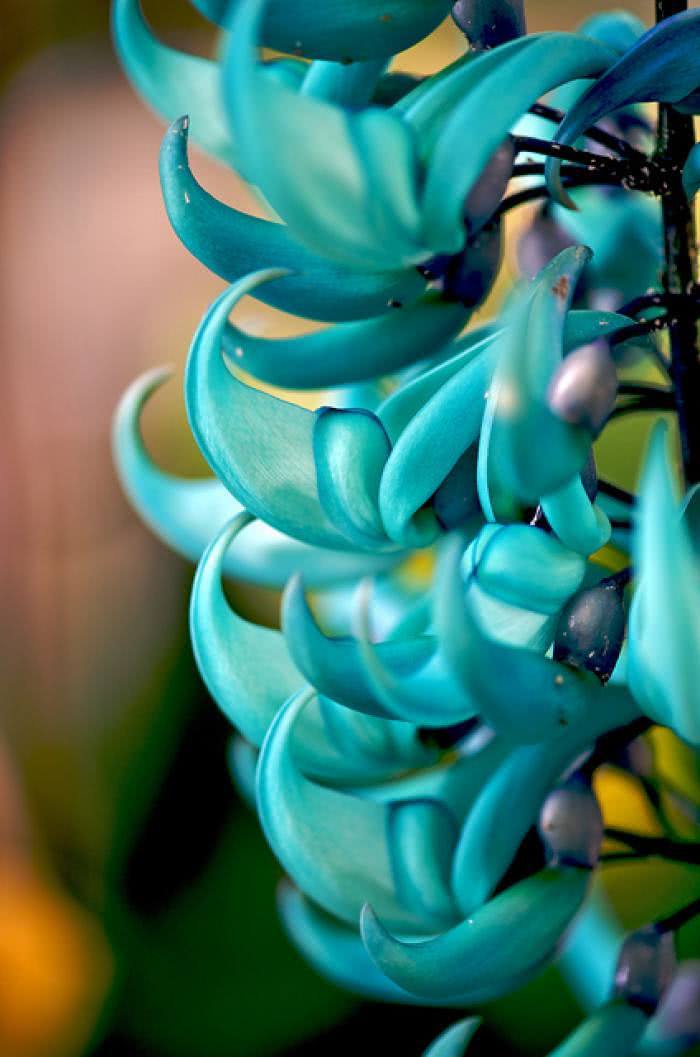
Jade vine, scientific name Strongylodon macrobotrys, is a perennial evergreen climbing plant of the genus Strongylodon in the Fabaceae (Papilionaceae) family. The stem is woody and can reach over 20 m in length. The leaves are palmately compound, usually with 3 leaflets; the leaflets are oblong-elliptic, with acuminate apex and cuneate base, obvious veins, and entire margins, and the lower leaflets are asymmetrical. The raceme is composed of many small flowers; the claw-shaped flowers vary in color from blue-green to mint green, and the inflorescence can reach 1.5 m. The fruit is a pod. Flowering and fruiting period: flowering from December to April.
The flowers hang among the dense foliage and look as if they emit a cold glow, extremely captivating. It is native to the tropical rainforests of the Philippines, and its highly unusual color is almost unlike that of any other plant. Some famous gardens, such as the Royal Botanic Gardens in the United Kingdom and the Cambridge University Botanic Garden, have introduced it, and it has been introduced and cultivated in South China and Southwest China.
Jade vine
Origin and habitat:
Strongylodon macrobotrys mostly grows by streams in moist forests and relies on bats for pollination. It is native to the tropical rainforests of the Philippines; in Hawaii, Strongylodon macrobotrys is used to make leis, and in Thailand it is used for vertical greening of walls. It has been introduced and cultivated in South China and Southwest China; the Xishuangbanna Tropical Botanical Garden introduced it from Thailand in October 2003, and it has already flowered.
Jade vine
Growth and propagation:
Strongylodon macrobotrys is not tolerant of frost, and the winter temperature must be kept above 15.6oC. It is suitable for planting in neutral to acidic soil and prefers full sunlight. Semi-mature stems can be cut and inserted into a bottom-heated sand bed to root. The seed-setting rate is low; in tropical forests it is pollinated by bats. The fruit resembles a green mango and turns brown when mature, containing 6 to 10 brown seeds, and the seeds are shaped like cashews. After the seeds mature, it is best to sow them as early as possible, but the sowing temperature must be maintained above 26.7oC.
Jade vine
Main value:
The flowers of the jade vine are peculiar in shape and rare in color. In full bloom, they are like a hundred birds returning to their nests, a magnificent sight. From late spring to early summer, the flowers grow in a flat-spreading manner along the peduncle; each cluster has dozens of flowers, and the flowers are jade-green with a blue luster. The keel petal curves upward in the shape of a parrot's beak, and each blooming flower looks like a small bird carved from jade. The flowers come one after another, one after another, like a flock of birds taking flight.
This species is an excellent flowering climbing plant. In parks and courtyards, it can be trained to climb frames and shaped into arches, hedges, flower corridors, pavilion tops, and so on. In April and May, the luxuriant flowers set off against the green leaves create a delightful contrast and have a distinctive charm.