For beginners, choose these 9 plants: the less you water, the more easily they burst into a full pot
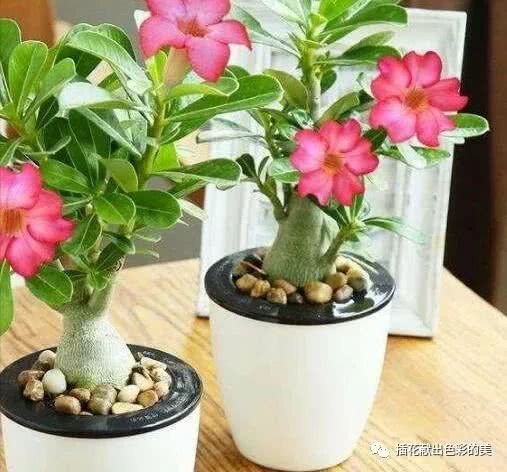
Gardeners agonize every day over whether to water their plants, and reading everyone's questions is quite worrying too. So why not just grow some plants that don't need much watering at all! These 9 plants won't die the less you water them, and there's sure to be one that suits you!
1. Desert rose
The desert rose (Adenium obesum) is a short plant with an ancient, rugged tree form and a swollen root and stem shaped like a wine bottle. It blooms twice a year, from April to May and from September to October, with bright red, gorgeous flowers shaped like trumpets, extremely unique and deeply loved by people
The desert rose is relatively drought-tolerant, and the amount of water given each time must not be too much. If there is too much moisture, it very easily causes root rot.
In spring and autumn, water thoroughly, keeping the potting soil moist but not overly wet. Water according to the principle of "water when dry, let dry between waterings; water thoroughly when completely dry."
In summer's high temperatures, water once a day, and at other times once every 2-3 days.
In winter, when temperatures drop, watering should be appropriately controlled, taking care to keep the soil dry; watering once a week is enough.
2. Gymnocalycium baldianum
Gymnocalycium baldianum belongs to the cactus family, genus Gymnocalycium. Because it blooms abundantly and beautifully, it is loved and accepted by everyone. Its care is also very simple: just give it plenty of sun and water it less. However, it must not be exposed to strong direct sunlight, otherwise its appearance will deteriorate.
3. Graptopetalum paraguayense
Graptopetalum paraguayense, also called "windmill plant," is a succulent of the Crassulaceae family. It is extremely adaptable and not strict about its environment. It is drought-tolerant and won't die even if not watered for ten days to half a month.
4. Snake plant
The snake plant (Sansevieria trifasciata), also known as mother-in-law's tongue, is an evergreen plant with stiff, upright leaves that have white-and-green mottled patterns on the surface. It is suitable for placing at home. When growing a snake plant, be sure to keep it in sufficient sunlight
In spring and summer, keep the potting soil moist, but do not let water accumulate. In autumn and winter, water only after the potting soil has completely dried out.
In daily care, you can wash the leaf surfaces with water to keep the plant looking attractive and to help it grow better. In winter, when the temperature is below 10°C, do not water, to avoid cold damage. Watering should be done in the morning or evening.
5. Jade plant
The jade plant (Crassula ovata) has thick, fleshy leaves and is evergreen year-round. Depending on its size, it can be placed on a sunny bedroom windowsill or balcony to grow. Because it releases oxygen at night, it is beneficial to human health and is suitable for long-term placement in the bedroom.
The leaves and branches of the jade plant both have a strong water-storage capacity, so one watering can sustain it for many days; it is very drought-tolerant. In this season, watering once every 15-20 days is enough.
6. Aloe
The aloe (Aloe) has thick, fleshy leaves, pure green or with mottled patterns, long and lance-shaped, with pointed tips. The leaf edges are mostly spiny or entire, clustered on the stem and arranged in a spiral. The raceme emerges from the leaf cluster and grows upright, with the flower stalk taller than the leaves and orange-red flowers that are very beautiful
It has strong drought tolerance: during the growing period it prefers slightly moist conditions, and during dormancy it prefers dry conditions. It is not shade-tolerant, and in a shaded environment it mostly does not bloom; when there is plenty of sunlight, the leaves are beautiful and the flowers are abundant
Note that drought tolerance does not mean you can go without watering forever; long-term water shortage can also cause wilting. Watering once a week can keep the aloe vigorous for a long time.
In summer, keep the potting soil moist, watering alternately dry and wet. At the same time, because the aloe likes a dry air environment, it should be placed separately from other plants that like moist air.
In autumn, keep the potting soil on the dry side. After the autumn temperature gradually cools, reduce the water supply until it maintains a state of dry but not parched. In winter and early spring, when the temperature is relatively low (above 5°C), the aloe is in a semi-dormant state and should not be watered much; it is best for the potting soil to be dry but not parched, and only water lightly after it has completely dried out.
7. Money tree
The money tree (Zamioculcas zamiifolia) is called the money tree because its leaves resemble strings of coins. It is native to Africa, and the plant grows 50 to 80 cm tall. It is a very popular indoor foliage plant, suitable for placing in the living room, study, or office.
The money tree can be watered once a month. The soil must be ensured to be loose and breathable, otherwise water easily accumulates.
The money tree is a plant that likes light and is also shade-tolerant. It is not suitable for growing in strong light; it is best placed beside a window where there is something to provide shade, so that it can fully receive sunlight without its leaves being scorched by excessive sun exposure
8. Kalanchoe
Kalanchoe (Kalanchoe blossfeldiana), also known as florist kalanchoe, dwarf kalanchoe, and Christmas kalanchoe, is a perennial evergreen succulent, fleshy flowering plant of the Crassulaceae family. Its natural flowering period usually begins in late December and can last until early May of the following year, hence the name "longevity flower."
Kalanchoe leaves are plump, which helps store water, so generally watering once a week is enough.
The watering principle for kalanchoe is also "don't water if not dry." It's better to let it be a bit dry than to always give in to the urge to water. Once water accumulates, root rot comes easily, so gardeners must control their hands.
9. Money tree (Pachira aquatica)
The money tree (Pachira aquatica) symbolizes good fortune and is deeply loved by many homeowners. It is evergreen year-round, with a graceful form. Used to beautify halls, rooms, and homes, it carries the meaning of "making a fortune," in hopes of good luck and happiness. The money tree can also play a very good role in purifying indoor air and absorbing formaldehyde and other harmful gases.
The money tree has relatively strong drought resistance. Generally, water once a week. In summer, when temperatures are high and the soil dries quickly, it may need watering once every 3-4 days; in winter, reduce watering.
In spring and autumn, water once every 5-10 days. In winter, watering once a month is enough.