Is using the parasitic wasp Anastatus japonicus to control the lychee stink bug effective? Taichung's three-pronged approach is working well
This year the lychee stink bug (Tessaratoma papillosa) is still rampant across Taiwan, China, and an outbreak has been reported in the Changhua area, believed to be due to the poor effectiveness of the released natural enemy, the parasitic wasp Anastatus japonicus. To avoid affecting the lychee and longan harvest, the county government plans to fully subsidize chemical control. But Taichung City's agricultural authorities, also a lychee and longan production area, believe that controlling the lychee stink bug requires a three-pronged approach of biological, physical and chemical control, and that when problems arise, the failure of Anastatus japonicus cannot be blamed alone.
Wufeng farmer: releasing 50,000 Anastatus japonicus reduced the lychee stink bug by 70%
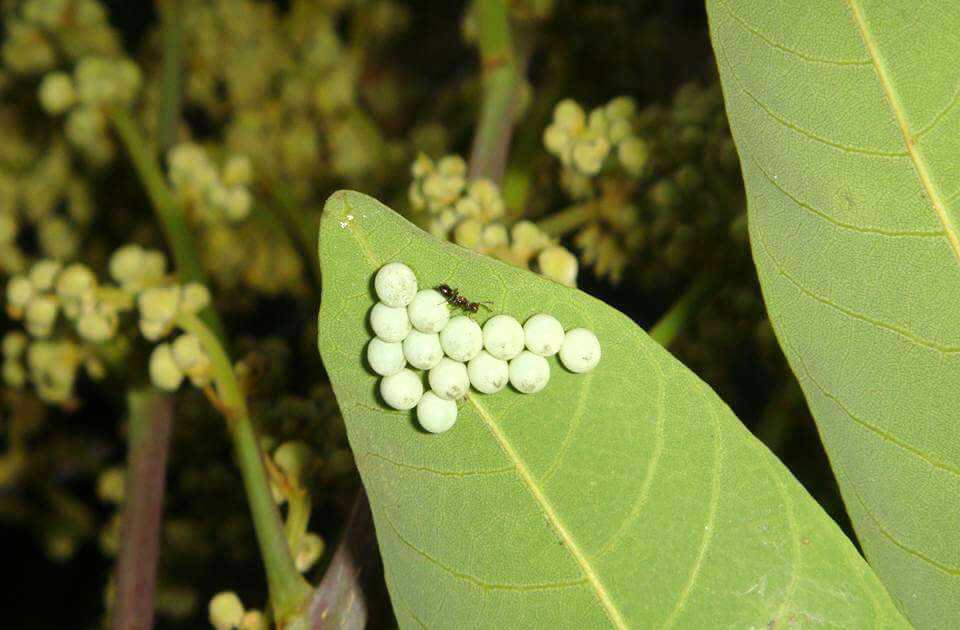
This year, Wufeng farmer Zhang Danfeng in Taichung followed the control calendar, and with the assistance of the township office released 50,000 Anastatus japonicus, reducing the number of lychee stink bugs by about 70%. "But you have to be very diligent; whenever you see eggs on the leaves, you have to remove them at once."
"Biological control can't be like pesticides, killing every last one," Zhang Danfeng believes that farmers' own management is more important, and that "you can't dump all the responsibility on the wasps."
This year the lychee stink bug is even more rampant than last year. Observing poorly managed fruit trees, Zhang Danfeng said, "A single tree can have several thousand of them; there are more red bugs than green young longan fruits." When she and her husband pruned branches earlier, they flipped through the cut twigs and leaves and removed the leaves bearing lychee stink bug eggs. Because burning branches and leaves is not allowed in the mountain area, and these branches and leaves can serve as organic matter, farmers generally pile them at the base of the trees, but this way, after the lychee stink bug eggs hatch, the nymphs climb straight up the tree.
Zhang Danfeng is also a farmer who dislikes spraying pesticides, and says she really misses the days when spraying once a year was enough. But now at least one treatment is needed before flowering and one after flowering, plus diligent cleaning and management, and she has finally kept the lychee stink bug density at an acceptable level. However, she is very worried about the abandoned orchard next door; once the nymphs grow into adults, they will fly over to her own orchard.
Neglected abandoned orchards are a headache
The Wufeng District Office built a breeding center for Anastatus japonicus, costing about 2 million yuan including technology transfer fees. Liu Shihong said this is the first year and equipment had to be purchased, so the cost can be lower next year. The egg card purchase method also does not require much funding and is worth adopting by local units short of funds.
Zhang Danfeng pointed out that the most important thing for the lychee stink bug is early control, that is, around the Lunar New Year, when it has just overwintered and has not yet laid eggs, its body is at its weakest, and using pesticides at this time reduces the adults to a minimum. Otherwise, if control is neglected at the start, the density of the lychee stink bug rises, and it becomes hard to deal with later.
Overall, the lychee stink bug is still rampant this year, but Taichung City's multi-pronged plus collective control strategy has achieved results. What remains a headache is still the neglected abandoned orchards. "Abandoned orchards are hotspots for the lychee stink bug; this is the most difficult problem," said Liu Shihong.
To effectively combat the lychee stink bug, early control and collective control are crucial, and beyond pesticide use, farmers' independent management must be strengthened and Anastatus japonicus breeding increased, so as to attack from multiple sides while also taking into account the ecological balance of bees and other organisms.