How to make a Buddha's hand bonsai? A full breakdown of the detailed methods and steps
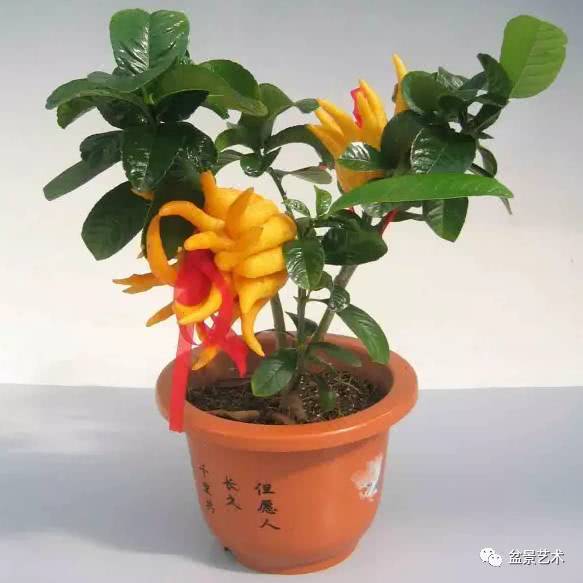
Buddha's hand (Citrus medica var. sarcodactylis) is a variety of citron in the genus Citrus of the family Rutaceae. The flowers are white, tinged with pale purple on the outside, and fragrant. The tip of the fruit splits into finger-like sections and is yellow, with ornamental value. Buddha's hand prefers warm conditions and requires a sunny, well-ventilated environment; it likes warm, humid soil with good drainage. The soil is best slightly acidic, with a pH between 5.5 and 6.5. The methods for making and growing a Buddha's hand bonsai are as follows:
I. Sources of young plants
Buddha's hand bonsai plants are mostly obtained through cuttings and grafting. The cuttings are taken from vigorous one- to two-year-old fruiting branches, each 10-15 cm long. Before cutting, soak the base in a 200 PPM naphthaleneacetic acid (NAA) solution for about 10 hours. Late April is the more suitable time for cuttings. Roots form about 1 month after cutting. For graft propagation, citron and citrus are mostly used as rootstock.
II. Shaping
1. Potting
Choose early spring or late autumn for the timing. Use fertile, moist, well-drained sandy loam as the potting soil, and adjust the pH value so that it is slightly acidic.
2. Shaping techniques for Buddha's hand bonsai.
This includes flower thinning, bud removal, pinching, and pruning. Flower thinning means removing overly dense flowers, infertile flowers, and underdeveloped flowers, keeping only the 2-3 fully developed flowers at the top. The purpose is to concentrate nutrients and increase the fruit-setting rate. Buddha's hand has strong sprouting ability, so newly sprouted buds and new shoots need to be pinched and pruned for shaping. The principle is to keep no new shoots, keep few summer shoots, and keep many autumn shoots. This is because autumn shoots receive better fertilizer, water, and light conditions than spring shoots and summer shoots, and the branches are also stronger, which is favorable for flowering and fruiting. In addition, be careful to thin out surplus branches, water sprouts, overly dense branches, and diseased or pest-infested branches.
3. Care
(1) Location
Buddha's hand likes light and prefers warmth and humidity, so it should be placed in a spot with ample light and slightly higher air humidity, and be protected from the cold in winter.
(2) Watering
Buddha's hand likes moisture but fears waterlogging. If the soil is too wet or water accumulates at the bottom of the pot, it will cause flower and fruit drop. But if the potting soil is too dry, it can also easily cause flower and fruit drop. Therefore, watering should follow the principle all year round of not watering when dry and watering thoroughly when you do. Buddha's hand requires high air humidity, between 70% and 90%. Therefore, in summer, water should often be sprayed on the leaves or the ground to maintain a certain humidity.
(3) Buddha's hand is evergreen all year round, and its fruit is relatively large, so it needs a lot of fertilizer. Generally, apply a base fertilizer once in early spring, and apply a dilute fertilizer once every 10 days during the growing season. During the flowering period, appropriately increase the amount of phosphorus fertilizer. Before winter arrives, apply a strong fertilizer once more and water thoroughly once to ensure it survives the winter safely.
(4) Pest and disease control
The main pest and disease problem of Buddha's hand is aphids, which should be controlled promptly and effectively.