How are goji berry bonsai made? A master teaches you how to create a premium bonsai
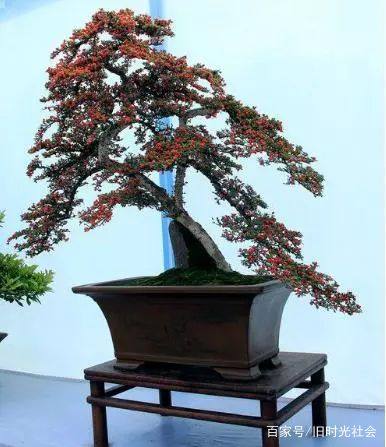
Goji berry: most of us know goji berry as a precious Chinese herbal medicine and tonic. In fact, goji berry not only has high nutritional value, but is also one of the ancient "eighteen bachelors of bonsai." The branches of goji berry are arched, and the roots of goji berry are arched. The root system is snake-like and branch-like, the flowers are purple, and in autumn and winter, the red, red fruit hangs heavily and is adorned under the name "snow-pressed coral." It is one of the best materials for making bonsai.
Goji berry has a well-developed root system and strong tillering ability, and goji berry is easy to grow. As a potted plant, it is very easy to do. However, most goji berry potted plants can only be called potted plants, not bonsai. The reason is that most of those sold are fast-growing goji berry varieties grown only for goji berries. The tree species is not a high-quality material for bonsai.
Goji berry is widely distributed in our country, and the quality of goji berry differs from place to place. If speaking of the medicinal effects, Ningxia goji berry is naturally good, but from the perspective of bonsai production, Ningxia goji berry trees are not suitable for bonsai production. So how do you choose good material?
There are more than 80 species in the genus Lycium, the vast majority of which are deciduous plants. There are 7 species in 3 varieties, including Ningxia goji berry, Xinjiang goji berry, Yunnan goji berry, goji berry, Lycium barbarum, Lycium barbarum, black fruit goji berry, goji berry, red branch, and goji berry. Among these goji berry varieties, if choosing good goji berry material, the author recommends wild goji berry, goji berry, goji berry, etc., because some other goji berries, although also shrubs, belong to upright shrubs, with a plant shape like a tree, gray bark without markings, and only high yield, can be used as economic plants. They cannot be used as ornamental bonsai.
The morphology of the goji berry shrub determines the choice of goji berry bonsai. It mainly consists of trunk, trunk, cliff, water, and root styles, and this is the most classic. As for how to make a premium bonsai, attention should be paid to the following aspects:
In other seasons, the best choice for goji berry is very tall. Because wild goji berry resources are abundant and distributed in most provinces and regions across the country, they can be selectively collected. It is recommended to choose goji berry shrubs that are simple in shape, short and stocky and sturdy, with poor traits. The main height of the main stem is less than 1 m (and it has not been truncated). The root system of goji berry is mostly developed, and the main root is obvious.
Digging wild stumps of goji berry is simple. Goji berry has a developed root system, and the main root is obvious. The author recommends digging deeper, keeping the main root, and properly preserving the soil. Not much is needed. Cut off useless branches, fill in soil, and fill the pit. As for those useless branches, because the soil is suitable for sprouting again, they can be used to protect wild resources and protect the ecological environment. Do not dig indiscriminately, do not fail to fill the pit, and do not destroy vegetation. This is not what a plant lover should do.
After digging up goji berry, if it was purchased from elsewhere, moisture retention should be done well, all leaves should be smoothed, nutrients should be preserved, the roots should be wrapped in moss, and the outer layer should be a plastic bag. If it is locally produced, it should be supplied as soon as possible. It is recommended to use coarse sand to cultivate the embryo. Goji berry sprouts easily. As long as the root system is kept moist and the upper part is wrapped in plastic wrap, it will sprout in half a month. At this time, do not remove the plastic wrap. Gradually let it adapt to the new environment. The branches and leaves can be kept within 15 cm for normal maintenance.
After the goji berry survives, it can be repotted. The potting soil distribution should use loose, breathable humus and sandy soil as the substrate. Goji berry is tolerant of barren soil, and no base fertilizer should be applied. The flower pot is chosen according to different shapes. Pots, purple clay pots, and ceramic pots are good materials. Porcelain pots are not recommended. If it is the basin type, it can be used in a shallow pot, and then a high-perimeter method can be adopted so that the roots can be gradually raised and gradually exposed.
The branches of goji berry are relatively brittle, so attention should be paid to the storage room season. In winter, the branches should be breathable, because at this time the fallen leaves allow a good observation of the shaping trend. Branch work is usually carried out in autumn. Because most of the year's branches begin to lignify and are softer and more pliable, combined with pruning, use brown wire or aluminum wire. According to the concept of breathing, for root styles, each method of washing can be adopted, gradually exposing them from the roots, cutting off useless fibrous roots, opening the guardrail, and letting the roots develop downward.
Goji berry has a strong sprouting ability. In spring, new shoots often sprout from the root-trunk area and should be erased in time, while retaining useful bud points. After a year of growth, we can observe the trend of goji berry after one year of growth and cut off useless branches. According to the growth of the branches, prune the branches by grade, then secure and fix them.
Daily management: the daily management of goji berry bonsai is extensive and simple, and it has strong adaptability. In summer, appropriate shading is suitable. In winter, it should not be below zero temperature, because the bonsai area is small and the root cold resistance is poor. In spring and autumn, there is more sunlight. The water principle is "see dry, see wet; if not watered, do not water; when watering, water thoroughly," avoiding water accumulation. Apply fertilizer appropriately in spring and autumn, every ten days to half a month, alternating with decomposed cake fertilizer and potassium dihydrogen phosphate solution. Special effect. As for pests and diseases, potted goji berry has few pests and diseases. Only when water is unsuitable or ventilation is poor can some fungal diseases occur. Oracle can be used for prevention and control. Pests include aphids, red spiders, etc. 40% dimethoate emulsifiable concentrate at 2000 times can be used, once every 7-10 days, for 3 prevention and control treatments.