What kind of succulent plant is the pink cross star variegated?
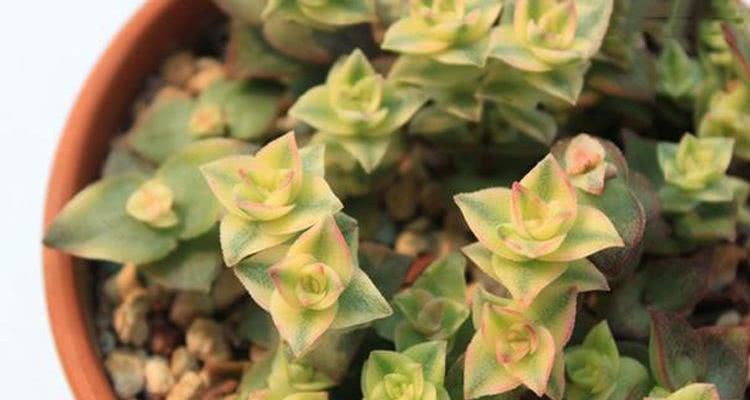
The pink cross star variegated is a variety of the cross star variegated, also known as Xingyinv variegated. It belongs to the Crassulaceae family, genus Crassula. It gets its name from the pink rings around its leaves. Its place of origin is the Cape Town region of South Africa. It is a perennial succulent herbaceous plant. The plant is clustered, with branches, and the stem is succulent. After being grown for a long time, the stem gradually becomes semi-woody.
The cross star variegated has fleshy leaves that are grayish-green to light green, with yellow or red variegation on both sides of the leaves. The leaf surface has green spots. When the temperature difference at the leaf margins is large, it becomes slightly red. In late autumn and early spring, when the temperature difference is large, the red color at the leaf margins is especially obvious, so winter is the most beautiful time for the cross star variegated. The plant's leaves are decussate, ovate-triangular, without petioles, and connected at the base. New leaves are stacked one above another, while mature leaves have a small gap between top and bottom. The flowers are cream-colored and bloom from April to June.
Pink cross star variegated
The pink cross star variegated needs plenty of sunlight and a cool, dry environment. It tolerates partial shade, fears waterlogging, and avoids muggy, humid conditions. It has the habit of growing in cool seasons and going dormant in high summer temperatures. Each year from September to June of the following year is the plant's growing period (the growing period may be longer or shorter depending on the grower's environment). If light is insufficient, the plant will become leggy, the vertical distance between leaves will lengthen, making the plant shape loose, the pink color at the leaf margins will also fade, the leaf stems will become tender, and the variegation in summer is not very obvious; whereas plants grown in a place with sufficient sunlight have a short, sturdy plant shape and relatively compact arrangement between stem nodes.
Pink cross star variegated
Propagation methods:
Propagation of the pink cross star variegated is generally by beheading (cutting, division). Take healthy branches with growth points, cut them into sections about 3 to 5 cm tall, dry the wounds and then insert them for cuttings. They can also be inserted directly into dry granular soil, and after a few days give a small amount of water. The cross star variegated is a very easy variety to propagate, and many small roots easily grow between the leaves. When they meet suitable soil, they will firmly take root in the soil. Beheading propagation also has the advantage of allowing the mother plant to achieve a better shape. Interested growers can give it a try. After beheading, the cut area will sprout new growth points again, and some will sprout 2 branches. If beheaded many times, the plant will take on an inverted cone shape. Top-heavy and bottom-light, at this time something will be needed to support it.
Pink cross star variegated
Cultivation techniques:
During the growing period, the pink cross star variegated needs to keep the soil moist and avoid water accumulation. For the soil, Kite used coal cinder mixed with peat and a small amount of perlite, at a ratio of roughly 5:4:1, with small stones spread on the soil surface. The cross star variegated can tolerate low temperatures of around minus 2°C, which is an indoor temperature, not outdoors. At lower temperatures, the growth point at the tip of the leaf will suffer frost damage, dry up and die, and the following year new side branches will sprout again from the withered area. Basically cut off water throughout winter, and below 5 degrees, water should gradually be cut off. In high summer temperatures, the whole plant grows slowly or stops completely. At this time, there should be good ventilation and appropriate shading, avoiding exposure to the sun, with controlled watering, and it must not be rained on for a long time, so as to avoid the plant rotting. During cultivation, the cross star variegated needs frequent pruning, cutting off overly messy branches to maintain a beautiful and shapely form.