Succulent leaf cuttings hard to survive? Master the method to easily boost the survival rate
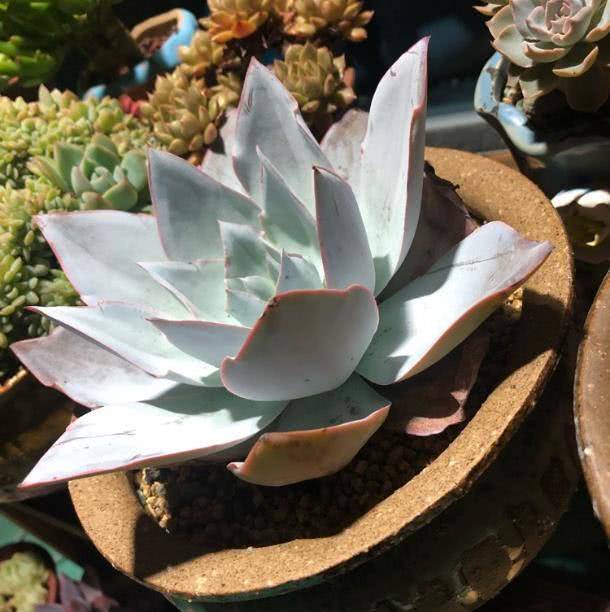
Succulents have really taken off, and their adorable looks have melted many people's hearts. Today, our topic is succulent leaf cuttings. Leaf cuttings are used for species that can produce adventitious buds and adventitious roots from leaves, and most succulents qualify. Leaf cuttings are a common method of artificial propagation for succulents, with a high rate of bud formation. Because it is asexual propagation, the traits are inherited from the mother plant, which keeps the plants uniform. So how can you improve the survival rate of succulent leaf cuttings?
Succulents can be leaf-propagated in both spring and autumn, but the temperature in spring is especially suitable for leaf cuttings. Summer can actually work too, as long as the temperature stays around 15°C there is no problem, and you can choose healthy leaves for propagation.
When selecting leaves for leaf cuttings, you need to meet these points specifically: the leaves must be mature, healthy and well developed, free of insect damage, and not yellowing. Of course, newly grown tender leaves will not work either. For succulent varieties whose leaves can sprout, small-leaved succulents like Sedum hispanicum and Sedum acre 'Aureum' generally cannot be leaf-propagated and are instead stem-propagated. For thin-leaved types like Aeonium arboreum 'Zwartkop', the success rate of leaf cuttings is very low. So usually, the leaves suitable for leaf cuttings are mainly thick leaves and large leaves.
Choose leaf mold soil suitable for plant growth. Leaf mold soil holds moisture for a long time, and leaf mold soil is also rich in nutrients, which can meet the nutritional needs of succulents during their growth period. After mixing the leaf mold soil, it is best to put it in the sun to dry, then spray the mixed soil with a carbendazim solution to moisten the soil, then cover it with a bag and continue to bake it in the sun for two days. Take the bag off and bake it in the sun for another two days, so the soil is thoroughly sterilized.
So-called succulent stem propagation means separating the growth point from the plant and letting it grow into a plant on its own. So as long as there is a growth point on the leaf, it can be leaf-propagated. There is no rule that something must be stem-propagated and cannot be leaf-propagated. If anything, it is only that some have a negligible survival rate with leaf cuttings while division has a relatively high survival rate, so everyone uses division propagation for them, such as Frithia pulchra and Cotyledon tomentosa.
In summary, for succulent leaf cuttings, as long as callus tissue can form, the leaf cutting can succeed. This is why some succulent leaves can still take root and sprout even when the leaf is snapped off, such as Echeveria 'Black Prince'. For some Crassulaceae succulents, even without a growth point some can still be leaf-propagated, provided the leaf stays dry and the wound dries completely without infection or turning to mush, in which case there is a chance of successful leaf propagation. In addition, the choice of season for leaf cuttings is very important. Generally choose spring or autumn, when the plant is in its growth period and growing vigorously, so the survival rate of leaf cuttings is also relatively high.
This is a gathering place for succulent lovers, sharing succulent care tips. Welcome to follow and exchange ideas.