Succulent plants are beautiful and easy to care for, symbolizing good fortune and bringing good omens
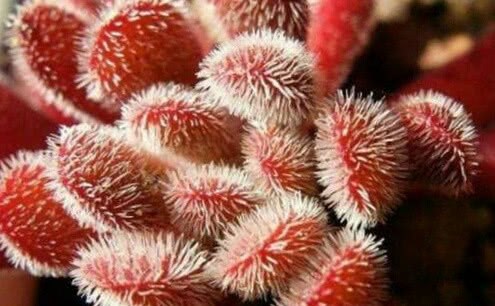
The "chubby" succulent plants are not only easy to grow but also beautiful, making them excellent small indoor potted plants. In recent years, they have become highly favored by plant enthusiasts and have high ornamental value. With so many succulent varieties, many friends are dazzled and at a loss. Don't worry! Today, the editor will introduce some succulent varieties that are beautiful, easy to care for, and carry auspicious meanings. Keep one at home to bring you good omens. Let's take a look below!
Mengchunzi (Echeveria 'Mengchunzi')
I. Mengchunzi
When you encounter Mengchunzi, aren't you also charmed by its petite, cute, and fuzzy appearance? Its bright colors and form are full of vitality and rich in meaning. It blooms annually from September to October, with small and delicate flowers. Sufficient light and a large temperature difference between day and night can make its colors more intense and beautiful. During the care of Mengchunzi, the more sufficient the light and the greater the temperature difference between day and night, the more vibrant the leaf colors of the succulent Mengchunzi. When temperatures permit, it is best to place the succulent Mengchunzi outdoors for care to ensure sufficient light. When light is insufficient or soil moisture is excessive, it will become leggy, and the entire Mengchunzi plant will turn light green or dark green with sparse leaves, seriously affecting its ornamental value, and may even die due to blocked photosynthesis; because the succulent Mengchunzi has a high internal water content, it is very prone to rot in overly humid environments. Never overwater.
Jixiangguan (Agave 'Jixiangguan')
II. Jixiangguan
The succulent Jixiangguan, also known as Jixiangtian, has a festive and grand name. Its appearance is elegant and refined, deeply captivating. Placed at home, it adds a touch of nobility. Jixiangguan is drought-tolerant but not cold-resistant. It prefers warm, humid environments with plenty of sunlight. During the growing period, the temperature should be between 10°C and 25°C. At this time, watering frequency should be increased to keep the soil moist. In winter, watering frequency should be reduced to avoid root rot. Choose well-draining, loose sandy soil to promote root growth and nutrient absorption. Jixiangguan leaves remain evergreen throughout the four seasons, the petals are yellow-green, and the plant is full and well-shaped, making it very popular for homes.
Lithops
III. Lithops
Lithops have a unique form and variable colors, with bright yellow being the most popular among the public. Because they are native to Africa and grow in rock crevices, they are known as "living stones." They have extremely high ornamental value and are easy to cultivate and manage, making them one of the rare and precious varieties among succulents. During the care of Lithops, the growing soil should be breathable, and a ventilated state should be maintained. At the same time, in midsummer, Lithops should not be moved around casually to avoid environmental changes; Lithops are generally watered in the evening, not when temperatures are high, to avoid sudden temperature drops causing harm to the plants.
Black Prince
IV. Black Prince
Black Prince is a very common succulent potted plant. Its petals are thick and plump, with rich and vivid colors, full of charm. Black Prince needs well-draining, breathable sandy soil for cultivation so that excess water can be drained in time. The mixing method can use leaf mold, sandy soil, and garden soil in equal proportions. Repotting can be done every two years, and when repotting, cut off the necrotic old roots; Black Prince prefers dryness and contains a certain amount of water in its body, so if watered too much or if the roots are left in a humid environment for a long time, rot can easily occur. Watering can be done once every ten days, thoroughly each time; dry and withered leaves should be trimmed in time to avoid bacterial growth. If the plant becomes leggy, the height can be controlled by beheading, which not only makes the plant more attractive but also allows the cut stems and leaves to be used for cuttings.