Bonsai Art: How to Create a Flowing Water Waterfall in Bonsai?
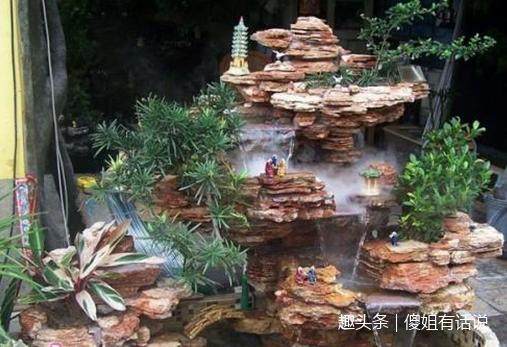
Creating Flowing Water Waterfalls in Bonsai
Advances in technology have made electric motors smaller (even miniature), allowing the addition of real flowing water waterfalls to rockeries and bonsai, becoming an important element and landscape feature of rockeries and bonsai. Based on practice, flowing water and waterfalls can be summarized into several basic forms of expression: triple-tiered waterfall, inverted-V spring, water pool, and gushing spring:
①. Triple-tiered waterfall: At the main peak, a curtain of water cascades down, and below it two more water curtain waterfalls are made. Of course, the shape, size, orientation, and position must differ and vary, thus forming a triple-tiered waterfall landscape. This method is suitable for large horizontal cloud-layer-style hard rockeries, with a grand momentum, beautiful and spectacular.
②. Inverted-V spring, water pool, and water curtain cave composite type: Several streams of mountain spring water spray out from the main peak and secondary peaks, each splitting below to form inverted-V springs. Most of the spring water gathers into a water pool in the middle of the rockery. The water in the pool overflows through the waterfall outlet, forming a water curtain that pours directly into the pond below. Behind the water curtain, a cave is built to form the scene of a water curtain cave. This method is suitable for rockeries and large bonsai; both soft stone and hard stone work. Its characteristics are abundant flowing water content, many variations, and a lively, thought-provoking form.
③. Inverted-V spring: As the name suggests, a stream of spring water flows gently down, and when it meets an obstacle midway, it splits into two streams, hence the name "inverted-V spring." This method is simple and easy to implement; it can be set at both the main peak and secondary peaks, and is suitable for medium and small bonsai.
④. Water pool: Generally set below 1/2 of the rockery body, with a cliff above and a cave below. There can be an outlet that may be a trickling stream or a water curtain waterfall. The water pool is both a landscape feature and serves to make the flowing water pause and calm here, then overflow from the outlet, making it easy to form a water curtain. This scene can be designed for rockeries and large and medium bonsai.
⑤. Gushing spring: Set an outlet on the island in the water. This outlet must be set below the water surface and facing vertically upward. After turning on the pump, the water surface rolls and surges, similar to the effect of Baotu Spring. This scene is suitable for rockeries and large bonsai with a wide water surface.
I. About water curtain waterfalls:
To create a water curtain waterfall, you must first understand two properties of water
①. Surface tension: Because the contact surface between liquid and gas reduces the surface pressure of water, causing the molecular structure of water to loosen, the mutual attraction between water molecules increases, forming the surface tension of water;
②. The attraction of water to other objects: When water flows downward, if there are other objects it can cling to, the water will cling to those other objects and flow down along them. This is the attraction of water to other objects.
To create a water curtain waterfall, first, there must be a calm, stable, and sufficient water source supply so that water can continuously overflow from the overflow outlet; second, the surface tension of water must be used so that the water flowing downward can connect together; third, the adsorption force of water to other objects must be overcome. Actually, achieving these three points is not difficult.
Choose a water pump with an appropriate flow rate.
The outlet must remain level, straight, smooth, and have a certain slope.
How to overcome the adsorption force of water to other objects? Our ancestors already provided the answer. To solve the problem of rainwater scouring and eroding walls, the ancients invented and used roof tiles. By extending the tiles forward beyond the wall, the rainwater lost objects it could cling to as it flowed downward and could only flow down naturally, thereby avoiding rainwater erosion of the wall (urine eaves). Therefore, the outlet of a water curtain waterfall must also follow this principle: the end of the outlet must extend beyond the surrounding and lower objects. With no adsorbable objects, the flowing water can only flow down naturally. Therefore, satisfying the above three conditions can make the flowing water form a water curtain waterfall.
II. About the outlet:
If the mountain is meant to be high, clouds and mist lock its waist; if water is meant to be distant, conceal and interrupt its end. Seeing only flowing water without seeing its source gives people a feeling of deep mountains and distant waters. Therefore, the outlet should be set in a dark place. Concealing the outlet can produce a subtle, mysterious, and thought-provoking effect. Before making the outlet, first lead the water to the highest point of the mountain (at the main peak). Carve a round hole behind the main peak, carve a vertical groove below the round hole, bury the soft hose in the vertical groove, and seal the round hole and the back of the vertical groove tightly with cement. Horizontal holes can be drilled anywhere in front to connect to the round hole. Large holes can show flowing water, while small holes form dripping seepage. After turning on the pump, the effects differ, depending on the creator's needs.