It was once a tribute fruit for emperors, priced at 15 times that of plums; farmers could not bear to eat it
Warm reminder
Hemu Report aims to share and popularize information about various plants and their uses, for reference only. If medicinal use is needed, it is recommended to consult a professional physician to avoid problems!
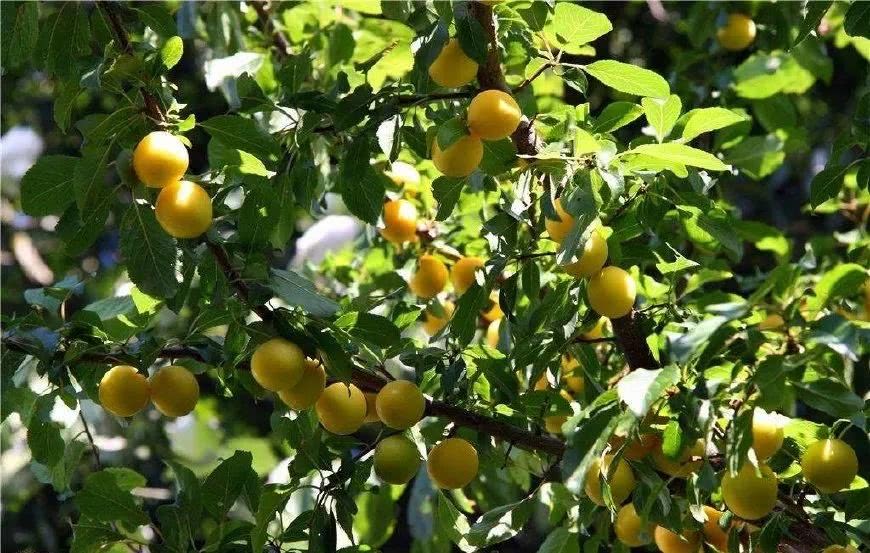
After the Start of Summer, summer has already arrived, and it is once again the season to freely enjoy all kinds of fruits. A delicious fruit of early summer begins to ripen slowly, green with a hint of yellow, large in size and thin in skin. It is a precious fruit of Xiaogan City, Hubei Province, China. According to historical records, after the Jiajing Emperor of the Ming Dynasty ate this fruit as a child, he could never forget it. When he became emperor, he designated this fruit as a tribute, and the common people called it "Jiajing fruit."
Jiajing fruit was once the emperor's favorite, which gave it a beautiful veil of mystique. In fact, it is a kind of plum called "Yuhuang plum," also known as "Yuhuang plum" (imperial yellow plum). Its name is tied to emperors, mainly thanks to the Jiajing Emperor's "blessing." Wang Zhen's Agricultural Treatise of the Yuan Dynasty records: "Imperial yellow plum, large in shape, thick in flesh, small in pit, sweet, fragrant, and beautiful." The fruit is large, the flesh is abundant and delicate, with an edible rate of 97%, and the taste is sweet with a slight sourness and a rich fragrance. There has long been a saying, "Hedong plums are fragrant, Hexi plums are fragrant," and "a stretch of plum trees fills the whole field with fragrance." It is much more fragrant than ordinary plums.
Its price is naturally not cheap either, since after all it is a fruit even emperors liked. Ordinary green plums are rather sour, so not many people grow them in rural areas, and many just rot on the trees. This kind of green plum is also sold in cities, very cheaply; 2 yuan per jin can buy quite a lot. Yuhuang plum is a precious variety, with those produced in Dawu and Xiaogan in Hubei having the highest reputation. At the plum appraisal meeting in Hubei Province, Yuhuang plum once achieved the excellent result of a "three-year championship." Its market price is generally no less than 30 yuan per jin, 15 times that of ordinary plums.
In the Yuhuang plum growing area of Dawu, Hubei, Fangfan Village has good water conservancy conditions. In the old society, during the peak season of Yuhuang plums, farmers in every household used baskets to hold the plums they picked and, taking advantage of the water conservancy advantages, transported them to various places for sale. At that time there was a local ballad: "One boat of plums, five boats of grain; in good years there is money to spend, in disaster years it helps get through famine." This shows the extremely high value of Yuhuang plum; from ancient times to the present, it has been people's "money tree."
Today Yuhuang plum is cultivated in Zhangjiakou in Hebei, Liaocheng and Weifang in Shandong, and other places. The fruit ripening season is slightly later than in Hubei, and the price is similarly expensive. Farmers who grow it cannot bear to eat it, keeping it to sell for money to increase their income. Readers and friends, have you ever eaten Yuhuang plum?
Text/Hemu Report, Images/Internet
If you like Hemu's articles, you are welcome to follow