Re-blooming azaleas also burst into a full pot, with lush branches and leaves even better than newly bought ones, which gives a great sense of achievement.
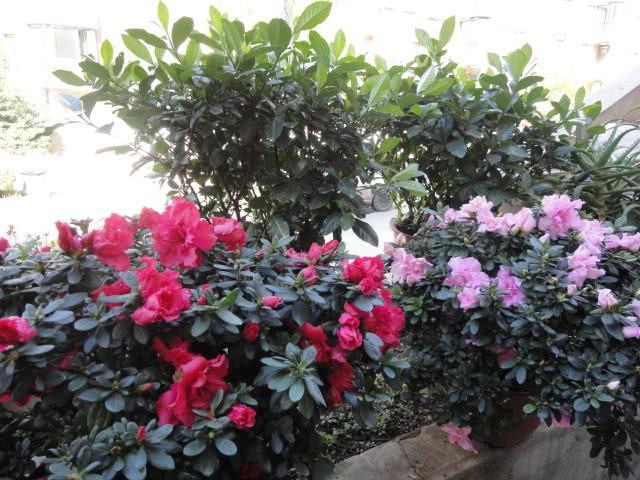
The re-blooming azaleas also burst into a full pot around last year's past holiday season. Friends, take a look, the azaleas have lush branches and leaves, aren't they even better than newly bought azaleas? Many friends say azaleas are hard to grow, and I used to think so too. Every time I bought azaleas, the flower seller told me that when watering azaleas you should water when dry and let them dry between waterings, and as a result I killed countless azaleas in my care. The symptoms were that the edges of the azalea leaves dried out, and the flowers could not be touched, because with one touch a large number of leaves dropped, and the flowers all died, because the potting soil had not dried out yet, so I still did not dare to water.
Since learning from the azalea-growing experience of my seniors, plus exploring the characteristics of azaleas myself, I gradually figured out a little bit of the trick.
When growing azaleas in summer, watering only when dry and letting them dry between waterings does not work; they need plenty of water. If there is too much water that still does not work either, and the leaves drop; if there is too little water that also does not work, and the leaves also drop. The timing of the two waterings must be grasped well. Growing azaleas definitely requires carefulness. Whether you grow them indoors or outdoors, you must figure out a watering method for yourself; no one can teach you this. Just remember, they need more water than ordinary plants. Growing azaleas is all about watering being hard to grasp. If you have mastered watering, then there is basically no problem growing azaleas. Different varieties have different water needs; my Red Double Happiness needs less water than those two.
Azaleas are definitely grown differently in the south and the north. The air humidity in the south is high, while the climate in the north is dry, so azaleas in the north absolutely must not be allowed to lack water.
After the Start of Autumn, the weather is cool in the morning and evening, and the temperature difference is large, so azalea watering also changes, requiring less water than a few days earlier. Two azaleas were about to bloom one after another, and I watered as usual, but it did not work; some of the flower buds could not open and wilted. I let the potting soil dry a little before watering, and as a result the flower buds opened. When watering azaleas, you definitely must not use a fixed pattern; you have to handle it flexibly.
When azaleas are bought back, they generally need repotting. When repotting, do not cover the original old roots with potting soil; that is, the topmost roots of the original potting soil should be visible to the eye, and not even a bit of soil should cover them. Being able to see the original old roots allows you to better judge whether the potting soil is dry or wet, and is also more conducive to the azalea roots breathing oxygen.
Some friends ask how to fertilize azaleas. When my azaleas are blooming, I hardly fertilize them. Possibly when the flowers are nearing the end, when I give other flowers liquid fertilizer, I incidentally give them a little fertilizer too, and not in a large amount. I feel azaleas do not need too much fertilizer. In spring, after the flowers are moved to the north terrace before May 1, when I see the new leaves clearly growing, then it is time to fertilize. The fertilizer I use is ordinary compound fertilizer, buried just a little at the edge of the pot, and the amount must not be large. Once a month, provided the azaleas are growing very well. A week ago, when I saw the flower buds, I applied it for the last time. Altogether 3 applications of compound fertilizer. Fertilizer is better less than more.
As long as you have mastered watering azaleas and grasped their habits, with a suitable environment in summer they are still very easy to grow. If you let them grow naturally, the flowering period is quite long, and even when not blooming, the leaves are also quite nice to look at, lush and verdant.