Detailed Explanation of the Trunk Development Technique in Tree Stump Bonsai Styling
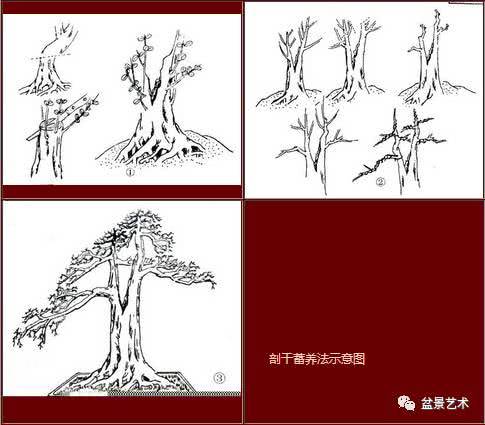
Trunk development: The trunk is an important component of a tree's form; it connects the canopy and the roots into a whole and serves to transport nutrients and support the canopy. In terms of processing tree bonsai, the thickness, strength, and dynamic movement of the trunk have a decisive influence on the overall styling. To create an excellent tree bonsai, you must, based on the tree material's own characteristics, first develop the roots and trunk well, then develop the branches and side branches. For trunk development of tree stumps collected in the wild, you must adapt flexibly according to the habits of different tree species. For species that grow slowly and whose cut surfaces heal with great difficulty, such as pines and cypresses and miscellaneous broadleaf species like Chinese sweet plum (Sageretia thea), Chinese wolfberry (Lycium chinense), and snowbush (Serissa japonica), you should preserve the roots, trunk, and branches to the greatest extent possible at collection time, seeking completeness. However, when you collect species that grow relatively fast and whose wounds heal easily, with a very good root flare but an unsatisfactory trunk form, you can resolve to cut off the unsatisfactory part of the trunk and regrow the main trunk. A large cut surface can be developed into a double-trunk form, while a small cut surface can be developed into a single-trunk form.
Split-trunk development method: For miscellaneous broadleaf tree stumps collected in the wild, such as trident maple (Acer buergerianum), Chinese elm (Ulmus parvifolia), and Fujian tea (Carmona retusa), which are relatively fast-growing species with very good root flares but unsatisfactory upper trunks, you can saw them off and split the trunk's cut surface into a double-trunk or triple-trunk form. In the following spring, determine the trunk form according to how the shoots emerge. For the double-trunk form, cut the main trunk into one tall and one short, one main and one secondary, with an irregular, well-balanced arrangement. And let it grow freely, using the branch-development-and-trunk-truncation method to develop the main trunk. Once the developed main trunk is basically satisfactory, use metal wire to bend and shape the branches and side branches. After several years of trunk development and bending, the branches and trunk developed at the split-trunk site gradually become fuller and take shape.
Single-trunk development method: For tree material with intact roots, if the upper main trunk is unsatisfactory, you can cut it off at an appropriate height and regrow the branches and trunk; a small cut surface can be developed into a single-trunk form.
Schematic diagram of the single-trunk development method