The process of making a cliff cypress bonsai: one moment of carelessness and it dies, and survival is extremely rare
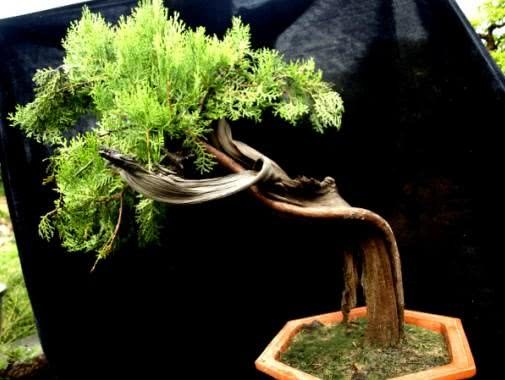
A cliff cypress bonsai can be said to be a bonsai that is both easy to grow and delicate. Why say so? Because cliff cypress can survive in environments with higher or lower temperatures, it is not like other plants that have high soil requirements, and its lifespan is quite long; but it can also be said to be quite delicate, because during the process of digging up old stumps of pines and cypresses its bark is quite fragile, and the slightest carelessness will cause the bark to be damaged, and then the liquid resin will wrap and seal the wound, ultimately making it difficult for the sap to circulate, which then leads to its death. Therefore it can be said to be quite delicate, but even so it is still loved by many people.
So if you want to cultivate a cliff cypress bonsai you must do enough homework. First, you need to understand the season for digging up its stump. The flow of sap inside it is the main factor affecting collection, so choosing the right time is especially important. The 20 days around the Beginning of Spring is the best collection season. Because during this period the sap is still in a dormant phase, and when digging it up not too much sap will be lost or the wound will seal, and as the ambient temperature warms up it will also recover its vitality.
After collection is completed, the branches and leaves must be dealt with according to how many fibrous roots there are. The retention of branches and leaves is directly proportional to the number of fibrous roots, because it will affect the balance of water supply and demand, and will also have a great impact on the flow of sap. Unreasonable sap flow will lead to the death of the stump. In addition, the saw cuts must also be treated well; its moisture will be lost and its immunity will decline, so it is best to seal them with film.
In martial arts across the world, speed is the only thing that cannot be broken, so collection, treating the stump head, and the subsequent planting should be done in one continuous effort and completed in the shortest possible time, so that its survival rate will increase. When first transplanting, it is best to choose soil from its original environment, and pay attention to the depth of planting, otherwise it is not conducive to the plant's respiration, and moisture is also a point to note. After completing the transplant, it is best to place it in a shaded and ventilated place, which is conducive to its growth.
After it survives, you must pay attention to whether the plant has any diseases, and rust disease is relatively common. Therefore, at an earlier time, for example in February or March, spray it with "Fenxiuning" and the like, and you can also use insecticides to kill snails, so as to avoid damage to the bark of the newly sprouted tender branches.
Even after a cliff cypress bonsai finally survives, you cannot relax; it needs one to two years or even longer of careful care, so that its branches and leaves can grow more luxuriantly. During its growth process you can shape it, and the personality of cliff cypress is extremely unique, fully displaying the charm of nature. Another thing worth noting is that after it survives you cannot transplant it, because even if it has survived its roots are not necessarily fully grown, so if you want to obtain a cliff cypress bonsai full of vitality, you cannot avoid caring for it.