Is the red spider lily poisonous, and can it be kept in a bedroom?
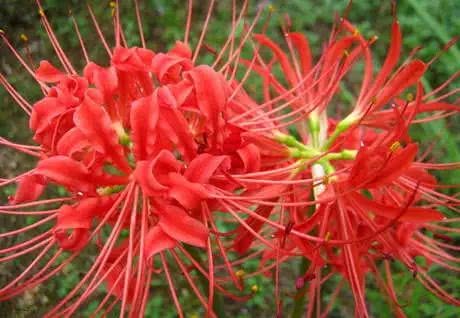
The blood-red spider lily, also known as manjusaka, is a plant in the Amaryllidaceae family. This flower grows in gloomy, damp places, in graveyards or along wild roadside paths. The three days around the autumn equinox are called the autumn equinox period, and the spider lily blooms during this period, which is why it is called the equinox flower. When the flower blooms, you cannot see the leaves; when the leaves are present, you cannot see the flower. Flower and leaf never meet, forever missing each other.
Manjusaka is said to be the flower of hell, representing death, but because it is very beautiful, quite a few people also grow and care for it. So why is the spider lily said to represent death? Is it poisonous?
Its rhizome is poisonous. The bulb contains the alkaloid lycorine, which can cause symptoms such as vomiting and convulsions and has a clear effect on the central nervous system. It must not be eaten casually. Accidental ingestion can cause more severe reactions in some people, such as coma and respiratory arrest. So if there are children or pets at home, it is not advisable to grow spider lilies.
Although the spider lily is poisonous, it can also be used as a medicinal material. After processing, the bulb can be used as medicine for sedation, inhibition of drug metabolism and anti-cancer purposes. In many ancient texts, there are records of its effects. For example, taken with wine after being decocted, it can help treat conditions such as throat wind and phlegm nodes. It also has emetic and diuretic effects, mainly treating food poisoning, difficult urination and so on. In addition, its heat-clearing and detoxifying effects are also very obvious, and it can help treat diseases such as dysentery.
Overall, the spider lily is poisonous, and it is not advisable to put it in a bedroom. As long as it is not eaten by mistake, the spider lily is still a very beautiful ornamental plant.