In May, pomegranate flowers blaze like fire; pomegranate blossoms bloom as red as flame
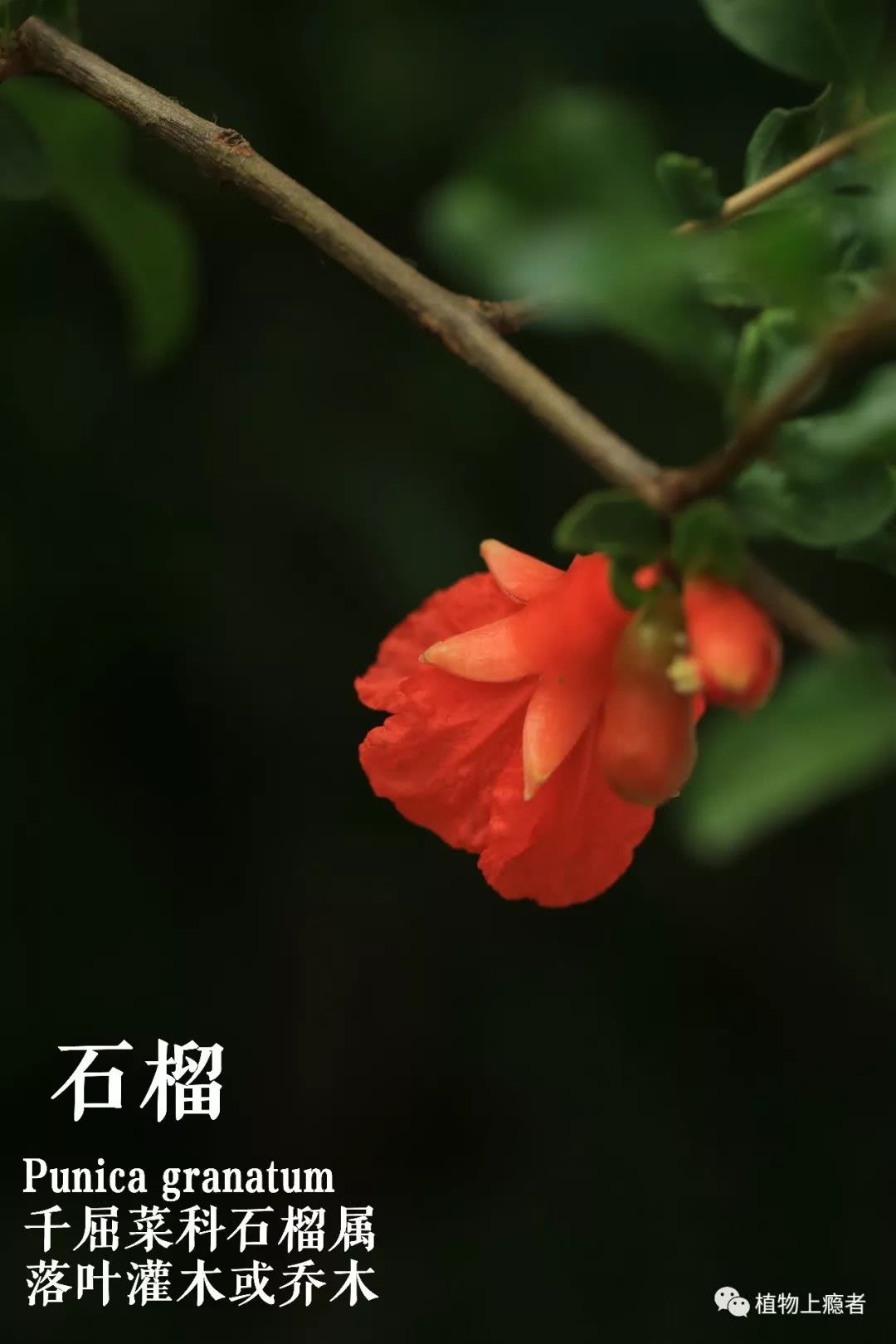
In May, just as summer begins, the season belongs to pomegranate flowers.
Pomegranate flowers are so distinctive that there are probably very few people who do not recognise them. Its fruit, the pomegranate, is likewise well known, and both are highly recognisable.
Unlike most flowers we are familiar with, the pomegranate does not have a fixed number of petals; it can have anywhere from 5 to 9. The petals are naturally crinkled, thin and light in texture, like the finest xuan paper, and the colour is equally distinctive. My mother often says, "This red of the pomegranate is unique." The stamens are a big cluster, also red.
Yet it is not only the flower colour that is distinctive. The calyx of the pomegranate is equally full of interest. Before the bud splits open, there are several small green dots at its centre; these are its glandular dots. Usually the calyx is slightly paler than the petals, thick and fleshy, splitting at the tip down to the middle, with the number of lobes usually equal to the number of petals.
When the flower opens, the sepals spread outward at an angle, like a medal, very rounded. After the flower fades, the calyx that remains on the tree persists and grows along with the fruit; and those calyxes that fall to the ground always remind me of starfish, full of beauty. The flowers bloom on the upper part of the branches, terminal or axillary, one or several together.
Green glandular dots at the tip of the calyx lobes
When the flower opens, the sepals spread outward at an angle
8-lobed and 6-lobed calyxes
Calyxes that have fallen to the ground
One or several, terminal or axillary
Photographed by Yunyou
Familiar places also hold scenery. Following Mr. Han Shaogong'sfinding a thousand miles of rivers and mountains or ten thousand miles of sandy plains on a single fallen leafspirit, the pomegranate, a flower I have seen year after year, likewise gave me fresh stimulation and surprise.
For example, the pomegranate tree, so gentle in temperament, turns out to be covered in thorns. The Flora of China describes its characteristics by saying, "young branches often sharp-spine-like," and at first I found this puzzling, because in my memory I had never thought the pomegranate had thorns.
But with this question in mind, every time I saw a pomegranate tree, I would unconsciously look for this thorn. The first time, I found it at the tip of a new branch on a low shrub; this thorn was extremely small and short, extending from between two crimson young leaves. This discovery greatly lifted my spirits.
Next, the Peugeot 307 law proved true once again. It was as if I suddenly had a filter; looking at other pomegranate trees again, I could at once clearly see the thorns all over them! These thorns are distributed on the small branches and upper parts, and also on the old branches. This feeling was truly wonderful.
The first thorn I found
Then a whole cluster of thorns
The thorn slowly grows into a new branch
The new branch is four-angled, with slight wings
The thorns of the pomegranate grow in a way very similar to Chaenomeles speciosa. Both first grow a thick thorn from the branch, and as this thorn grows thicker and longer, it becomes a new branch, with new leaves growing out from the thorn itself.
The new branches of the pomegranate are also different from the old ones. The new branches are greenish-white, square, with narrow wings on the angles; the old branches, as they grow, become smooth and cylindrical.
Afterwards I asked my father and mother, and even they, with considerable experience, did not know that the pomegranate tree has this characteristic of thorns. Things discovered through one's own firsthand experience, though small, bring overflowing joy. In fact, the very fact that the pomegranate has thorns is what most satisfies the joy of my observation. I admit that the joy of a plant addict is a little unconventional.
From this I think, in this world there is probably no one happier than Darwin, haha.
The genus name of the pomegranate, Punica, comes from the Latin word for pomegranate (malum punicum), originally meaning "Carthaginian apple." The species epithet granatum means many-seeded. Besides red, horticultural varieties include red double-flowered, white, yellow, and the patterned agate pomegranate, among others.
Double-flowered pomegranate
White double-flowered pomegranate, photographed by Zhang Yongmei
The pomegranate family is extremely small, with only one genus and two species. The other is called Socotran pomegranate (Punica protopunica), native to Socotra Island in Yemen, located in the Arabian Sea. Its flowers are smaller, and its fruit is not as sweet as the pomegranate. The latest taxonomy has abolished the pomegranate family and merged it into the Lythraceae family (the one that includes crape myrtle). No wonder today's developers all strive desperately to acquire land and grow bigger and stronger; otherwise, in the future there may well be no place for you.
Socotran pomegranate, image from the internet
The pomegranate is an introduced species, but it was already introduced into our country as early as the Han Dynasty, said to have been brought back by Zhang Qian when he traveled to the Western Regions. Its place of origin is Iran, Afghanistan and other parts of Central Asia. Writing this, I suddenly recall that a few years ago when traveling in Turkey, I often saw freshly squeezed pomegranate juice sold in the streets and markets; so it really does have Arabian genes.
But the pomegranate really does not look like a foreign species. Not to mention how its green leaves and red flowers are such a typical Chinese-style colour pairing; its roots in Chinese culture run so deep, and its meanings are so multiple, that it far surpasses many native Chinese plants. The pomegranate skirt symbolises dazzling beauty, the pomegranate seeds symbolise many sons and much fortune, and in the writings of literati it is also a symbol of being ten thousand miles from home and drifting away from one's country. In Dream of the Red Chamber, Cao Xueqin's line "where pomegranate flowers bloom, they shine upon the palace chambers" made it even more famous; the obscure meaning of this line has still not reached a conclusion among Redologists to this day.
Pomegranate flowers blaze like fire
The pomegranate flower is most beautiful when viewed against the light. Under the sunlight, its soft petals look as if they are about to burst into flame, radiating an indescribable brilliance and magnificence, like years of burning passion, and also like youth in its prime. Ancient poets captured this quality very accurately. Han Yu said, "In May the pomegranate flowers dazzle the eyes," and Su Shunqin of the Northern Song went further:
In the deep courtyard, the summer mat is cool,
Pomegranate blossoms all around shine through the curtain.
Tree shade covers the ground as the sun reaches noon,
Waking from a dream, an oriole calls from time to time.
Today, pomegranate blossoms can still be seen everywhere, but such a mood and state of mind have already faded away before an era that hurries ever forward.
The article and plant photographs (except where the source is noted) are all original works by the author
If you like it, please share, thank you for your support
Plant Addict
WeChat ID: plantfiend
Discover the unique beauty of every plant