The flower language of the hibiscus is pure love.
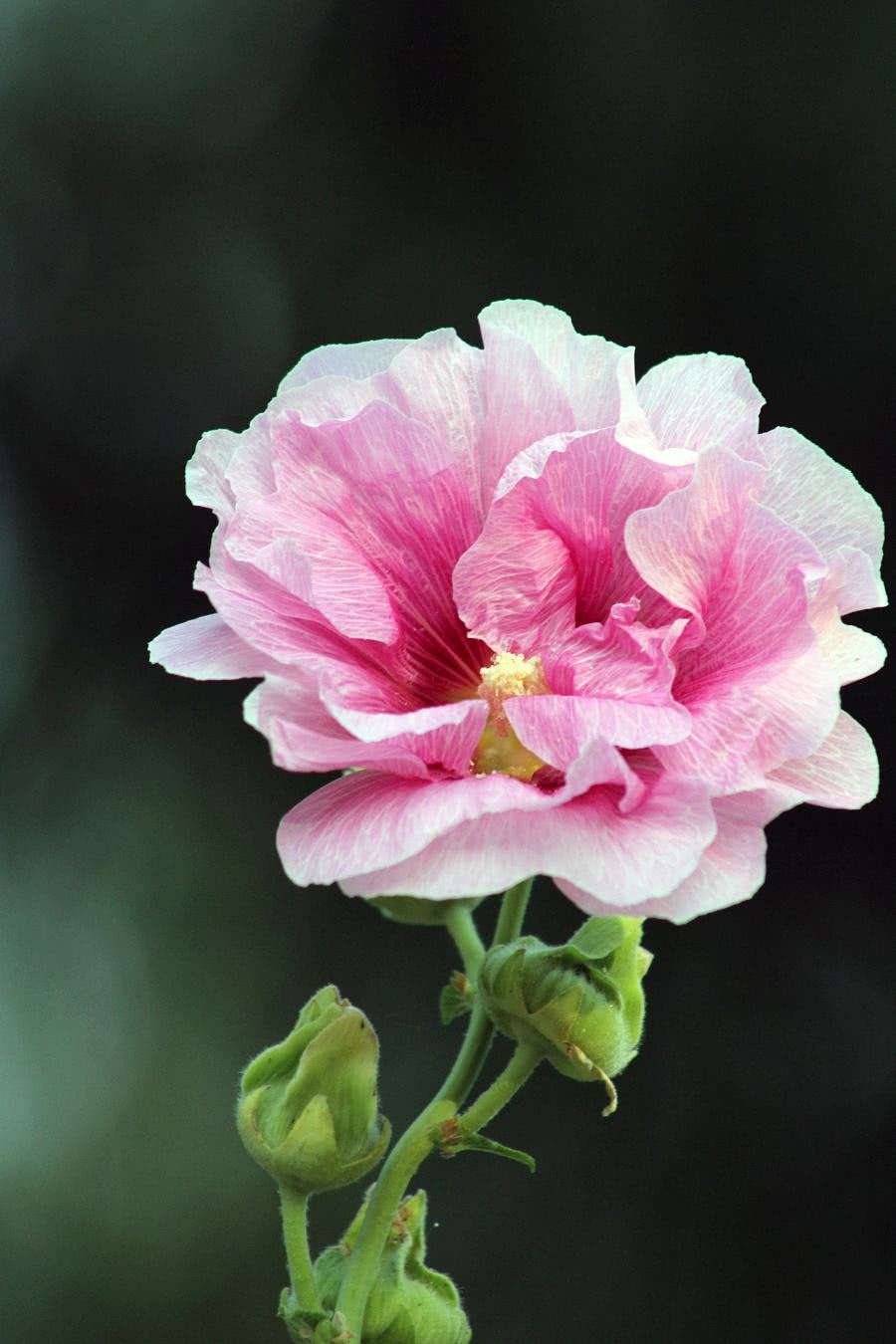
Hibiscus, also known as cotton rose, frost-resisting flower, and wood lotus. It belongs to the Malvaceae family, a deciduous large shrub or small tree, reaching up to 7 m in height. The stems have stellate hairs or short pubescence. The leaves are large, broadly ovate and nearly round-ovate, palmately 5-7 lobed, with bluntly serrate margins, and both surfaces have yellow-brown down; the flowers are large and beautiful, borne at the branch tips, single or double, with pedicels 5-8 cm long, bearing 8 small bracts, the calyx is short and bell-shaped, flowering from October to November, opening in the early morning as milky white or pink, and turning deep red by evening. The capsule is spherical.
Hibiscus
Native to China, it is distributed in Sichuan, Yunnan, Shandong, and other places, with the most cultivation and the longest history in the Chengdu area, which is why Chengdu is also called the "City of Hibiscus." The hibiscus flower prefers a warm and humid climate, likes sunlight, and has strong adaptability.
The hibiscus flower is extremely beautiful and is the main flowering tree species for viewing in late autumn. The hibiscus has relatively wide uses; the bark fiber can be twisted into rope and woven into cloth; the roots, flowers, and leaves can all be used as medicine, and external application has the effect of reducing swelling and detoxifying.
Hibiscus
The reason the hibiscus flower is loved by everyone is, first, that it is incomparably gorgeous and changes three times a day, pinkish white in the morning, light red at noon, and deep red at dusk; its delicate and charming appearance often makes people linger. Second, it has the unique trait of "resisting frost"; this flower blooms from the ninth to the eleventh lunar month, when the hundred flowers have withered, yet it still blooms proudly in the frost. Thus Bai Juyi wrote in a poem: "Do not fear that autumn has no companion for sorrow; when the water lotus is gone, the wood lotus blooms." Su Dongpo even praised the hibiscus flower's character: "To call it frost-resisting still does not do it justice; it seems it is truly most suited to frost." Third, the cotton rose is a treasure in every part, and both its flowers and leaves can be used as medicine. Li Shizhen said that using hibiscus flowers and leaves to treat "carbuncles, swellings, toxins, and malignant sores" is wonderfully effective. The people of Changde love the hibiscus flower, plant it widely, and have a long history of doing so; it once bloomed red everywhere. When Qu Yuan was exiled to Changde and saw this beautiful scene, he wrote in "Nine Songs": "I gather salsify in the water, I pluck the hibiscus at the treetops." Chen Hongmo of the Ming dynasty compiled the "Jiajing Changde Prefecture Gazetteer" and recorded it as one of Changde's most proud "local products": "The cotton rose, also called frost-resister, is so named because it blooms in the ninth month; it has red and white colors, with single-petaled and double-petaled forms; the one that opens white in the morning and gradually turns red after noon is called the drunken hibiscus." Although the hibiscus flower has long enjoyed great fame in Changde's history, few people today still plant it, and they do not know that this flower has Changde as its authentic place of origin. This is thanks to Mr. Hu Qiaomu's research; it was he who unraveled the mystery that Changde is the authentic place of origin of the hibiscus flower.
Hibiscus
After Mao Zedong's seven-character regulated verse "Reply to a Friend," written in 1961, was published, Shi Ximin, head of the Publicity Department of the Shanghai Municipal Party Committee, asked Hu Qiaomu about the meaning of "the hibiscus land is all bathed in morning glow." Mr. Hu replied in a letter on March 13, 1964: "The 'hibiscus land' refers to Hunan; Mao Zedong borrowed the line 'autumn wind for ten thousand li across the hibiscus land' by the late Tang poet Tan Yongzhi and wrote it with the opposite meaning." He also pointed out: hibiscus has two meanings, one referring to the lotus and one referring to the cotton rose; both interpretations are possible, because according to materia medica the cotton rose is said to come from Dingzhou, which is present-day Changde, Hunan (see "Collected Letters of Hu Qiaomu," People's Publishing House, May 2000 edition). It can be seen that Changde is the authentic place of origin of the hibiscus in "the hibiscus land is all bathed in morning glow." Mr. Hu's statement has ample grounds. First, Su Song of the Tang dynasty clearly recorded in the "Illustrated Classic of Materia Medica": "The cotton rose comes from Dingzhou; its leaves are collected in the ninth month to treat sores and swellings; this is likely the very plant." Second, when Li Shizhen of the Ming dynasty wrote the "Compendium of Materia Medica," he followed the account in the "Illustrated Classic of Materia Medica," came to Changde for field investigation, confirmed that the cotton rose produced in Dingzhou was the authentic "geo-authentic medicinal material," and recorded it in the "Cotton Rose" section of the "Compendium of Materia Medica," saying that its bark can be made into rope and its flowers and leaves can be used as medicine, with remarkable efficacy in treating carbuncles and swellings. While cultivating the hibiscus flower, the people of Changde also nurtured in themselves a character of striving and forging ahead like the hibiscus's "frost resistance," creating many historical glories. Today, although not many hibiscus flowers are planted, people's "frost-resisting" character remains, and this is precisely the basic driving force for our city's continuous progress in reform and opening up and its brilliant achievements. We should all work together to cultivate and nurture it, so that this hibiscus flower of Changde blooms even more luxuriantly and vividly!