Death's love, a painful love - the golden spider lily
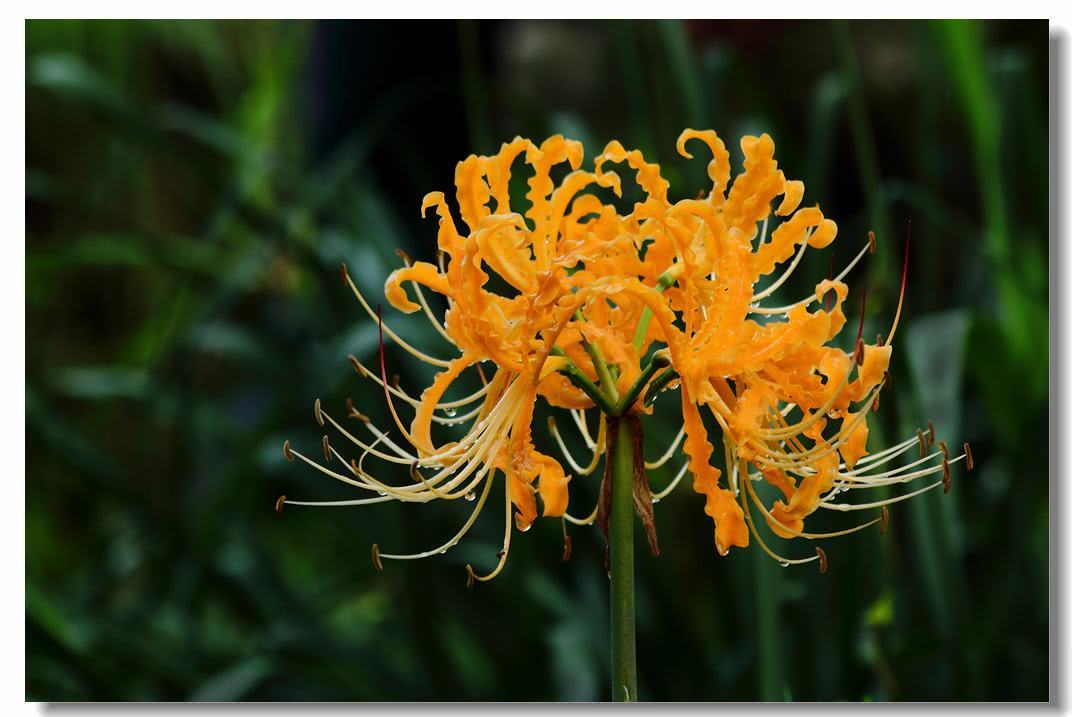
The golden spider lily (Lycoris aurea) is a herbaceous, terrestrial plant. Bulb ovoid; leaves sword-shaped; umbel with 4-8 flowers, flowers yellow; tepal lobes with a pale green midrib on the back, stamens slightly extending beyond the tepals, filaments yellow; capsule three-angled, loculicidal; seeds few, nearly spherical. Distributed in Fujian, Taiwan, China, Hubei, Hunan, Guangdong, Guangxi, Sichuan, Yunnan and other places in China, mostly growing on shady, damp hillsides.
Golden spider lily
The golden spider lily is a perennial plant. Bulb ovoid, about 5 cm in diameter. Leaves emerge in autumn, sword-shaped, about 60 cm long, up to 2.5 cm at the widest point, gradually narrowing toward the base, about 1.7 cm wide, apex acuminate, with a distinct pale central band. Flower scape about 60 cm tall; spathe bracts 2, lanceolate, about 3.5 cm long, about 0.8 cm wide; umbel with 4-8 flowers; flowers yellow; tepal lobes with a pale green midrib on the back, oblanceolate, about 6 cm long, about 1 cm wide, strongly recurved and wrinkled, floral tube 1.2-1.5 cm long; stamens slightly extending beyond the tepals, about 1/6 longer than the tepals, filaments yellow; upper part of the style rose-red.
Golden spider lily
Medicinal:
The whole plant of the golden spider lily contains lycorine and other raw materials used in medicine, and has effects such as expelling phlegm, inducing vomiting, reducing swelling and relieving pain, and promoting urination, but it is highly toxic and should be used with caution. Among these, the bulb is a raw material for extracting galanthamine, a drug for treating the sequelae of polio. The bulbs of wild or cultivated Lycoris are usually dug in spring and autumn after 2-3 years, washed and sun-dried, or sliced and sun-dried. When used, it is applied externally, pounded into a paste and applied to the affected area.
Ornamental:
In gardens, the golden spider lily can be used as a groundcover flower under trees, planted in clumps in flower borders, or planted in a naturalistic style among rocks. Because it blooms when it has no leaves, it is best paired with other more shade-tolerant herbaceous plants. The planting density is 15-20 cm between plants and 40 cm between rows, with 1 row of other evergreen plants planted between the rows.
In addition, it has characteristics such as sturdy scapes and long flower stems, making it an ideal cut flower material.
Golden spider lily
Because the whole plant of the golden spider lily is highly toxic, its flower language and legends carry a certain mysterious quality. Legend says the golden spider lily is the tenderness of demons. It is a flower in heaven that voluntarily threw itself into hell, but was sent back by the demons. Yet because it could not return to heaven, it still wandered on the road to the underworld. The demons, unable to bear it, agreed to let the golden spider lily bloom on this ordinary road, giving guidance and comfort to the souls leaving the mortal world. Therefore, its flower language is: death's love, a painful love.