What Is Sempervivum tectorum? Get to Know This Succulent Plant
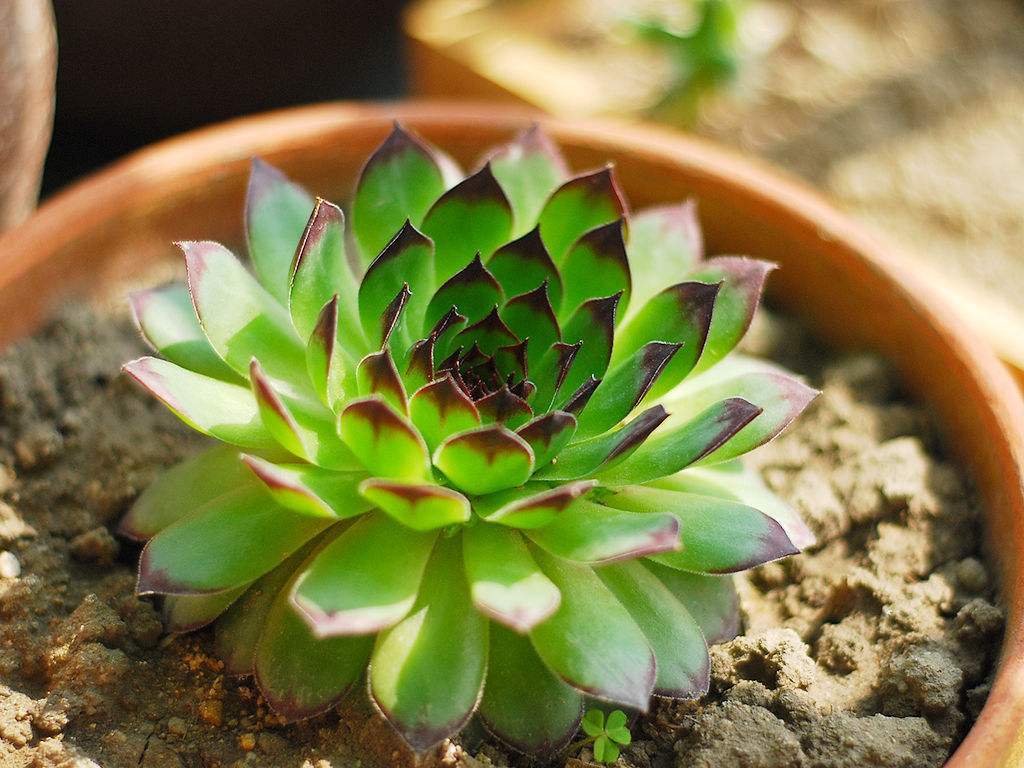
Sempervivum tectorum, also known as hens and chicks, belongs to the Crassulaceae family, genus Sempervivum. Because of its dignified shape resembling a green lotus and its easy survival and propagation, it is favored by many flower enthusiasts. The plant is relatively large and opens outward, slightly flattened, usually 5-7 cm in diameter (smaller plants are about 3 cm in diameter, and a single old plant can reach 20 cm in diameter). The stolons are short and sturdy, reaching up to 4 cm. Young plants have fewer leaves.
Sempervivum tectorum
Morphological characteristics:
Leaves: the surface is smooth and hairless or has fine soft hairs, usually green or slightly bluish-gray, sometimes with leaf tips turning dark red to purplish-red. The leaves are lanceolate to obovate, about 20-60 cm long and about 10-15 cm wide, with a sharp point at the tip, both sides slightly convex (the upper side is relatively flatter), and the cilia are white.
Inflorescence: the flower stalk is thick and sturdy, 20-50 cm long, with dense rough white hairs on the surface, growing from the growth point. The small leaves on the flower stalk are lanceolate with sharp tips. The cymose panicle is huge and densely flowered, with 40-100 flowers blooming at one time. The bracts are arranged in a linear pattern, with sharp tips and hairy surfaces. The flower buds are ovate with a distinct point.
Sempervivum tectorum
Flowers: 12-16 petals, about 2.5 cm in diameter, sepals about 0.8 cm, with sharp cilia on the surface (about 4 mm long). The petals are about 0.9-1.2 cm long and about 0.2 cm wide, white or purple, with red markings, generally purple, arranged neatly in a lanceolate pattern, with pointed tips, and cilia and soft hairs on the back. The filaments are bright purplish-red. The stamens are orange-red.
Sempervivum tectorum
Note: It is normal for Sempervivum tectorum to die after flowering. After a flowering plant dies, its side shoots can be used for cutting propagation, or pollination can be carried out during the flowering period for seed propagation.
Propagating Sempervivum tectorum is very convenient, and cutting is usually the most common method. Cut off healthy side shoots, let the cut surface dry, then insert them into a loose, slightly moist sand tray (or vermiculite), and place them in a cool, dark place. They will root in a few days to a week. It can also be propagated by sowing seeds.