Houseplants suitable for growing at home: both beautiful and able to purify the air
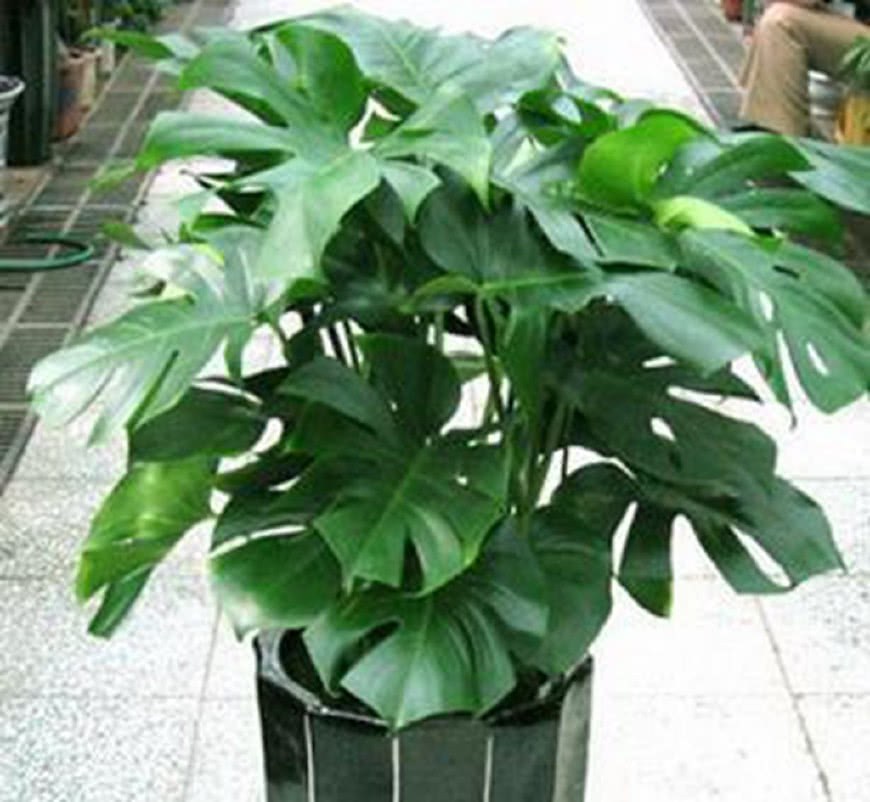
Many people like to keep some green plants at home, and there are a great many kinds of green plants that can be grown at home. When choosing green plants, everyone first considers ones with fairly strong vitality. Some green plants are quite ornamental and are very easy to keep alive; for example, the Swiss cheese plant (Monstera deliciosa). I believe some people who love growing plants will place a few pots of it at home. The Swiss cheese plant can purify the air at home, and it is also a green plant that stays green all year round. Let's take a look together below.
The Swiss cheese plant (Monstera deliciosa) is a perennial woody climbing evergreen shrub of the genus Monstera in the family Araceae. It is also known as Penglai banana, Swiss cheese banana and electric wire orchid. It grows in forests and climbs trees. Its stem is green and fairly thick, with a ring-like structure around it. The leaves are very large, with a heart-shaped outline, 40-60 cm wide, thickly leathery, shiny on the surface, light green, greenish-white on the underside, with pinnately divided edges and 1-2 relatively large holes between the lateral veins; those near the midrib are mostly horizontally round, 1.5-4 cm wide, while the outward ones are horizontally oval, 5-6 cm wide. The appearance of the Swiss cheese plant is roughly like this, and it has great ornamental value.
The Swiss cheese plant likes a warm and humid environment, so be sure not to place it in strong sunlight or in a dry place. It is fairly shade-tolerant and grows easily in fertile, loose, slightly acidic loam with high water absorption and good water retention, with leaf mold or peat soil being best. In summer it needs to avoid strong light, but in winter it should have sufficient light. This plant is very suitable for growing at home. Let the Swiss cheese plant trail over a trellis or cling to a wall, making it an excellent vertical greening material. It will make the home full of life and put you in a very happy mood.
The Swiss cheese plant blooms in summer. To increase the seed setting rate, artificial pollination is needed. Pollinating twice, at 9-10 am and 3-4 pm, is best, and the success rate of pollination is relatively high. After pollination, the seeds need 15 months to mature. Note that during the seed development stage, attention should be paid to ventilation and fertilizer and water management, so as to promote full and plump seeds. Besides this planting method, the Swiss cheese plant can also be propagated by stem node cuttings. Cuttings in spring from April to May and in autumn from September to October work best, because the temperature at these times is suitable for the cut stem nodes to heal and take root, and they survive quickly. If you want to grow it yourself, these two methods are quite good!
When transplanting the Swiss cheese plant into a pot, you can use fertile pond mud or black mountain soil. Because it grows fairly quickly, it needs to be repotted once a year. The best time for repotting is between March and April. Also, when repotting, it is better to remove some of the old soil and dead roots, which is beneficial to the growth of the Swiss cheese plant. In addition, it is best to change to a slightly larger pot. Friends who grow Swiss cheese plants must pay attention to these small details!
The leaves of the Swiss cheese plant are emerald green all year round, the stem is thick, and the nodes have relatively large crescent-shaped leaf scars and bear cord-like fleshy aerial roots. It is extremely shade-tolerant and is a well-known large indoor potted foliage plant. Moreover, the Swiss cheese plant has the effect of absorbing carbon dioxide at night, which greatly helps improve indoor air quality and increase oxygen content. It also has the characteristic of preferentially absorbing harmful gases such as formaldehyde, benzene and TVOC. The amount of formaldehyde absorbed by one Swiss cheese plant is equivalent to that absorbed by 10 g of coconut shell activated carbon, and its purifying ability is super strong, so keeping a pot of Swiss cheese plant at home is a good choice. Do you have one at home? If not, I suggest you grow a pot. You are welcome to leave comments, like and follow.