Succulents got sooty mold? Learn to tell whether it's the real thing
Sooty mold is probably the most famous of all fungal diseases in succulents. Many plant lovers had heard sayings like "guard against black, guard against heat, guard against sooty mold" before they even got into the hobby.
But after talking with fellow growers a lot, I found that many of them simply don't recognize sooty mold. Some growers always suspect their succulents have come down with sooty mold, but once they show me a photo, it turns out that most of these so-called "sooty mold" cases are not the "real deal."
So when it comes to how to prevent and treat sooty mold, you have to start by identifying the genuine article.
As we said before, the common fungal diseases of succulents can be divided, unscientifically, into two types: one called internal disease, and one called external disease. Internal disease means the fungus has gotten inside the plant's body, and you need the plant to take in the medicine so it kills the fungus from within. The usual medicine for internal disease is carbendazim, because after drenching the roots with carbendazim it is easily absorbed into the succulent's body.
External disease, on the other hand, means the fungus is growing on the plant's surface, and you need to spray the medicine directly onto the pathogen to kill it. There are lots of medicines for external disease; chlorothalonil and mancozeb both belong to this category. The way to kill the fungus is to spray the leaves.
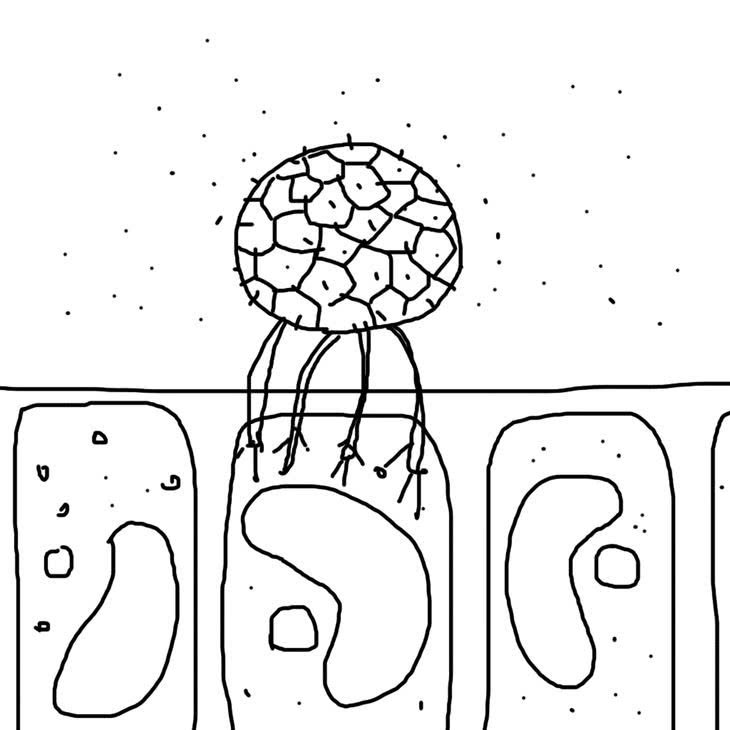
So which category does sooty mold fall into? Ha, none of them. Sooty mold is a disease that works both inside and out. Let me draw a thoroughly unscientific sketch to help everyone understand sooty mold.
In the picture above, the lower part can be understood as the cells of the plant's leaf epidermis. The thing on top that looks like an alien spaceship is the pathogen of sooty mold, called Meliola fungus.
Meliola fungus has some attachment branches growing on it, whose function is much like a plant's root system. These attachment branches can take root inside the plant's cells and absorb the nutrients within.
The big head of Meliola fungus that protrudes above the leaf surface is covered with a great many spores, and these spores scatter into the air, making it highly contagious.
Looking at this picture, everyone can understand why I say sooty mold works both inside and out: it's because the pathogen of sooty mold takes root inside the plant's body, while the closed ascocarps that release the spores are exposed on the leaf surface.
These Meliola fungi look black, and they thrust their attachment branches deep into the epidermal cells, so the genuine sooty mold looks like tiny black dots that are hard to remove from the leaf surface by wiping.
Most of the sooty mold photos circulating online are inaccurate. Some are merely photos of sunburn. Some are photos of black mold or gray mold, and some are photos of other fungal diseases.
Those with an obvious fuzzy, downy look on the surface, which can be removed by wiping and washing, are not genuine sooty mold. The pathogen of sooty mold does not join together into a large patch forming a mold spot visible to the naked eye; what they look like is a leaf whose color is dull and blackened, densely covered with a great many extremely small black dots. The leaves go soft. They are covered with all kinds of tiny pits. Waxy leaves lose their luster. The leaves wilt and lose water. The stems of infected succulents also go soft, losing their normal supporting strength.
After all that talk, let's put up a photo of the genuine sooty mold.
Some growers may think: since the attachment branches of Meliola fungus take root inside the cells, can't we just use a systemic insecticide (such as carbendazim) and be done with it?
Unfortunately, no. In fact, carbendazim is not a specific cure for sooty mold. The reason? Let me draw another picture and you'll understand.
When the plant's epidermal cells are infected, the cells soon die. At this point, the fungicide the plant has absorbed can no longer be conducted through the dead cells, and so it cannot kill the pathogen either.
Even setting that aside, even if the Meliola fungus absorbs carbendazim and is poisoned to death, we still can't cure sooty mold at the root. Why? Because the big head of the Meliola fungus exposed on the plant's surface will still keep releasing spores outward. These spores keep landing on the leaf surface and will keep rooting and sprouting again.
As more and more cells are infected and die, these dead cells also turn black. The plant's epidermis becomes even more pitted. The damaged epidermis becomes opaque, preventing light from passing through the cells into the healthy cells below, which seriously affects the plant's ability to photosynthesize, weakens the succulent's ability to repair itself, and ultimately leads to death.
So for a disease like sooty mold, the most terrifying features are the following three:
1. Systemic fungicides don't work; even if you kill the mold, it doesn't stop the mold from releasing spores outward to spread the pathogen.
2. The dead epidermal cells also turn black, then block light, affecting photosynthesis and making the plant's disease resistance weaker, until the whole plant loses water and goes limp.
3. New spores keep landing on the leaf surface, causing new infections, until the plant dies.
In response to these three features, our strategy against sooty mold becomes clear. First, use a protective fungicide, such as mancozeb, to kill the fungus from the outside, and at the same time give strict protection to the leaves that have not been infected with sooty mold, so that the spores flying around are killed the moment they land on the leaves.
Second, we know that leaves already infected with sooty mold actually cannot be cured. Even if you kill the mold attached to the leaf surface, those leaf cells already infected and killed still appear black, and these dead cells will block light and affect photosynthesis. The infected stomatal cells will be unable to close, the leaf's moisture will keep being lost, and in the end the leaf will wilt.
So don't expect a succulent that has come down with sooty mold to be cured; the black spots caused by sooty mold are all permanent. We can only block new routes of transmission and keep the other leaves from becoming infected.
If some of the more tender stems have already been infected and gone soft, or some leaves are already severely infected, you can consider cutting them off or picking them off. The final standard for sooty mold being cured is that the newly grown leaves are clean, with no signs of further infection.
Finally, let's briefly answer a few common questions about sooty mold:
Q: What causes sooty mold?
A: The spores of Meliola fungus and a humid air environment are the most important triggers. Meliola fungus cannot survive in a very dry environment. So if your succulent infected with sooty mold successfully makes it to the relatively dry autumn, these succulents may recover without treatment.
Q: Does sooty mold come back every year?
A: I think there isn't much point in talking about recurrence. Mold spores are everywhere, and it's almost impossible for us to kill them all off. Once the environment starts to get humid, sooty mold will make a comeback.
Q: What is the specific cure? How do you use the medicine?
A: The specific cure for sooty mold is difenoconazole; this medicine treats both inside and out, that is, it can be taken up systemically and also applied externally, so treating sooty mold with it alone works fairly quickly. Mancozeb is the medicine I recommend most often. The reason is that mancozeb's protective effect is very good, and after spraying it can quickly block the spread of sooty mold, giving good results.
When spraying, all the succulents in the whole space need to be sprayed uniformly; you don't need to spray a lot of medicine, just use a fine-mist sprayer until it's covered. Repeat the spraying once every 2-3 days; while treating, what's even more important is to strengthen the protection of healthy plants.
Q: Is there any hope for a plant with very severe sooty mold?
A: Leaves that are already severely infected and wilted can simply be picked off by hand; such leaves can never recover their condition. If some tender stems have already been infected and show softening, they should also be cut off directly. The only hope for a plant with severe sooty mold is to sprout new shoots again. Even if the diseased spots are cured, they will not grow back.
Final summary:
1. Before treating, first recognize what sooty mold is, and only after confirming the diagnosis treat it the right way.
2. Spray all plants together; blocking transmission is the real business.
3. Sooty mold is not hard to treat at all, and there is a specific cure; the three-early rule of early prevention, early detection and early treatment is the secret to dealing with sooty mold. Don't use folk methods like alcohol cotton balls, which waste time and effort and achieve very little. Most of the growers whose whole collection was wiped out by sooty mold were those who believed in folk methods and didn't use medicine.