Many people grow it in pots for ornamental purposes, but its sap can cause temporary blindness if it gets into the eyes, so care is needed when cultivating it.
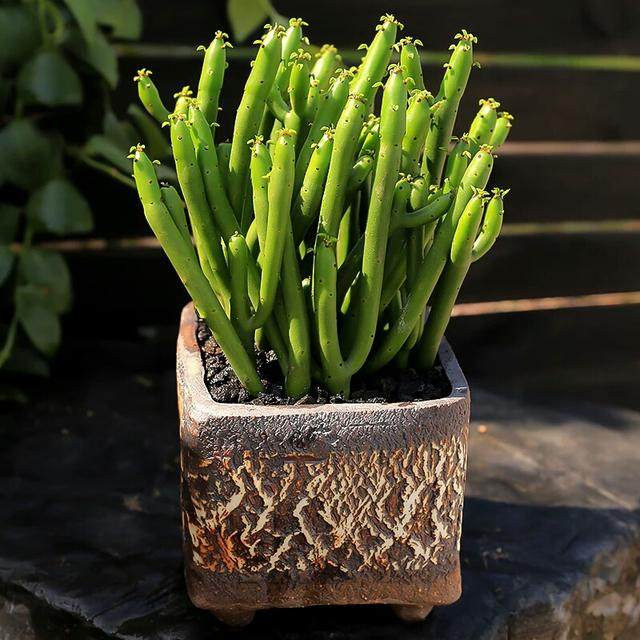
This plant is botanically named Euphorbia tirucalli, also known as the pencil tree or green coral. It is therefore drought-tolerant, salt-tolerant, wind-tolerant and tolerant of poor soil, and it likes plenty of light. To reduce water evaporation, the leaves of Euphorbia tirucalli have gradually become reduced, or even disappeared. Because of its unusual tree shape, with no thorns and no leaves, people call it the "naked tree". This naked tree is very popular on the market as a potted plant, costing anywhere from a few yuan to several tens of yuan, very cheap, and it offers a bit more interest than leafy potted plants such as pothos.
The sap of Euphorbia tirucalli can promote tumor growth and is carcinogenic by causing chromosomal rearrangements in human lymphocytes; it irritates the skin and can cause redness and swelling, and if it accidentally gets into the eyes it can cause temporary blindness. The white milky sap is highly toxic, so special care is needed when viewing or cultivating the pencil tree, and the milky sap must never be allowed to enter a person's mouth, ears, eyes, nose or wounds, but this toxic milky sap can resist invasion by viruses and pests, thereby protecting the plant body.
The branches of Euphorbia tirucalli are emerald green, smooth and glossy. In warm southern regions, Euphorbia tirucalli can be planted in the open, while in the north it needs to be grown in a greenhouse. If the naked tree is planted in a warm, humid place, it may also grow some small leaves to evaporate excess water in order to adapt to the moist environment. So if the Euphorbia tirucalli you are growing suddenly grows leaves, you can adjust the environment appropriately. The optimum temperature for growth is 25-30°C; generally it is cultivated outdoors in summer and in a greenhouse in winter.
Euphorbia tirucalli is a succulent plant with very good drought tolerance, so it does not need much watering; when it does need water, water it only after the soil has dried out completely. Summer temperatures are relatively high, and after exposure to intense sun it must definitely not be given a heavy watering. Although water demand is high in summer, watering must still be controlled. If you run into problems growing Euphorbia tirucalli and do not know how to handle them, you can consult experts on Yunzhongyang, the world's largest agricultural technical Q&A platform. It brings together tens of thousands of experts in planting and breeding, and every question raised receives a reply within 2 minutes.
Euphorbia tirucalli is used medicinally in small amounts; it has galactagogue, insecticidal and detoxifying effects, and is mainly used to treat insufficient postpartum milk, ringworm and sores, and swollen and painful joints. The fiber remaining after juicing can also be used as a raw material for papermaking. The white milky sap in the stems can be used to produce biodiesel; it is low-pollution and renewable, making it a highly efficient and environmentally friendly energy plant. In addition, experiments have shown that the milky sap of the naked tree has a very high content of hydrocarbons, making it a very promising petroleum plant.