Illustrated explanation of Teacher Wang Hengliang's single-branch crown: the bonsai shaping art of a single branch forming a scene
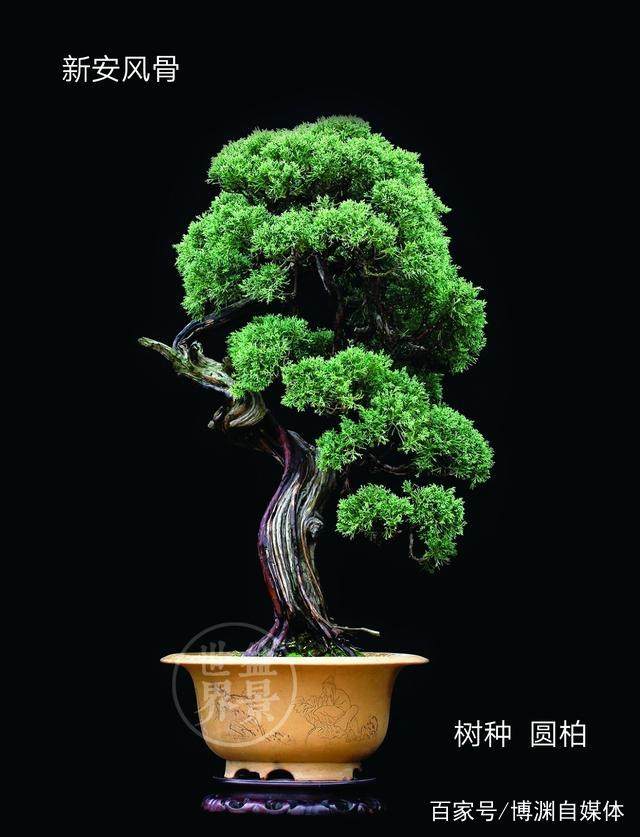
Teacher Wang Hengliang is a Chinese bonsai art master. He is currently a member of the China region committee of the International Bonsai Association. "Single-branch crown, single branch forming a scene" is the insight and understanding Teacher Wang has gained most deeply from more than 40 years of bonsai creation, learning from nature and absorbing the painting principles of the ancients, and it has greatly enriched the theory and practice of bonsai creation. Here, first let us explain what "single-branch crown, single branch forming a scene" is.
Single-branch crown: using the principle of apical dominance in trees, select one branch on the trunk intended for the crown and bend it. When the side branches grow until they become woody, train the left-side branch to the left and the right-side branch to the right. Train the rear branch downward, then bend it to the left or right, and keep it as a backward-extending branch. The front branch is also bent downward, then redirected to the left and right. After crowning, control the growth vigor, only increasing branch density and no longer increasing height. The effect of the single-branch crown technique, different from ordinary trees, is that a single branch also independently forms a small bonsai.
Single branch forming a scene means applying the same technique as the single-branch crown to the side branches on the trunk to shape them, so that the side branches can also independently form a small bonsai. These small bonsai may be semi-cascade or cascade. No matter what style is created, each small bonsai is required to coordinate and unify with the overall tree momentum, forming a whole.
The specific operation is as follows:
▲Above: a tree stump is cut off at the top, leaving one bud; when it grows to about 20 cm, begin bending.
▲Shape the trunk into two bends or two-and-a-half bends. The bending should be done in a rotating way, not simply a mechanical S shape, to show a three-dimensional effect.
▲Then bend the side branches: those growing on the left are trained to the left; those growing on the right are trained to the right; those growing at the rear are trained backward; those growing at the front are bent in a zigzag to the left or right. All branches are made into two bends or two-and-a-half bends. The curvature of the side branches should follow the curvature of the trunk, seeking unity amid variation.
▲Then cultivate for some time; by this point, the transition is already relatively harmonious.
▲After repeated wiring and pruning, until "deer-antler branches, chicken-claw branches" are formed. The single-branch crown and single branch forming a scene are completed.
▲Covered with leaves, single-branch crown.
Single-branch crown and single branch forming a scene have a natural charm and the effect of fine brushwork and freehand painting. Looking closely at the specific form of a single branch forming a scene, it may be firm or soft, curved or straight, with countless postures and endless variations. The direction of each branch is clearly expressed, seeking unity amid variation, with layers within layers. The art of negative space is used ingeniously, achieving the artistic realm of "sparse enough for a horse to run through, dense enough that wind cannot pass."
Appreciation of bonsai created by Teacher Wang Hengliang using the "single-branch crown, single branch forming a scene" technique:
▲Award-winning work at the 7th World Bonsai Convention
Look closely: each branch and trunk, listed separately, is a perfect small bonsai.
Each trunk can independently form a scene.
▲Gold Award at the 3rd China Bonsai Exhibition
Each trunk can independently form a scene.
▲Gold Award at the 7th China Bonsai Exhibition
Each trunk can independently form a scene.