A Detailed Guide to Identifying Common Chinese Orchid Varieties
Promoting Chinese orchid culture and spreading orchid knowledge
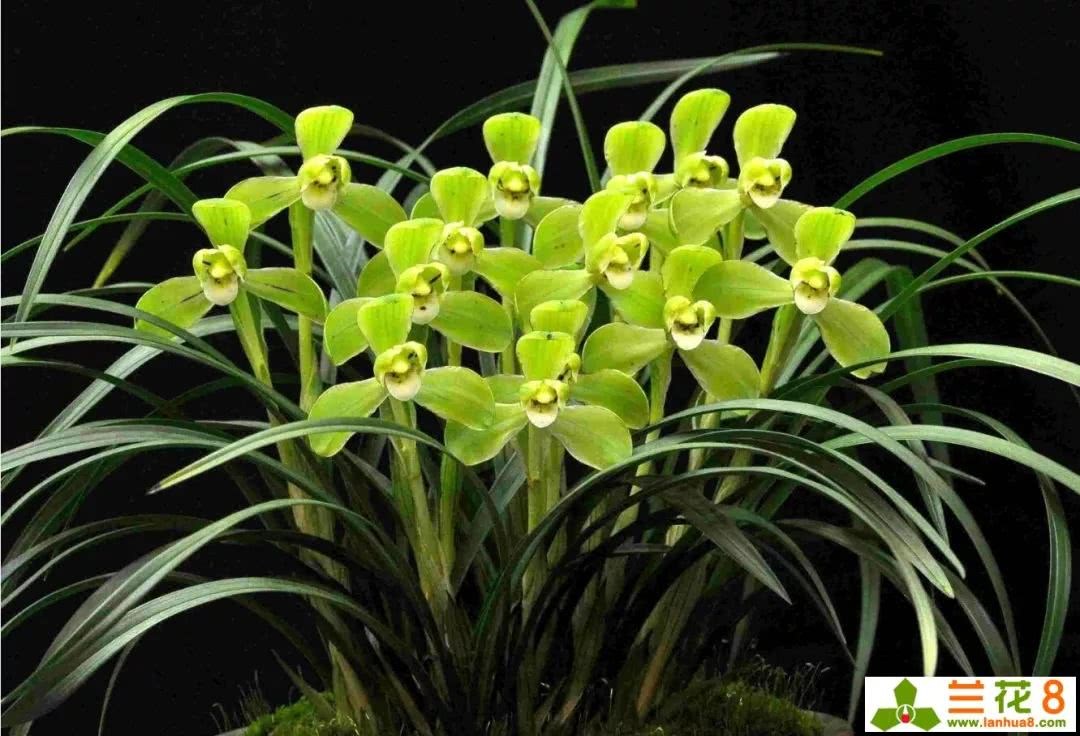
Chinese orchids generally refer to the terrestrial orchid species within the genus Cymbidium native to China, mainly Cymbidium goeringii, Cymbidium faberi, Cymbidium ensifolium, Cymbidium kanran, Cymbidium sinense, Cymbidium tortisepalum, and Cymbidium tortisepalum var. lianban, etc. Chinese orchids include about 30 wild species distributed within China
1. Cymbidium goeringii
Cymbidium goeringii is also known as mountain orchid, grass orchid, ground-crawling orchid, ground-crawling moth, and duoduo xiang. The main characteristics of Cymbidium goeringii are as follows:
Roots: The roots of Cymbidium goeringii are slender and long, forming a long cylindrical shape, usually 20-40 cm long and 0.5-0.8 cm in diameter, occasionally exceeding this range. The roots taper gradually from base to tip and usually have no branches.
Stem: The pseudobulbs of Cymbidium goeringii are relatively distinct, slightly spherical or oval, rather small, enclosed within the leaf bases and leaf sheaths, growing in clusters, 1-1.6 cm tall and 0.8-1.5 cm in diameter.
Leaves: Cymbidium goeringii has 4-7 leaves, growing in clusters, narrowly strap-shaped, with leaf blades 20-55 cm long and 0.6-1.7 cm wide; the leaves are thinly leathery, soft in texture, green to dark green; the leaf surface is relatively flat.
Flowers: Cymbidium goeringii blooms from February to March, with early flowering in mid-February, full bloom from late February to early March, and late flowering beginning in mid-March. The flower scape emerges from the inner side of the sheath-like leaves at the base of the pseudobulb, is cylindrical, upright, shorter than the leaves, 2-15 cm long, with 1 or 2 flowers per scape; flowers are 4-8 cm in diameter, mostly fragrant; flower color varies greatly, from pale yellow-green, green, yellow-white, light brown to other colors, generally with mottled veins and spots
2. Cymbidium faberi
Its characteristics are as follows:
Roots: The roots of Cymbidium faberi are relatively thick and short, 21-35 cm long and 0.5-1 cm in diameter, slightly thicker at the base than at the front end, without branches.
Stem: The pseudobulbs are not distinct, clustered together, 1.4-1.8 cm tall and 0.8-1.3 cm in diameter, oval in shape.
Leaves: 5-8 leaves growing in clusters, 30-140 cm long, or even longer, 0.6-1.3 cm wide, narrowly strap-shaped, often folded at the base, strongly upright, slightly curved in the upper part, thinly leathery, relatively hard in texture; the midrib is distinct, semi-transparent, protruding on the back of the leaf, and the parallel veins are also relatively distinct; the leaf margins have coarse serrations, the leaf surface is rough, deeply concave in the middle and lower parts, with a "U"-shaped cross-section; the leaf tip is acuminate, symmetrical on both sides of the midrib; the petiole scar is not distinct; the sheath-like leaves are thinly leathery, 7-15 cm long; as the leaves mature, the leaf bases gradually spread apart and are not clasping;
Flowers: The flowering period is April to May, with early flowering in mid-April, full bloom in late April, and late flowering in May; there are 1-2 flower scapes, and the flowers are orange-yellow with dark purple-red veins and spots; the flowers usually have a rich fragrance.
3. Cymbidium ensifolium
Cymbidium ensifolium is also known as four-season orchid, summer hui, summer orchid, autumn orchid, autumn hui, sword hui, etc.
Roots: The roots of Cymbidium ensifolium are thick and strong, 20-25 cm long and 0.6-0.9 cm in diameter, with branches.
Stem: The pseudobulbs grow in clusters, oval-spherical, slightly vertically flattened; 1-1.5 cm tall and 1.2-1.7 cm in diameter.
Leaves: 2-6 leaves growing in clusters, narrowly strap-shaped, the leaf surface slightly glossy, 20-65 cm long and 1-2 cm wide; the leaves are upright and sturdy, with the upper part extending slightly outward; thinly leathery, relatively hard in texture; the leaf surface is flat, dark green.
Flowers: The flowering period of Cymbidium ensifolium is July to October, usually opening twice, with about one month between the two bloomings; the first flowering begins as early as early July, with full bloom in mid-July; the second flowering begins in early August, with full bloom in mid-August; if the first flowering is late, the second flowering will be delayed to begin in late August; full bloom in early September, and late flowering begins in mid-September. There are 1-2 flower scapes, bearing 3-9 flowers, or even more; when flowering, the ovary twists 180 degrees, releasing a rich fragrance; the flowers are medium-sized, about 4.3-6.2 cm in diameter; flower color varies greatly, often yellow-green, with purple and purple-red veins and spots.
4. Cymbidium kanran
Roots: The roots of Cymbidium kanran are relatively slender, 20-30 cm long and 0.4-0.6 cm in diameter. With branches.
Stem: The pseudobulbs grow in clusters, 2-4 cm tall and 1.2-2 cm in diameter, long oval or narrowly ovate, enclosed within the leaf bases.
Leaves: 3-7 leaves growing in clusters, strap-shaped, thinly leathery, dark green, glossy or not; leaf blades 40-80 cm long and 0.9-3.5 cm wide, the leaf surface flat, the upper part drooping; the midrib is distinct, protruding on the back; entire or with fine teeth at the tip, the leaf tip is acuminate, symmetrical on both sides of the midrib; the petiole scar is distinct; the sheath-like leaves are thinly leathery, 10-12 cm long.
Flowers: The flower scape of Cymbidium kanran emerges from the inner side of the sheath-like leaves at the base of the pseudobulb, 25-60-(80) cm long, cylindrical, upright; with 5-8 sheaths, 5-7 cm long, membranous, semi-transparent, closely clasping the flower scape, often with a strong and lasting fragrance; the flowers are relatively large, 6-9 cm in diameter; flower colors are diverse, including yellow-green, purple-red, deep purple, etc., usually with mottled veins and spots.
The flowering period of Cymbidium kanran varies by region, usually concentrated in October-November, but some bloom in July and January, and some even bloom in April-May, so in recent years people have considered that Cymbidium kanran should be divided into spring kanran, summer kanran, autumn kanran, etc.
5. Cymbidium sinense
Roots: The roots of Cymbidium sinense are thick and long.
Stem: The pseudobulbs are oval or ovate, clustered together; 1.4-2.5 cm in diameter.
Leaves: 3-5 leaves growing in clusters; strap-shaped, entire, nearly leathery, dark green, glossy, the upper part spreading outward, the lower part with a joint; 60-90 cm long and 2-4.2 cm wide.
Flowers: The flower scape emerges from the base of the pseudobulb, usually rising above the leaves, upright; with 7-20 flowers, medium-sized, 4-5 cm in diameter, flower colors various, but mostly purple-brown with deep purple veins, flowers often fragrant; bracts small, with nectaries at the base; sepals narrowly oval to lanceolate, petals shorter and wider than the sepals, extending forward, covering the column.
Cymbidium sinense is also known as bao sui lan, bai sui lan, feng sui lan, and ren sui lan.
6. Cymbidium tortisepalum:
Cymbidium tortisepalum has a tall plant form, leaf width 1-2.2 cm, leaf length 40-100 cm, and leaf texture similar to Cymbidium goeringii. Its flowering period is also the same as that of Cymbidium goeringii, with 2-5 flowers per stem, flower diameter 4-8 cm when open, and rich and varied flower colors with a very good fragrance. It is a variety of Cymbidium goeringii.
The leaves are strongly upright, the flower stem is upright, 20 to 30 cm tall, with 2 to 5 flowers, sometimes 7; the flower bracts are longer than the ovary plus pedicel; the flowers are 5 to 6 cm in diameter, pale yellow-green, often semi-transparent, and fragrant.
The sepals are oblong-lanceolate, the middle sepal upright and slightly inclined forward, the lateral sepals spreading obliquely left and right, the petals shorter than the sepals, with three purple-red stripes at the base, and the lip is blunt at the tip and recurved. The leaf posture of Cymbidium tortisepalum is upright, vigorous, and extraordinarily elegant, with great charm.
Flower colors include red, yellow, white, green, purple, black, and multi-colored, brilliant and dazzling, with a graceful appearance, elegant charm, strong fragrance, and pure scent, often praised as the first choice by orchid growers.
Cymbidium tortisepalum was earliest treated as a variety of Cymbidium faberi, and later was established as an independent species.
7. Cymbidium tortisepalum var. lianban:
Also known as xiao xue lan and bei ya lan. Its distribution area is very narrow. The leaves of Cymbidium tortisepalum var. lianban are slender and narrow, 50-80 cm long and 0.5-1.2 cm wide. The leaves grow in clusters of 6-9, the pseudobulbs are small, generally only about 1 cm in diameter, but the roots are very thick and strong, up to about 0.5 cm in diameter. The flower stalk is upright, slender, round, and straight, bearing 2-3 flowers, the petals are relatively thin, the hidden stripes on the perianth are distinct, and the flower diameter is about 3.5-6 cm. The sepals are lanceolate, and the petals are long ovate. The flowering period is January to March, and when the flowers open, the fragrance is strong and elegant. Due to time constraints, the information has not been fully organized. The following content is published first, and more will be added and organized when there is time.
Orchid Bar, your good teacher on the path of growing orchids