2018 Taiwan-Japan-Korea Civil Society Joint Declaration on the Anti-GMO Movement Signed in Taiwan
By Chen Ju-wei
At 1:50 p.m. on May 8, 2018, civil anti-GMO action organizations from Taiwan, China, Japan and South Korea, at the "Taiwan-Japan-Korea Food Moment - School Lunch and Anti-GMO Action" workshop, had representatives of the three parties jointly sign the "2018 Taiwan-Japan-Korea Anti-GMO Movement Joint Declaration," taking the first step toward pooling the strength of civil anti-GMO action in East Asia.
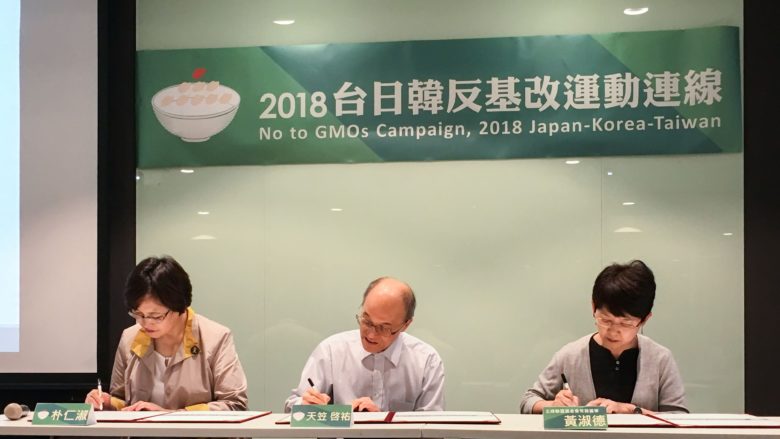
2018 Taiwan-Japan-Korea Anti-GMO Movement Joint Declaration
Safeguard biodiversity, protect food sovereignty, demand the right to know about food
More than twenty years have passed since genetically modified crops were first commercialized. The four major GM crops and foods - soybean, corn, cotton and rapeseed - have flooded people's daily lives, bringing far-reaching and complex impacts on the environment and ecology, human health, food sovereignty, international trade and other aspects.
Taiwan, Japan and South Korea in East Asia, although none of them currently cultivate any GM crops, all bear the pressure of multinational corporations aggressively dumping GM raw materials: Taiwan is one of the few countries in the world that directly consumes large amounts of feed-grade GM soybeans as food; South Korea imports about 10 million metric tons of GM raw materials each year; and Japan has approved the import of more than 300 GM foods and additive raw materials. What is more, the subsequent incidents of GM crops growing wild and contaminating the environment brought about by the import of GM raw materials have caused even more serious damage to agricultural production and the ecological environment in various countries.
Civil society groups in Taiwan, Japan and South Korea concerned with local agricultural development and consumer rights have for many years continued to launch numerous anti-GMO advocacy campaigns. The interim results achieved include Taiwan, Japan and South Korea all revising their GM food labeling systems, the South Korean government committing to halt the promotion of commercial cultivation of GM crops, and Taiwan legislating to prohibit the use of GM ingredients in school lunches.
However, multinational corporations that control GM seeds are expanding their monopoly through mergers, and organisms using a new generation of genetic technology may enter the market without regulation. For civil anti-GMO movement organizations that are relatively short of manpower and funds, only through international alliances can they strengthen their force to stop GMOs from invading daily life.
In May 2018, on the eve of the global "March Against Monsanto," representatives of the civil anti-GMO movement alliances of Taiwan, Japan and South Korea gathered in Taiwan for the first time, putting forward demands such as "safeguarding biodiversity," "protecting food sovereignty" and "demanding the right to know about food," and declaring the formation of the "East Asian Anti-GMO Movement Alliance" to maintain close exchange and cooperation and jointly build a rural-urban symbiotic society in which everyone can eat safe food.
May 8, 2018 Taipei
2018 Taiwan-Japan-Korea Joint Declaration Against Genetically Modified Organisms
Safeguarding biodiversity, protecting food sovereignty, the right to know what is in food
More than twenty years have passed since the first genetically modified crops appeared on the market. Today, our daily lives are flooded with GM crops and foods such as soybeans, corn, cotton and rapeseed. They have profound impacts on every aspect, including the environment and ecology, human health, food sovereignty and international trade.
In Taiwan, Japan and South Korea in East Asia, commercial cultivation of GM crops is basically not carried out, but under strong pressure from multinational corporations, large quantities are imported every year. Taiwan is one of the few countries in the world where feed-grade GM soybeans are used as food; South Korea imports about 10 million tons of GM raw materials each year; and Japan has already approved the import of more than 300 GM foods and additive raw materials. With large-scale imports, incidents of GM crops growing wild and contamination occur one after another, raising concerns about the impact on agricultural production and ecosystems.
For many years, in order to protect agricultural development and consumer rights, civil society groups in Taiwan, Japan and South Korea have each engaged in anti-GMO movements. Through the power of citizens, the governments of Japan, South Korea and Taiwan have revised their GM food labeling. In addition, the South Korean government has begun considering banning commercial cultivation of GMOs, and Taiwan passed a bill prohibiting GM crops from entering all school lunches.
In recent years, mergers among major biotech companies have given rise to giant monopoly corporations, and the consideration of regulations capable of dealing with genome editing and the like has become an urgent task. So that people can have a safer and more secure diet, civil society groups in each country must work together and jointly prevent GM crops and foods.
In May 2018, before the "March Against Monsanto" was held, representatives of the anti-GMO movements of Taiwan, Japan and South Korea gathered in Taiwan and, seeking "safeguarding biodiversity," "protecting food sovereignty" and "the right to know what is in food," resolved to form the "East Asian Anti-GMO Movement Alliance." From now on, we will exchange information with one another and carry out regular exchanges, and hereby declare that we will enable every citizen to lead a safe and secure dietary life.
May 8, 2018 Taipei
2018년 대만.일본.한국 GMO반대운동연대선언
생물다양성의 유지、식량주권의 보장、먹거리 알 권리의 요구
GMO식품이 상업화된 지 20년이 지났고 콩, 옥수수, 면화, 유채 등 4가지 유전자변형농산물 및 식품은 우리 생활속에 널려 있을 뿐만 아니라 환경생태, 인체건강, 식량주권 및 국제무역 등 면에 크고 복잡한 영향을 미치고 있다.
동아시아에 위치한 대만, 일본, 한국은 아직 유전자변형작물을 재배하지 않았지만 모두 다국적 기업으로부터 유전자변형원재료에 대한 강력한 덤핑 수출 압력을 받고 있다. 대만은 전세계에서 식용 및 사료용 유전자변형 대두를 직접 대량으로 수입하는 소수나라 중의 하나가 되었고 한국은 해마다 약 천만톤의 유전자변형 원재료를 수입해 왔으며 일본은 300품목 이상의 유전자변형 식품 및 첨가 원재료에 대해 수입 허가를 하였다. 심지어 GMO 원재료의 수입으로 인해 야외 GMO 작물이 자생하는 오염 사건도 발생했고 각 나라의 농업 생산 및 생태계에 심각한 영향을 미치고 있다.
대만, 일본 및 한국에서는 국내농업 발전과 소비자 권익 보호에 관심을 가지는 시민단체들이 여래 해 동안 각각 국내에서 GMO반대운동을 펼쳐왔다. 이에 따라 단계적 성과도 이룩해 냈고 그 중에서는 3개국이 모두 GMO표시 규제를 개정한 것, 한국 정부가GMO작물의 상용화를 중단하겠다는 것, 그리고 대만의 학교 급식에서 GMO식재료의 사용금지를 입법한 것 등을 포함하고 있다.
그럼에도 불구하고 GMO종자를 장악하고 있는 다국적 기업이 인수합병을 통해 지속적으로 독점세력을 확대하고 있는데다 신세대의 유전자기술을 적용한 생물체가 모니터링 없이 시장에 진입할 수도 있는 것은 인력과 자금이 부족한 GMO반대운동의 시민단체에게 국제 연대를 통해야만 그것이 우리 생활에 침투하는 힘을 막을 수 있다.
2018년 5월에 전세계 “몬산토 반대운동”하기 직전 대만, 일본과 한국 등 3개국의 GMO반대운동시민단체연맹의 대표들은 처음으로 대만에서 다같이 모여서 “생물다양성의 유지, 식량주권의보장, 먹거리 알 권리의 요구” 등을 촉구하할 것이며 “동아시아 GMO반대운동연대”를 결성하기로 하겠다. 향후 서로 긴밀한 교류와 협력을 유지해 나가며 모든 사람들이 안전한 먹거리를 먹을 수 있는 도시와 농촌이 상생하는 사회를 만들겠다.
2018년 5월 8일 타이페이