Some Reflections and Experiences on Growing Orchids on a Balcony
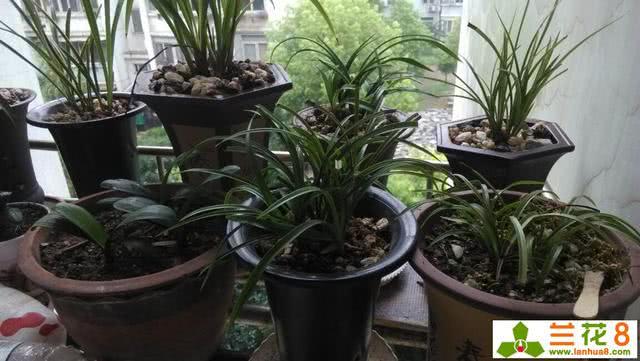
That orchids can be grown well on a balcony is already an indisputable fact. But not everyone can grow orchids well on a balcony. I believe that by reflecting on habitual practices and constantly adapting to environmental changes, one can grow orchids well.
1. Reverse thinking - dare to rebel
There is already a great deal of knowledge about growing orchids on balconies, and a complete theoretical knowledge system has been formed. If you ask anyone to talk about it, everyone will have a whole set of ideas. But why do the orchids people grow turn out so differently? To find the reasons, we need to learn to think in reverse, to have a bit of a rebellious spirit. In other words, we must constantly update our fixed notions about growing orchids.
There is a story: a photographer prepared many works for a competition, but unfortunately a fire broke out at home and all the works were destroyed, so he had to enter a piece that was kept at his mother-in-law's house. Unexpectedly, this piece, which he himself did not consider his best, actually won the grand prize. Later, many times, the photographer entered what he considered his best works, but never won another award.
Thinking about this story, we can easily draw a conclusion: what we consider our best is often not actually the best. The same principle applies to growing orchids. Could the variety you think is the best really be the best variety that everyone recognizes? Could the best growing method you cling to still be replaced by a method that grows orchids even better? The path to success calls on us to consider problems from another angle. To always stay at the forefront, we need to dare to break traditional notions.
News needs to constantly update its concepts to attract viewers more effectively; teaching and educating people requires constantly updating teaching methods and knowledge structures to meet students' needs; practicing calligraphy requires constantly correcting mistaken understandings and poor movements to reach ever greater refinement. Orchid growers, too, need to reflect on established knowledge and experience, and through repeated updating and rebuilding, gradually form more scientific and reasonable methods and experience for growing orchids well. An advertising slogan says, "There is no best, only better." "Better" - that is the driving force for people to keep moving forward.
It is especially worth noting that orchid growers must not be too stubborn in their thinking and concepts, and should not always think, "I am number one under heaven, mine is the best." Do they not know: beyond the green mountains there are more green mountains, and beyond this tower there are more towers - there is always a greater expert further ahead!
2. Drainage and aeration - know when to stop
"Drainage and aeration" is the four-character mantra of orchid growing. When the ancients said this, there were not many high-rise buildings, at least not as many as now, and generally people did not grow orchids on a large scale on balconies. At that time, orchids were mostly grown in courtyards under almost completely natural conditions, and the vast majority directly used mountain soil as the growing medium. Therefore, the theory of "drainage and aeration" was very necessary and widely followed.
Now, for orchids, the environment has changed, and the times have changed too. They increasingly live in high-rise buildings and Western-style houses, partly because people's living environment is limited, and partly because without protective measures, growing orchids in a large courtyard is no longer safe. Changes in conditions require us to change our orchid cultivation accordingly - drainage and aeration, but know when to stop.
The environment where wild orchids grow is relatively cool and shady, and the moisture in the soil of the earth can be kept at just the right level of "moist." Once separated from the earth, orchids lose this advantage on which they depend for survival. Now, people strongly advocate growing orchids in granular media, in which moisture is not easily retained. In addition, emphasis on aeration and ventilation, opening windows and vents to strengthen air convection, causes orchids to lose water rapidly. Orchids that have moved into high-rise buildings are like people from the watery towns of Jiangnan relocating to the windy, dry Northwest. If we then stubbornly emphasize "drainage and aeration," theoretically speaking, is that not artificially creating a "drought" and driving orchids onto a dead-end road?
Everyone knows that Yunnan people like to use leaf mold to grow orchids, with plastic pots that have no holes around the sides, plastic film covering the pot surface, and balcony windows that are rarely opened for ventilation, yet the orchids grow very well. Some greenhouse orchid growing is similar. This makes one ask: do the orchids they grow have drainage and aeration? On the contrary, do orchids really need that much drainage and aeration?
Chinese people love "just right," so the "drainage and aeration" for orchids should also be "just right, and know when to stop." Therefore, when growing orchids on a balcony, one should comprehensively consider the environmental factors inside and outside the orchid pot, ensuring moderate humidity and moderate ventilation and aeration, so as to be more beneficial to orchid growth.
3. Cultivation and management - follow nature
Orchid cultivation already has a certain procedure: first place drainage material in the pot, then add coarse granules, then add fine growing medium up to the pseudobulb area, and finally tidy the pot surface. From this we can easily see that the middle and lower parts of the orchid pot are relatively loose and airy, and if environmental humidity can be achieved, the orchid roots should grow very well. But what if the humidity on an open balcony cannot be achieved? What if the owner is away on a business trip and cannot return for more than half a month? I dare say with certainty that the orchid roots will either not grow, or their tips will be hollow and shriveled.
I remember when I first started growing orchids, I did not care about the size or coarseness of the growing medium, let alone know that it should be used in layers. Anyway, I just mixed it all together and started planting orchids, and only remembered to tend them after ten days to half a month. Now when I open those photos and look closely, they actually grew quite well. In 2009, I began using Orchid Stone to grow orchids, cultivating completely according to the principle of coarse first and fine later. It happened that in August I went on a business trip to Qinghai for more than a week, and after returning home there was continued high temperature, so I did not dare to water. At the end of the year, when I repotted, I found that many snow-white orchid roots that had originally grown very well had become hollow and shriveled due to lack of water.
Successes and failures inspired my thinking and also transformed my ideas: what if the growing medium in the pot were the same size from top to bottom? Perhaps the situation would change somewhat. At the end of last year, when I repotted again, I mixed the sizes uniformly and used them together, but instead used coarser granular material in the pseudobulb area. First, because the pseudobulb area is loose, moist, and clean, which helps stimulate orchid roots and shoots; second, to avoid water accumulation and stem rot in the pseudobulb area. I also used wire mesh to make a self-made drainage cover about the thickness of a thumb. After spring began, I also planted small creeping-root grasses on the pot surface, and never pulled out the small grasses that grew naturally in the pot. This can create a natural environment for the orchids, allow observation of the moisture conditions in the pot, and also help loosen the soil and regulate water and fertilizer.
The management of balcony orchids should depend on the specific situation. Yunnan orchid friends mostly use enclosed balconies and emphasize heating and humidification, while more orchid friends use open balconies and strive for naturalness. Whichever method is used, humidity, temperature, sunlight, and ventilation are daily topics. A thousand people have a thousand methods, and they cannot be generalized. There is only one thing that must be noted: whether management is appropriate should be judged according to the growth of the orchids and the different seasons. Judgments about moisture retention, shading, and ventilation should be made primarily based on summer and autumn, especially summer. Some orchid friends look at the good humidity on the balcony in spring and think their "little plot of land" is suitable for growing orchids, and then in summer they still manage it the same way as in spring, carelessly and roughly, resulting in dried roots and rotted seedlings and the loss of varieties. Some friends who grow orchids on open-air balconies feel very comfortable in spring and autumn, and the orchids grow vigorously, but in summer when the temperature is too high, shade and cooling are needed, otherwise the consequences could be disastrous. Friends in the north who grow orchids on balconies should especially pay attention to heat preservation and wind protection in winter to avoid orchids freezing.
4. Variety selection - cut the coat according to the cloth
Generally speaking, balconies are not very large, while there are too many fine orchid varieties and too little money on hand, so balcony orchid growing must be tailored to one's means, so that it can be relaxed and natural and endlessly enjoyable.
For balcony orchid growing, first of all, it is not suitable to grow orchids in large quantities. Growing a large number of plants takes up a large amount of balcony space. In an apartment that is not large to begin with, if orchids take up too much space, it will inevitably reduce the living space for the whole family. Before 2008, I had successively grown more than 100 pots of wild-collected gamble orchids, occupying the only balcony at home and four windows fitted with protective grilles. There was nowhere to dry the laundry on ordinary days, and once the shade net was pulled out, the house was so dark that lights had to be turned on even in broad daylight, which made my wife, children, relatives, and friends frequently "impeach" me. Because there were too many, management was too troublesome. Each watering took two days, and I feared summer most: after the potting soil dried out, the pots had to be soaked, which took even more time, and I was often so tired that my back and waist ached. In 2009, I made a painful decision to grow only named varieties, and only then was I freed.
Second, in balcony orchid growing, attention should be paid to variety selection, and one should not be greedy for quantity or completeness; even when growing named varieties, one must be selective. Whether for personal enjoyment or for business and profit, choosing a few varieties you like, or that have "money prospects," is enough. Of course, if the business becomes large-scale, that is another matter. A few days ago, I chatted with a literary friend and orchid friend from Yunnan on QQ. He does not grow many orchids on his balcony, but his annual income is quite considerable, achieving a true "balcony economy." He does not emphasize that the more named varieties the better; the key is to select one or two good varieties each year, and when appropriate, be willing to sell. This year he and a partner brought in two seedlings of Fen He and several seedlings of Douban Honghe Hong. He said this way he lives relaxed and happy, has a high interest in growing orchids, and has also written many articles related to orchids. An orchid friend in Zhejiang runs an automobile business as the family's main occupation. He loves orchids very much, but over several years his varieties have not exceeded ten and his pots have not exceeded twenty. He has always adhered to one principle: "It is enough to have orchids to grow; I do not care how many there are." Although these two balcony orchid-growing friends have different purposes for growing orchids, they both understand well enough to know when to stop and not let it become a burden.
In addition, attention should also be paid to regional differences and the selection of variety characteristics. For example, orchid friends in the south should grow fewer spring orchids and cymbidiums that require vernalization to bloom. After working hard for several years, if in the end one cannot smell the fragrance of the flowers, that would be a regret.
For balcony orchid growing, the experts originally have much experience to discuss; I am merely stating my own practices and insights for everyone's reference. As for anything inappropriate, orchid friends can just regard it as a lesson. I publish orchid knowledge and pictures every day to take you deeper into understanding orchids and teach you to grow orchids easily. If there is anything you do not understand about orchids, you can ask me at any time or leave a message below. If my knowledge has helped you, I hope you can give me a like or repost it to help more people!