Detailed Guide to the Making Method and Steps of a Blue Star Juniper Bonsai
(1) Botanical Knowledge
Belongs to the Cupressaceae family, Juniperus genus. An upright shrub, much branched; leaves are all needle-like, covered with white powder on both upper and lower surfaces, glossy, appearing turquoise-blue, mostly clustered upright and upward. Dioecious, flowers and fruits borne singly in leaf axils, fruit elliptical, the cone contains only one seed. Its original species is the Himalayan juniper (Sabina Squamata [Buch.-Ham.] Ant.), whose leaves are jade-green, with a white powdery band only on the upper surface.
Blue Star Juniper is produced in the central and western provinces of China, and is cultivated in garden nurseries throughout the areas from the Yellow River basin to the middle and lower reaches of the Yangtze River basin, used as garden trees or bonsai for ornamental purposes.
It prefers light, is slightly shade-tolerant, relatively cold-tolerant, and can grow in neutral soil, slightly acidic soil, and calcareous soil; it requires deep, loose, well-drained sandy loam. It is not tolerant of waterlogging and is tolerant of pruning.
(2) Material Collection and Cultivation Measures
Artificial propagation: Blue Star Juniper is usually propagated by cuttings, layering, or grafting. For cuttings, spring from April to May is best; select 1- to 2-year-old tender branches for the cuttings, semi-lignified being ideal; the cuttings should be 12-18 cm long, with the branches and leaves below the middle removed, and the upper branches and leaves appropriately thinned if too dense; insert to a depth of 1B3. The seedbed should be chosen on high, dry terrain with fertile, loose, well-drained sandy soil; before inserting, first loosen and rake the soil flat. After inserting, water thoroughly and set up a shade frame; roots can develop in about 8 months. During this period, as long as the leaves do not turn yellow, wither, or fall off, careful management is required. Spray water frequently in summer; after survival, divide and transplant in the spring of the 2nd year to cultivate larger seedlings.
Layering can be carried out throughout the year, but spring from March to April is best. For layering, select branches 1-1.5 cm in diameter, perform ring-barking and cutting down to the xylem, bury the branch in the soil, earth up and compact it, and manage and care for it carefully; generally roots will develop about 3-4 months after layering.
Grafting propagation mostly uses the approach grafting method. Select juniper or Chinese arborvitae seedlings as rootstock; the rootstock trunk diameter should preferably be 1.5 cm; the scion should preferably be 2-year-old branches that are growing vigorously and still green. Approach grafting should be done in May; after about 2 months, cut off the scion from below the junction, and in the spring of the 2nd year when replanting, cut off the rootstock seedling above the junction.
(3) Potting Process
Pot selection: Blue Star Juniper is suited to purple clay ceramic pots; pot shapes such as relatively shallow or medium-deep rectangular, square, oval, or round are all acceptable; for large bonsai, deep large horse-trough pots or deep round pots may be used. Pot colors such as ochre-red and purple clay and other dark colors are best, so that the Blue Star Juniper bonsai appears more antique and natural, with a verdant and vigorous posture.
Soil: Blue Star Juniper is not strict about soil and can tolerate mild acidity and alkalinity. For potting, commonly use matured garden soil or leaf mold, mixed with 20% rice husk ash or sandy soil.
Planting: It is best done in spring from March to April, and also possible in autumn. Before planting, note that the bottom of the pot should be padded with broken tiles to leave space, and a layer of vermiculite or peat soil should be spread to facilitate drainage. After potting and planting, water thoroughly once; afterward, water only after the soil dries.
(4) Styling Techniques
Processing: The styling and processing of Blue Star Juniper is mainly by wiring, with pruning as a supplement. Wiring can use palm fiber or metal wire; Blue Star Juniper branches are soft and full of flexibility, easy to process, and can be coiled and shaped at will. Focus on wiring the main branches well; small branches can be wired with palm fiber. After the Blue Star Juniper takes shape, its side branches are mostly in rounded clustered forms, so during processing pay attention to the gap distances between upper and lower, left and right branches and leaves, and do not let them be too crowded, causing a sense of blockage. With proper care and management, Blue Star Juniper grows relatively fast, so every 1-2 years it must be unwired and restyled.
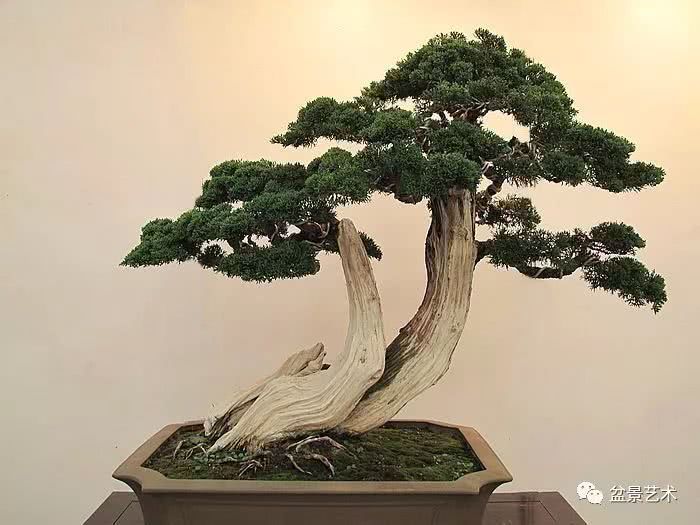
Blue Star Juniper can also use parts of its branches and trunk to create dead wood, to imitate the phenomenon in nature where trees, after long-term attack by wind, rain, thunder, and lightning, develop certain branches and trunks split and broken and bark peeling off, thereby producing an antique and peculiar effect. For example, in the Wenzhou Bonsai Garden there is a Blue Star Juniper bonsai called "Life and Death Love," in which a dead branch extends above the dripping-green crown, twisting upward, giving people a feeling of enduring a thousand years and striving tenaciously.
Tree shape: Blue Star Juniper has strong plasticity and is suitable for processing into various tree shapes. Common ones include the straight-trunk style, slanting-trunk style, curved-trunk style, waterside style, and three-tier style; tree shapes should avoid affectation and stiffness, and natural vigor, antique simplicity, and robust lushness are best. The main trunk must bend naturally; pay attention to the direction of the bends and changes in the degree of curvature, so that upper and lower branches, and left and right branches, are both connected and varied, and leave blank space; they must not stack vertically or connect in parallel, so that the tree shape expresses a beauty of elegance, unrestrained grace, and rich depth.