One year into the succulent hobby, I raised them poorly, but unexpectedly reaped a pleasant surprise, and the neighbors shook their heads when they saw it
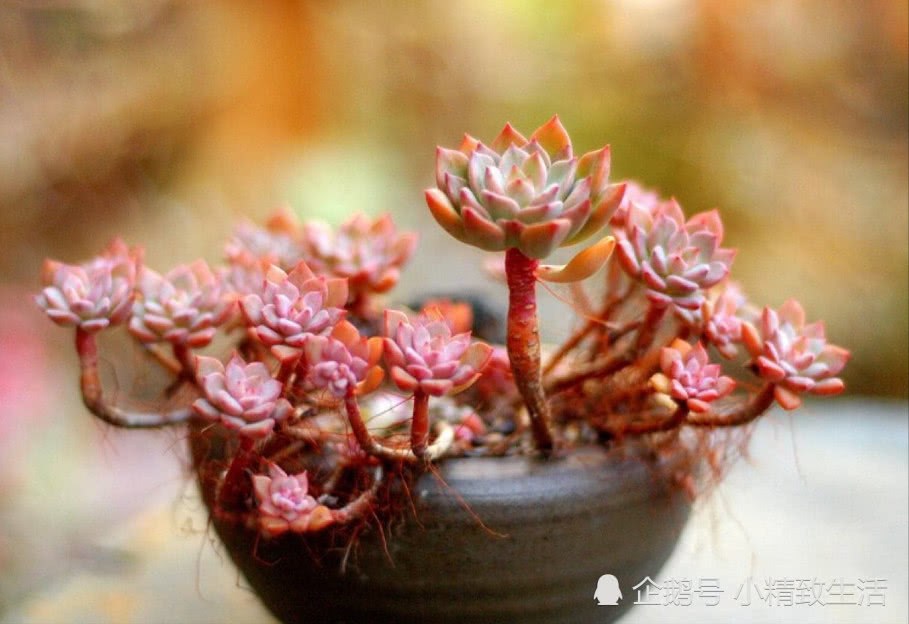
Friends who follow Xiaojingzhi Life should have read a previous article by Xiaojingzhi Life, "Gardening Knowledge: Why Have My Succulents Become Thin, Tender and Long? Teaching You How to Deal with Succulent Etiolation," which explained the causes of etiolation and how to deal with etiolation afterward. One point said that etiolation is irreversible; if your succulent becomes etiolated, you might as well behead it to make an "old stump."
Unlike a true old stump, this kind is grown by a speed-up method, so the resulting "old stump" is called a "pseudo old stump." Below is an introduction to how to rescue an etiolated succulent and turn it into a "pseudo old stump," and where it differs from a true old stump.
We won't say much about the process of etiolation; to be honest, apart from true experts, for beginners in some places, it should be something to be thankful for if succulents can etiolate in summer without dying. By autumn, these succulents that have etiolated badly should be beheaded and stripped of their leaves, leaving them as bare-stemmed commanders, then coated with carbendazim for disinfection, while increasing light, controlling water, and caring for them normally. Slowly, over about a year, when the stem gradually lignifies and many side shoots burst out, the "pseudo old stump" is basically formed.
So what is the difference between an old stump and a "pseudo old stump"?
1. A true old stump takes at least 3-5 years to form; its stem is lignified through the accumulation of time and does not break easily, while the stem of a "pseudo old stump," because it is speed-grown, still has mostly green stem and is relatively fragile.
2. Because the leaves dry up and fall off naturally, the marks left by fallen leaves on the stem of a true old stump are almost invisible, while the leaves of a "pseudo old stump" are picked off, so the marks left by the leaves on the stem are very obvious, and the spacing between them is very large.
A true old stump is the accumulation of a long time and bears witness to every bit of your careful care. When you slowly record this process with photos, you will be moved by your own persistence; while a "pseudo old stump" is also a rescue measure after a succulent has grown poorly, giving a sense of achievement like turning the tide. However, deliberately making a succulent etiolate and then turning it into a "pseudo old stump" is not advisable.
Compiled and published by Xiaojingzhi Life.