How do you care for a kalanchoe so it bursts into a full pot? Master these few tricks and you are all set
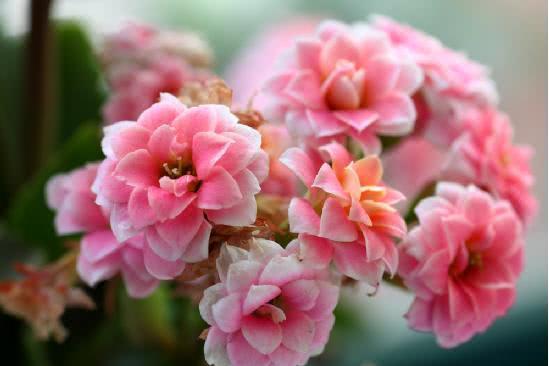
Entering May, the season of early summer, many people hope to bring a touch of freshness and coolness to their gradually warming homes by growing one or two green plants, and the kalanchoe (Kalanchoe blossfeldiana) is a very suitable choice. Of course, although growing kalanchoe is relatively simple, making it truly stand out as a splash of color still requires a few small tricks. So what should we do? Don't panic. As long as you master these "three attentions, two clever tricks," your kalanchoe will grow into a bursting full pot even with your eyes closed.
Three attentions
1. Pay attention to light
As everyone knows, the kalanchoe seems rather "casual" about light, but this casualness does not mean completely "letting it run wild." In fact, during this period as summer approaches, we still need to provide a certain amount of ventilation and shading. The purpose is to avoid direct sunlight damaging the plant's stems and leaves. Usually, 8-9 hours of light per day is enough, with shading the rest of the time. In this way, flower buds will form in about 20 days.
2. Pay attention to fertilizer
May is the period when summer is about to begin, and during this time we must pay attention to fertilizing. In this season, fertilizing kalanchoe should follow the six-word mantra "more watering, less nitrogen fertilizer." Especially once it enters the flower-forcing stage, be sure to increase the proportion of phosphorus and potassium in the fertilizer and reduce the amount of nitrogen fertilizer. Doing so can effectively control the problem of leggy growth in kalanchoe plants. Be sure to pay attention.
3. Pay attention to pest prevention
Now, as temperatures continue to rise, pest prevention has also become an important concern in growing kalanchoe. Kalanchoe itself is susceptible to infestation by snails, slugs, cabbage caterpillars, and the like, and these pests need to be prevented first and foremost. Therefore, properly disinfecting the indoor environment and regularly spraying protective insecticides is a very good method.
Two clever tricks
1. A small pot and loose soil give the best results
Kalanchoe is suitable for planting in clay pots with good permeability, with an inner diameter of 10 cm to 20 cm being most suitable. During planting, you can place a layer of crushed charcoal or crushed hard plastic pieces at the bottom of the pot to ensure sufficient permeability. As for the choice of soil, you can select loose, fertile, slightly acidic sandy soil. If growing it as a potted plant at home, you can also mix leaf mold, vegetable garden topsoil, and sand as a growing medium in a ratio of 4.5:4.5:1, and the results are excellent too!
2. There is an art to stem cuttings
If you want kalanchoe to branch out and spread its leaves, taking cuttings once every other year is essential. Generally speaking, cuttings can be taken in all four seasons, but it is best in spring and autumn. Cut a branch that includes at least four healthy leaves as your target. Once the wound has dried, it can be inserted for rooting. Be careful to provide appropriate shade during the cutting process, and spray water as needed to maintain moisture. Roots will appear in about a week, and if through observation we find the leaves have become firm and glossy, that indicates roots have formed and the cutting has taken.