Why is the Wuyou flower regarded as a sacred tree in Buddhism?
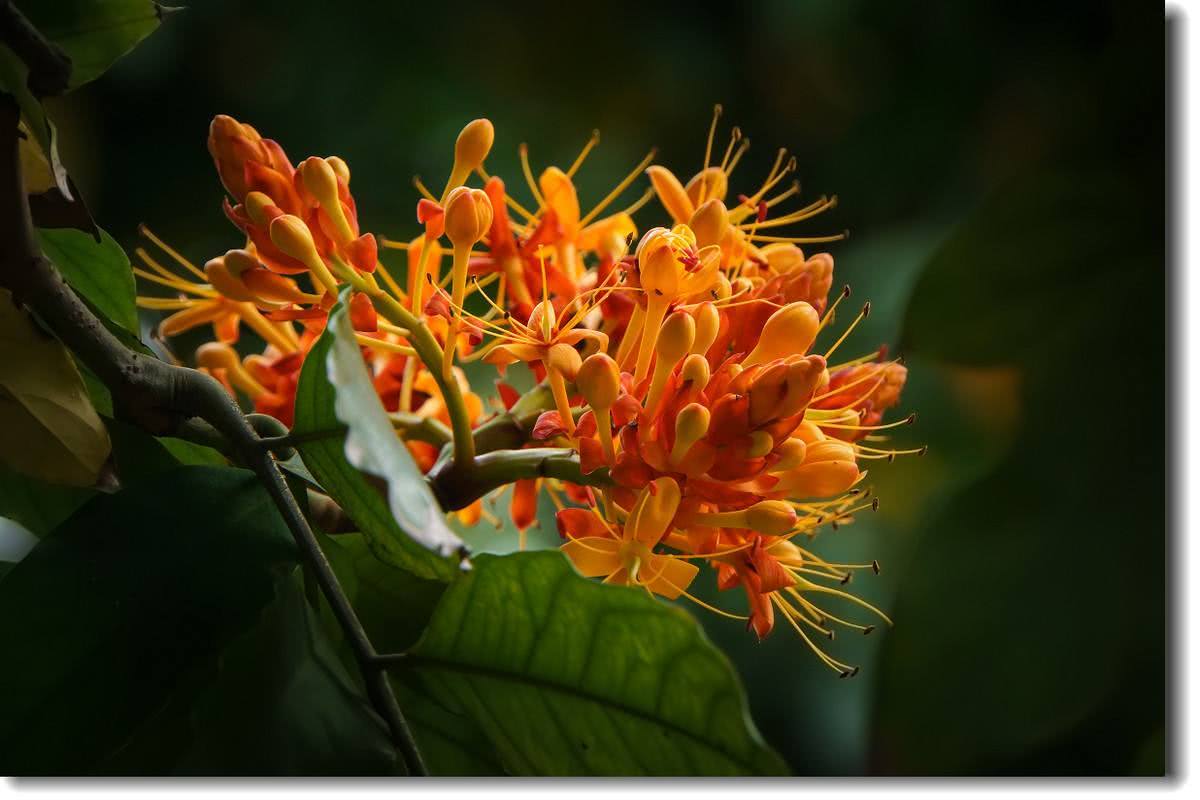
The Wuyou flower refers to the Chinese Wuyou flower, also known as the flame flower. It is an evergreen tree with dense branches and leaves, and large red flowers; when in full bloom, it looks like clusters of flames from a distance, hence the name. The Wuyou flower is a somewhat sun-loving species, prefers full sunlight, and has somewhat high requirements for water and fertilizer. It has few pests and diseases, is easy to manage, and combines greening, landscaping, and colorful flowers in one.
Wuyou flower
Tree, 5-20 m tall; trunk diameter at breast height up to 25 cm. Leaves with 5-6 pairs of leaflets; young leaves slightly purplish red, drooping; leaflets nearly leathery, oblong, ovate-lanceolate, or long obovate, 15-35 cm long, 5-12 cm wide, the basal pair often smaller, apex acuminate, acute, or obtuse, base cuneate, lateral veins 8-11 pairs; petiolules 7-12 mm long. Inflorescences axillary, relatively large, the main axis hairy or nearly glabrous; involucre large, broadly ovate, hairy, early deciduous; bracts ovate, lanceolate, or oblong, 1.5-5 cm long, 6-20 mm wide. The lowest one is the largest, gradually becoming smaller upward, hairy or glabrous, early or late deciduous; bracteoles similar in shape to the bracts but much smaller than the bracts; flowers yellow, later parts (base of calyx lobes and disc, stamens, style) turning red, bisexual or unisexual; pedicel shorter than the calyx tube, without articulation; calyx tube 1.5-3 cm long, lobes oblong, 4, sometimes 5-6, ciliate; stamens 8-10, of which 1-2 often reduced and subulate, filaments exserted, anthers oblong, 3-4 mm long; ovary slightly curved, glabrous or hairy along both sutures and the stalk. Pod brown, flat, 22-30 cm long, 5-7 cm wide, valves curled; seeds 5-9, irregular in shape, flat, with a shallow groove in the center of both surfaces. Flowering period April-May; fruiting period July-October.
Wuyou flower
This species can be used to rear lac insects and is an excellent host for lac insects; the bark is used medicinally and can treat rheumatism and menorrhagia. Because the flowers are large and beautiful, it is also a good tree for courtyard greening and ornamental use.
The Wuyou flower in the Royal Palace in Phnom Penh, Cambodia, has a tall trunk and beautiful flowers, and is a sacred flower in Buddhism.
In Xishuangbanna, the Dai people as a whole believe in Theravada Buddhism, and many plants related to Buddhism have been widely planted and worshipped, and the Wuyou flower is one of them.
Wuyou flower
Legend:
More than 2,500 years ago, in the northwest of ancient India, at the foot of the Himalayas (in present-day Nepal), there was the kingdom of Kapilavastu. King Suddhodana and Queen Mahamaya had been married for many years without having children, until the queen was 45 years old, when one night, in a dream, she saw a white elephant flying through the air and entering her womb--the queen was pregnant. According to the customs of ancient India at that time, a woman pregnant with her first child had to return to her parents' home to give birth. On the eve of giving birth, Queen Mahamaya rode in a palanquin carried by an elephant back to her parents' home to give birth. When passing through Lumbini Garden, she felt somewhat tired from the journey, got out of the palanquin, and rested in the garden. When Queen Mahamaya walked to a lush Wuyou flower tree covered with golden-yellow flowers and reached out to support herself on the trunk, her labor was triggered, and under the Wuyou flower tree she gave birth to a sage for the ages--Shakyamuni. Therefore, almost every Dai village in Xishuangbanna has a temple, and almost every temple is surrounded by planted Wuyou flowers. In addition, some families who have no children but wish to have them also often plant a Wuyou flower in front of or behind their house.