The snowdrop is the birth flower of Aquarius; let's learn about this flower together.
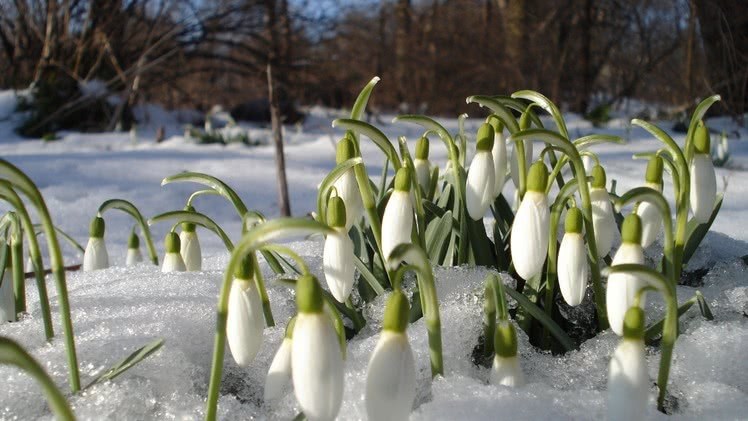
The name "snowdrop" first appeared in 17th-century German literature; at that time a newly popular teardrop-shaped earring resembled the flower's shape, rather than the name coming from the flower blooming in snowy weather. Based on its English explanation, people mostly assume the flower's shape is like a drop of snow, which is actually a misunderstanding, but the coincidence is quite interesting. The snowdrop grows in low clumps with abundant flowers and leaves, braving the cold of spring and blooming proudly. It is suitable for clump planting under semi-shade woodland or in lawns, and also suited to embellishing flower borders and rock gardens; it can also be potted for indoor display or used as a cut flower. The snowdrop is also known as the snow bell flower or lily-of-the-valley daffodil, and there are only two kinds: the snowflake and the summer snowflake. It represents wisdom and rationality, and is the birth flower of Aquarius. In some places in the United Kingdom it is also called a symbol of death.
Snowdrop
Perennial herb, plant height 10-30 cm. Bulb small, 1.8-2.5 cm in diameter, spherical. Leaves clustered, linear and strap-shaped, green covered with white powder, 15-23 cm long, 1.3 cm wide. Flower scape upright, hollow, flat-round; flower solitary at the top, drooping; pedicel short; perianth segments 6, elliptical, without a tube, broadly bell-shaped, white, each segment tip with a green dot. Flowering period in early spring from late March to April.
Snowdrop
It likes a cool and humid environment, grows well in soil rich in humus, has a certain tolerance for shade, and can grow in sunny or semi-shady sites. Before open-field cultivation, apply sufficient base fertilizer, and a small amount of bone meal can be added. The snowdrop generally sprouts in early spring, blooms in March and April, and after flowering its bulb goes dormant in the soil.
Snowdrop
Distribution range: the snowdrop is native to central Europe and the Caucasus region, and has been cultivated in many countries. It is highly adaptable and relatively cold-tolerant, and can overwinter in the open field in the middle and lower reaches of the Yangtze River in China.