What are the methods of graft propagation in bonsai production?
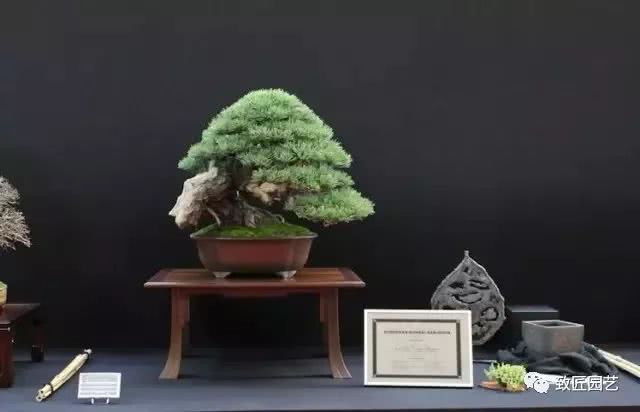
The technique of grafting the branches of a plant of a superior variety onto the branches, trunk or roots of another plant so that they heal and grow into a new plant is graft propagation. The new plant cultivated by grafting is called a grafted nursery plant.
(1) Bud grafting method: carried out during the growing season when the cortex peels easily, at which time the cambium cells are highly active and grafting readily succeeds. Bud grafting for propagation has the advantages of saving scion material, a high grafting survival rate, a firm union, quick plant formation, and a long grafting period, so it is widely used in production.
"T"-shaped bud grafting method: this is the ordinary bud grafting method. First select a plump bud on the scion, use a grafting knife to cut upward from 1.5 cm below the bud, with the cut deep enough to reach the xylem, cutting until 1.5 cm above the bud; then cut through the cortex 1 cm above the bud, connecting to the longitudinal cut, hold both sides of the bud with your fingers, and gently rock it left and right to snap off the bud plate. The bud plate is about 2 cm long and 0.6 cm wide, without xylem (if the bark does not separate easily, it may carry a little xylem). Cut a "T"-shaped interface at the grafting site on the rootstock, deep enough to reach the xylem, with the horizontal cut slightly wider than the bud plate and the longitudinal cut slightly shorter than the bud plate. Pry open the cut, insert the prepared bud plate into the cut, align the upper edge of the bud plate with the horizontal cut of the interface and press it tight. Bind tightly with a plastic strip from bottom to top, leaving the petiole or bud exposed. Generally, it survives 20 days after grafting. Chip budding: this method can be used when the bark of the scion or rootstock does not separate easily. Hold the scion upside down, make a downward oblique cut from 1 cm above the bud, about 2 cm long, then make a downward oblique cut from 1 cm below the bud to the bottom of the first cut, and remove the bud plate. In the same way, cut an incision on the rootstock, slightly longer than the bud plate, insert the bud plate into the incision, and bind tightly with a plastic strip from bottom to top. For bud grafting, check the survival rate generally after about 20 days. If the grafted bud is fresh and the petiole falls off at a touch, it has survived. Re-graft promptly those that have not survived. After the grafted bud sprouts, prune the rootstock promptly, with the cut 1 cm above the grafted bud and sloping down toward the back of the grafted bud.
(2) Branch grafting method: there are many branch grafting methods, and the commonly used ones include side grafting, cleft grafting, oblique cleft grafting, cut grafting, bark insertion grafting, tongue grafting, reverse-polarity grafting, etc. As long as the rootstock and scion are robust, the season is suitable, the operation is quick, the cut surfaces are flat and straight, the cambium layers of rootstock and scion are aligned tightly, and the binding is tight and firm, any grafting method will have a high survival rate. During operation, the requirements of styling should be taken into account, along with the orientation and angle of the rootstock branches and the form of the scion, to determine the grafting site and grafting method.
Side grafting method: on the straight lower part of the scion, cut a flat oblique surface on each side of the selected bud, with the two sides 2-3 cm and 2.5-3.5 cm long respectively, forming a wedge shape that is thicker on the side near the bud and thinner on the back side of the bud. At a smooth place on the rootstock, cut an incision obliquely downward, the same length as the cut surface of the scion. Then insert the scion, align the cambium layers of rootstock and scion, cut off the rootstock branch above the interface right at the interface, and bind the interface tightly and firmly with a plastic strip. This method can change the growth angle between the scion and the original branch of the rootstock, making styling easier. It is suitable when the rootstock and scion are of equal thickness or when the rootstock is about 1 times thicker than the scion. Cut grafting method: cut the scion into two oblique surfaces, the long surface about 3 cm, located on the same side as the first lower bud; the short surface about 1 cm, located on the opposite side of the long surface. Cut off the rootstock at the grafting site, and make a longitudinal cut downward at the edge of the xylem, with the incision length the same as the scion length. Then insert the scion, align the cambium layer on one side or both sides, and bind. This method is often used when the rootstock is relatively thick.
Cleft grafting method: the cut surfaces of the scion are of equal length (about 3 cm) and located on both sides of the bottom bud. After cutting the rootstock crosswise, make a longitudinal cut downward from the central part. The incision length is the same as the scion length. Then insert the scion, align the cambium layer on one side or both sides, and bind. This method can be used when the rootstock and scion are of equal thickness (so that the cambium layers on both sides can be aligned) or when the rootstock is several times thicker than the scion (so that the cambium layer on one side is aligned). If the longitudinal cut downward on the rootstock is changed to an oblique cut to one side, it becomes the oblique cleft grafting method. This method is suitable when the rootstock is slightly thicker; its advantages are that the scion is clamped more tightly at the interface and the direction of the scion is easy to adjust. Bark grafting: also called bark insertion grafting, suitable when the rootstock is relatively thick and the bark separates easily. On the side of the scion opposite the bottom bud, cut a horse-ear-shaped oblique surface 2-3 cm long, and cut away part of the cortex on the opposite side to expose the cambium. After cutting the rootstock crosswise, insert the scion along its cortex, then bind. Some natural tree stumps often have missing branches, and this method can be used to add branches. The procedure is: at the place where a branch needs to be added, use a knife to cut a triangle and remove the cut-off bark to expose the cambium. The base of the triangle is the direction in which the added branch is inserted. When the rootstock cortex is relatively thick, a bamboo skewer can be used to simulate the scion insertion first, to avoid breaking or damaging the scion when it is inserted. After that, insert the scion and bind it. Tongue grafting: suitable for grafting relatively thin branches, preferably when the rootstock and scion are close in thickness. During operation, first cut the rootstock and scion into large oblique surfaces of equal length, then make an oblique cut on the oblique surface from above the pith deep into the xylem about 0.5 cm, forming a tongue-shaped wedge, then insert the two together, align the cambium layers, and bind tightly.
Highlights