What are the methods for selecting materials for landscape bonsai? Explained clearly in one article
What are the methods for selecting materials for landscape bonsai?
To make landscape bonsai, you need to collect unusual rocks from various places. The best among them can be appreciated on their own; if mixed into a group of mountains (rocks), their unique charm will be buried, which is a great pity.
1. Form
Form is the primary quality sought. Appearance can determine the physical features and character of a rock, and for any type of stone, "form" is the first consideration. Form is divided into several aspects: beauty of body shape (changes in outward form), beauty of posture (the size of the stone body and its internal contrast), beauty of outline (the condition of the stone from all angles on its six faces), beauty of lines (the beauty of surface texture and crackle patterns), beauty of proportion (the harmonious beauty among front and back, left and right, top and bottom), and beauty of dynamics (having a sense of direction, a leaning dynamic, and so on).
2. Spirit
Spirit is where the temperament of a rock lies, commonly known as "presence." It is abstract, internal, and subtle, and must be grasped and sensed through imagination. A good stone must possess both form and spirit. Of course, from the external appearance of a rock, such aspects as the large or small posture, the moving or still pose, the hard or soft lines, the simple or complex outline, the smooth or rough stone surface and skin, the coarse or fine texture, the dense or sparse folds and crackles, the bright or dark color, and the tender or aged texture can also reflect a certain strength and display a certain spiritual temperament.
3. Color
Color is another indispensable condition in selecting viewing stones. Stones whose color is natural and non-fading are superior, while those artificially corroded or fumigated and dyed are inferior. A good stone needs to have a natural silky luster that is soft and bright. Many ancient stones, after being stroked by people over successive generations or nurtured by human hands, develop such a luster, called patina (acid-etched "patina" has no light or dark, deep or shallow variation, and is not valued either); if it relies on oil or wax polishing, it is inferior.
4. Veins
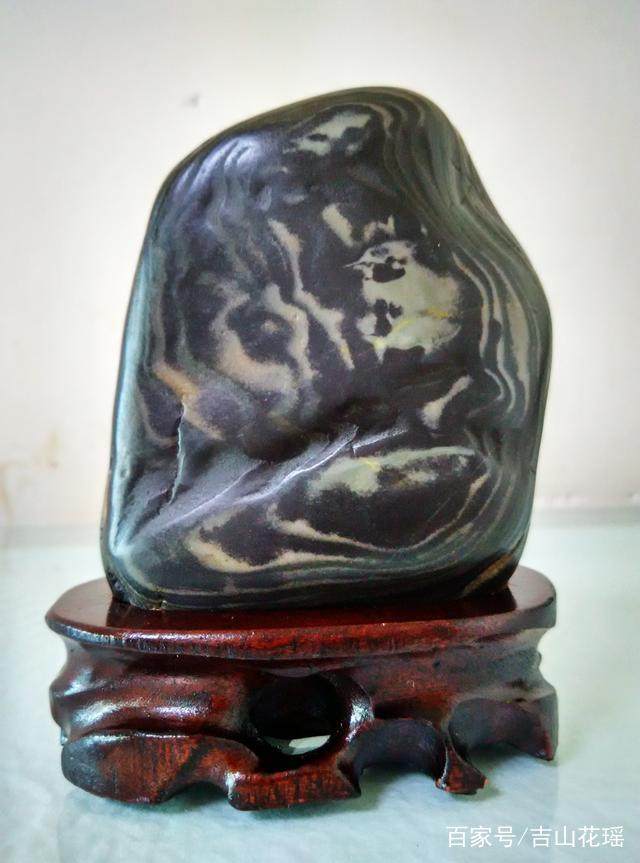
Due to differences in chemical composition and geographical region, rocks subjected to weathering will form surface wrinkles or hidden internal patterns, such as the wrinkles of Yingde stone, the smoothness of Yuhua stone, and the veins of Yellow River stone. Among these, some rocks even have naturally occurring wonderful contents such as landscapes, flowers and birds, figures, and characters, and these are all precious collectibles.
5. Charm
Some rocks are rich in charm. For example, among Taihu stones, ringing copper stones produce a gong-like sound when struck; Lingbi stones have a metallic lingering resonance when stroked; drifting stones float on the water surface yet are hard and smooth; and sounding stones have a sand sound or water sound inside when the stone body is shaken. Some of these rocks have nothing extraordinary in outward appearance, yet they have individuality and full charm.
6. Quality
Quality is a condition widely admired today. The harder the quality, the better, and the closer it can come to gem grade. This is the reason why dry, rough stones are inferior and smooth, moist stones are good. For example, petrified wood with a high silicon dioxide content (wind-eroded petrified wood from Xinjiang and Inner Mongolia), wind-eroded stones, and Guangxi's Dahua stones have excellent appearance, texture, and feel. It is very difficult to change them by physical or chemical methods. They have an original, authentic flavor and are what the stone appreciation world pursues.