Are Tamarisk and "Guai Liu" the Same Plant? Explained Clearly in One Article
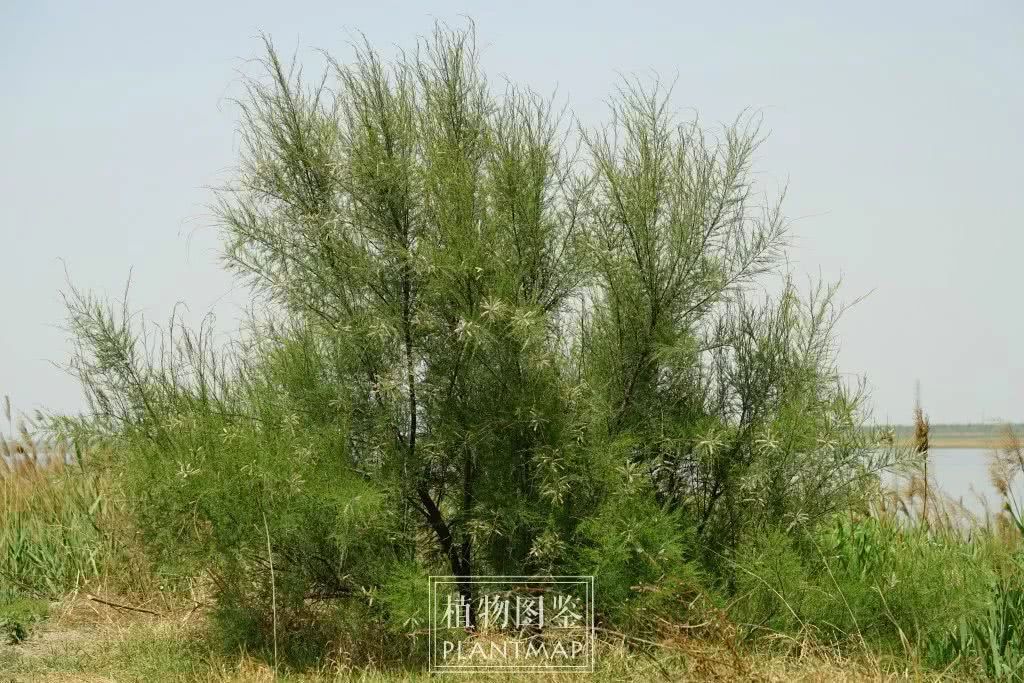
Tamarisk: most people seeing this name for the first time will take it for "guai liu" (strange willow), but in fact the character has the wood radical and is pronounced "cheng".
[Tamarix chinensis] Tamaricaceae >> Tamarix
Calling it strange is not wrong either. Overall, the tree shape of the tamarisk really does resemble the weeping willow, with dense, slender, drooping branches, but its leaves are more like those of a cypress or a pond cypress. The fine, dense leaves cover all the branches and trunks of the tamarisk, looking fuzzy, and also like a clump of algae in the sea.
The distribution of the tamarisk is also rather special; it loves to grow in all kinds of harsh environments, such as coastal saline-alkali land and desert wasteland.
Several saline-alkali wetlands in Tianjin are covered with tamarisk. In early May, when the tamarisk first sprouts, the originally dark and bare branches quickly turn green, becoming fuzzy within just a few days. Most northern plants are like this: after the long dormancy of winter, the spring burst also seems extremely rapid.
We can easily spot the pink among the fuzz - that is the flowering branches of the tamarisk.
When the tamarisk blooms, it too is fuzzy; many racemes emerge from the tips of the old branches, and the flowers are small and dense, weighing the branches down low. The flowers of the tamarisk are very small; even with a magnifying glass it is hard to see them clearly. One can vaguely make out that most of its flowers have 5 petals, each flower has 5 stamens, and a three-lobed stigma.
A tamarisk growing in barren land may struggle to put on a grand floral display, but the tamarisk bloom I saw in Beijing city could be called spectacular. The whole tree was draped with drooping flowering branches, like a grand fireworks display.
The tamarisk's performance is not limited to spring. In summer and autumn, the tamarisk continues to bloom. Therefore it also has another name, "three-spring willow". The tamarisk flowers of summer and autumn are different from those of spring. The inflorescences that bloom in spring are thick and short with large flowers, while those that bloom in summer and autumn are slender, and the flowers on the inflorescences are somewhat smaller, making the whole tree look lush with green leaves and sparse red flowers.
Photographed at the Old Summer Palace in October last year
Because of the tamarisk's good ornamental effect, quite a few tamarisks have already appeared in northern cities, used for landscaping or as garden flowering trees, and some southern cities have also tried introducing it.
Besides the species Tamarix chinensis, our country has about 18 species of Tamarix plants, mostly distributed in the northwest, Inner Mongolia and north China.
[1] The desert-common short-spike tamarisk, image by Юрий Константинович Пирогов
I also saw a tamarisk in the Old Town of Lijiang, incomparably tall, only I do not know which species it was.
[1] Author: Юрий Константинович Пирогов
Source: http://www.plantarium.ru/page/image/id/62546.html
Author: Jiang Mouren
Images: Jiang Mouren (unless otherwise noted)
This work is licensed under the (CC BY-NC-ND 4.0) license agreement; please retain this statement when reposting.
iPhone users can tip the author via the QR code below