No Need to Worry About Succulents in Summer: 6 Easy-to-Grow and Beautiful Heat-Tolerant Varieties Recommended
As temperatures rise higher and higher, summer is drawing nearer and nearer. At the thought of those scorching summer days, not only do people feel listless, but succulents do too. For the vast majority of succulents, summer is a "nightmare" of an existence, and with the slightest carelessness they will die in this summer. However, there are always some succulents that are the exception; for these succulents, summer is not torture but a kind of trial, and as long as they are cared for properly, they remain stunningly beautiful, getting through summer as easily as playing. So, which succulents get through summer easily? Below we introduce some succulents suitable for getting through summer, beautiful yet not delicate, with no pressure getting through summer! Let's take a look!
Echeveria glauca
I. Echeveria glauca
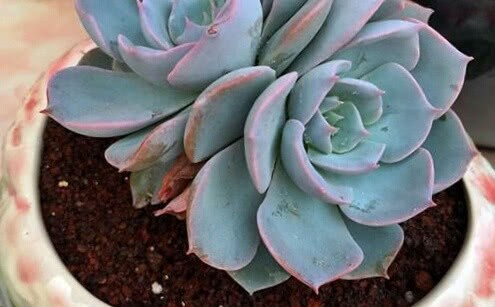
Echeveria glauca fully deserves to be called one of the most rampant succulents in summer; even grown outdoors it has no trouble getting through summer, and it is not only easy to grow but also very beautiful. Friends who dread getting through summer can rest assured that growing a pot of Echeveria glauca will do the trick. In the care of Echeveria glauca, the care and management of Echeveria is actually very simple: repot in early spring each year, and clean away shriveled dead leaves and excess offsets. For potting soil, use peat soil or leaf mold with coarse sand that drains well. During the growing period, a dry environment is preferable, and there is no need to water much. If the potting soil is too wet, the stems and leaves tend to grow leggy, and the ornamental period is shortened instead. Especially in winter under low-temperature conditions, too much water makes the roots prone to rot, turning the plant into one without roots. In the high heat of midsummer, it is also not advisable to water much; a little misting is fine, and never let it be drenched by sudden showers. During the growing period, fertilize once a month to keep the leaves fresh and green. But too much fertilizer will also cause the branches, stems and leaves to grow leggy. For Echeveria over 2-3 years old, as the plant tends to age, new seedlings should be cultivated and renewed in time. Also, the roots should still not be exposed; add a bit more soil to cover them, and occasionally watering with rice-washing water is quite good.
Graptosedum 'Francesco Baldi'
II. Graptosedum 'Francesco Baldi'
Graptosedum 'Francesco Baldi' is similar to Echeveria glauca, and is also a succulent with no trouble getting through summer when grown outdoors. It may even burst out with many pups after a summer, giving you a surprise. In the care of Graptosedum 'Francesco Baldi', it rots very easily in an overly humid environment, so never water too much. To avoid water accumulating at the roots, it is best to choose a pot with drainage holes at the bottom; beginners can choose a well-breathing terracotta pot (though this may affect how plump the leaves are). Glass containers absorb heat and have poor breathability, so use them with caution. Usually water about once every 10 days, watering thoroughly each time, and adjust the watering frequency up or down as appropriate according to the climate differences of different regions and seasons.
Echeveria 'Huth's Pink' (First Love)
III. Echeveria 'Huth's Pink' (First Love)
The lovely pink First Love can keep its pink hue even in summer, with no pressure getting through summer! In the care of First Love, this succulent needs sufficient sunlight so that the leaf color becomes vivid and the plant form becomes more compact and beautiful, and the leaves become thick and plump. Too little sunlight makes it grow leggy: the leaf color becomes pale, the leaves are loosely arranged, the spacing between leaves stretches out and becomes long, and the leaves become thin. Aside from paying attention to proper shading in summer, it can have full sun in all other seasons. First Love is generally watered only after the soil has dried out; although the leaves do not easily get water on them and lose their powdery coating, if water lingers too long in the leaf center, it easily causes rot. In addition, First Love is a small-to-medium-sized plant, and as it grows it must be repotted once every 1-2 years; the pot diameter can be 1-2 cun larger than the plant diameter, which promotes the plant's growth.
Pachyveria 'Clavifolia' (Frosty Dawn)
IV. Pachyveria 'Clavifolia' (Frosty Dawn)
When speaking of beautiful succulents that get through summer easily, Frosty Dawn is naturally indispensable. Its leaves look as if thickly coated in frost and brightly painted, and it withstands the summer heat, keeping a beautiful state even in summer, making it an indispensable choice. In the care of Frosty Dawn, as said before, the more sufficient the light and the greater the temperature difference between day and night, the more vivid and lustrous the leaf color. When the temperature is suitable, it is best to place it outdoors for care to ensure sufficient light. In addition, because the plant has a high internal water content, Frosty Dawn rots easily in an overly humid environment. Never water too much; to avoid water accumulating at the roots, it is best to choose a pot with drainage holes at the bottom; beginners can choose a well-breathing terracotta pot; glass containers absorb heat and have poor breathability, so use them with caution. When temperatures are too high (above 35°C) or too low (below 5°C) in winter and summer, the plant stops growing; at this time, watering should be temporarily reduced or stopped, and the watering frequency resumed once the temperature is suitable.
Echeveria runyonii 'Topsy Turvy'
V. Echeveria runyonii 'Topsy Turvy'
With its curled leaves, Echeveria runyonii 'Topsy Turvy' has unique ornamental value and is a very good succulent; moreover, it easily bursts out pups from the bottom, and summer is no pressure either. In the care of Echeveria runyonii 'Topsy Turvy', the more sufficient the light and the greater the temperature difference between day and night, the more vivid its leaf color. When the temperature permits, it is best to place it outdoors for care to ensure sufficient light. The plant itself has a very high water content, and heavy watering easily leads to rot; it is recommended to water about once every 10 days, watering thoroughly when dry. Adjust appropriately according to climatic conditions. Echeveria runyonii 'Topsy Turvy' should not be fertilized too much, especially with nitrogen fertilizer. Applying a thin fertilizer mainly of phosphorus and potassium once a month is appropriate.
Graptoveria 'Silver Star'
VI. Graptoveria 'Silver Star'
With red leaf-tip points, beautiful as starlight, it is a very easy-to-grow succulent. But note that sometimes when it has just been brought over from a greenhouse, do not give it too strong light all at once, as it easily gets sunburn spots; once it has adapted, there is no problem with any amount of sun. In the care of Silver Star, it likes plenty of sunshine. In summer's high temperatures the plant goes briefly dormant, and at this time it should be properly shaded. Spring, autumn and early summer are the plant's main growing periods, when sufficient light can be given. Watering Silver Star follows the principle of watering thoroughly when dry: water thoroughly only when dry, and do not water when not dry. In summer, water less or not at all. In winter, never mist or give large amounts of water. During the spring and autumn growing periods, water thoroughly when dry, keeping it appropriately dry is enough, and it can be watered once a week. In addition, when watering in winter, do not pour water into the leaf center, as it easily causes leaf rot, though the leaves can be cleaned at ordinary times.