How to Grow Red Edges on Succulents? A Full Guide to Care Techniques
Text
Image: This Girl Is a Bit Sweet
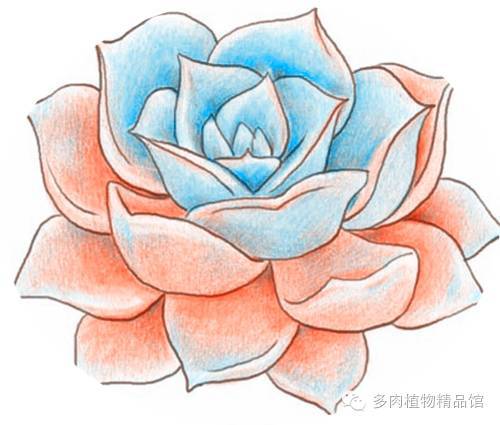
Whether a succulent can develop red edges depends on its variety. Some Sedum plants cannot develop red edges, but most Sedum plants have colorfully variegated leaf colors, ranging from dark red, brown, blue and purple to even black. This is caused by the plant producing different pigments in response to its environment, such as "beta-anthocyanin" and "anthocyanin."
To grow red edges, two important factors are involved:
1. Light
When caring for succulents normally, the light must be sufficient. These pigments can be produced along with photosynthesis, but sometimes certain pigments can only be produced through prolonged exposure to strong light, especially light sources that contain blue light and ultraviolet components shining on the plant, which forces it to produce such pigments. With prolonged exposure to strong light, the succulent will "change color" and naturally grow red edges. Therefore, to make Sedum plants grow red edges, the most important condition is that the light must be sufficient. However, in some areas, due to the objective living environment, this condition can sometimes be hard to come by.
2. Use artificial ultraviolet light
I believe many succulent lovers worry that there is not enough light at home, ultimately causing some succulents to become leggy and some to die, especially Crassulaceae plants, which themselves have a very high demand for light. So if the light conditions at home are not very good, it is indeed very difficult to produce colorfully variegated leaf effects and red edge effects. If the light conditions at home are not very good, artificial ultraviolet light sources can be used for supplemental lighting, but the effect is not as good as sunlight. Even artificial UV-simulating radiation lamps cannot completely replace the full-spectrum ultraviolet light of the sun, and this approach consumes a lot of electricity. Moreover, proper plant supplemental lamps and grow lights on the market are very expensive, and many cheap imitation products bought online have greatly reduced effects, or many of them are simply useless.
Sunlight is still better: it saves money, trouble and effort. Although artificial ultraviolet light sources can be used for supplemental lighting, they still cannot completely replace sunlight. The issue of balcony orientation itself cannot be solved unless you move. So if you have a south-facing balcony, terrace or yard, you are one step closer to growing them well. To give succulents red edges, the main thing is that the light must be sufficient.
How should supplemental lamps be chosen?
There are many plant supplemental lamps on the market. You can choose plant supplemental lamps/grow lights that contain red light, blue light, or a relatively fuller spectrum. If you want to both add warmth and supplement light in winter, you can choose UVA and UVB radiation lamps specially made for reptiles, but the irradiation distance should not be too close, because their other important function is heating, and the surface temperature of the lamp tube is very high. Close-range irradiation will scorch the plant. In addition, incandescent lamps are not of much use; they mainly emit yellow-white light and a large amount of infrared rays. Although they are very cheap and easy to obtain, their electro-optical conversion efficiency is very low, so they are not suitable for plant supplemental lighting. If a plant receives this kind of light for a long time, it will become thin and weak. Therefore, plants like Crassulaceae that have an extremely high demand for sunlight are certainly not suitable for care in an indoor incandescent lamp environment. Even if they do not die, their condition will certainly not be good. So many people worry that without sunlight they cannot grow Sedum well, and that is indeed the case. Sedum and sunlight are inseparable.
Direct sunlight is best (outdoors, terrace, south-facing balcony).
Growing them in a place with bright indirect light (near a window in a non-south-facing balcony) is actually nothing to worry about. At most, there will just be no brightly colored pigment effect, only lush green.
But if they are grown in a medium-light environment (a bright indoor spot), they are very likely to become leggy and develop a "snake waist."
If they are kept for a long time in a low-light environment (indoors far from a light source), they will definitely die.
The above environments are actually a ladder of states for Sedum plants. Choosing a different environment for them is actually just choosing what kind of state you want them to present to you. Besides being related to light, the red edges of succulents are also greatly related to temperature differences, so do not blindly make succulents take a sauna in hot weather just for red edges.
In addition, succulents such as Haworthia have much lower light requirements than Crassulaceae. They
do not need direct sunlight all day, and are more suitable for care in an indoor environment with bright indirect light. This is the difference in habits between different families and genera. "Succulents" include countless different families and genera, and their habits are all different, as are their needs. You cannot apply formulas from mathematics to them.
If succulent lovers really do not have good sunlight conditions and hardware conditions, they might as well try growing more shade-tolerant plants, such as Haworthia, some Aizoaceae and some Liliaceae succulents.
This article was compiled by the Succulent Boutique Hall. The copyright belongs to the original author. For some articles, the source cannot be identified and they are marked as sourced from the internet. If there is any infringement, please contact us immediately and we will handle it promptly.