Why are bonsai and garden art born of the same origin and mutually reinforcing?
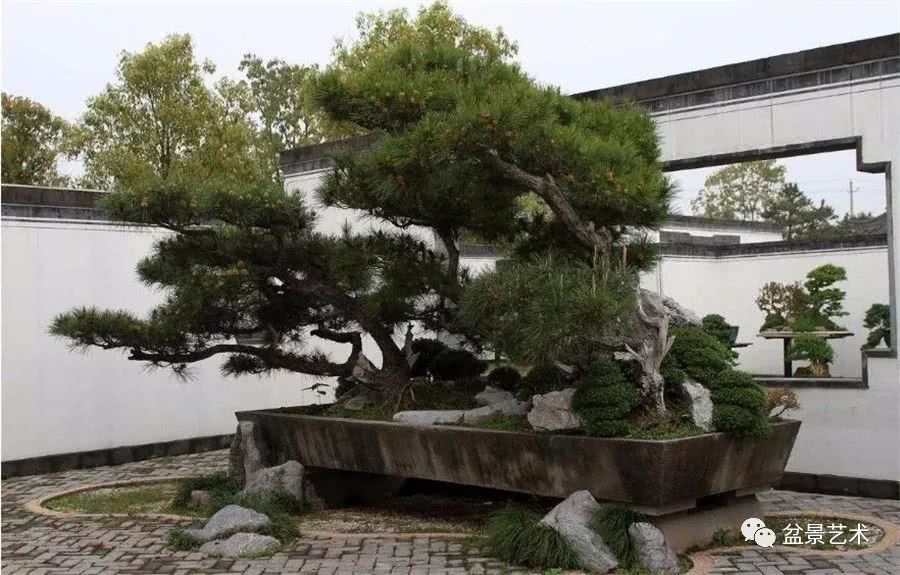
The aesthetic characteristic of Chinese bonsai art is that the great is contained within the small, that is, famous mountains and great rivers or ancient trees and rare flowers are all gathered into a single pot, using artistic expression techniques to convey nature through the mind. It emphasizes using the solid to set off the void, the combination of void and solid, and stresses layers and depth of scenery, in order to achieve the artistic realm of "seeking elegance and rising above the commonplace." "Try looking beyond the three misty rain peaks, they are all within a single palm of the immortal"; "Do not worry that the five ridges lie beyond a thousand peaks, Jiuhua is now within a single pot"; "One only sees the jade peak lying across Taibai, and then cuts off Emei by the bird path" - these lines from ancient poets all praise the mountain and river scenery expressed in bonsai. Bonsai is a formative art formed by the blending and combination of poetry, painting, horticulture, aesthetics, sculpture, pottery making, and other disciplines and crafts. Bonsai is a living, growing miniature garden, and this point distinguishes it from other works of art. It is a work of art formed by the combination of emotion and nature through human conception and operation, and the artistic beauty of the unity of opposites that it embodies is basically consistent with garden aesthetics.
Bonsai and gardens are born of the same origin and mutually reinforcing
Bonsai art, like gardens, has a long history and a distant source. As for the era of bonsai's origin, some say it appeared in the Wei and Jin dynasties, some say it appeared in the Yin and Zhou dynasties, and others say it appeared in the Neolithic Age 6,000 years ago; opinions vary and there is still no definitive conclusion. In sharp contrast to the endless debate over the era of bonsai's origin, people's opinions on the era of bonsai's formation are basically consistent. The vast majority of people believe that bonsai was formed in the Tang Dynasty, and it developed along with social, economic, and cultural development. After a long embryonic period, during the Wei, Jin, and Northern and Southern Dynasties, the rise of landscape painting and landscape poetry as well as rockery gardening greatly promoted the formation of bonsai art. Tang Dynasty society was highly developed, and culture and art flourished, creating the necessary conditions for the formation and development of bonsai art. Bonsai and gardens are a pair of twin arts, and bonsai is also the earliest originating model of Chinese gardens. Mr. Qian Xuesen divided Chinese gardens into 4 levels, namely bonsai, window scenery, courtyard gardens, and palace gardens, which shows that bonsai and gardens are born of the same origin and mutually reinforcing.
The constituent elements of Chinese bonsai include plants, mountain stones, pavilions, towers, small bridges, ancient pagodas, and figures, expressing mountain and water scenery, village houses and fishing hamlets, mountain scenes, and so on. Bonsai is divided into plant bonsai, landscape bonsai, and conceptual bonsai. The appreciation of plants in bonsai occupies the main aspect. By using the artistic expressive means of seeing the great in the small, and through shaping techniques such as sawing and cutting, carving, and grafting, it recreates in a pot only a foot across the artistic work of nature's strange stones, old trees, and the wild charm of mountain forests. In traditional Chinese garden landscapes, there are likewise mountains, water, architecture, and plants, but in gardens, the spatial experience is more distinctive. Comparing bonsai and gardens, what the two have in common is that both have
the essence of "the Dao follows nature"; the difference is that bonsai is focused scenery appreciation, while gardens are scattered-point scenery appreciation.
It interprets the meaning of bonsai and gardens being born of the same origin and mutually reinforcing, and holds that bonsai is the artistic product of combining garden landscapes, that gardens are the model for bonsai, and that bonsai is the small sample of gardens. It discusses the aesthetic thought of bonsai and gardens, analyzes the principles of formal beauty of bonsai and gardens, and summarizes the landscape art techniques of bonsai and gardens from the aspects of theme and conception, layout and composition, change and unity, primary and secondary and balance, and pointing out the theme and inscribing poems.