Detailed Explanation of the Production Methods and Techniques for Holly Bonsai
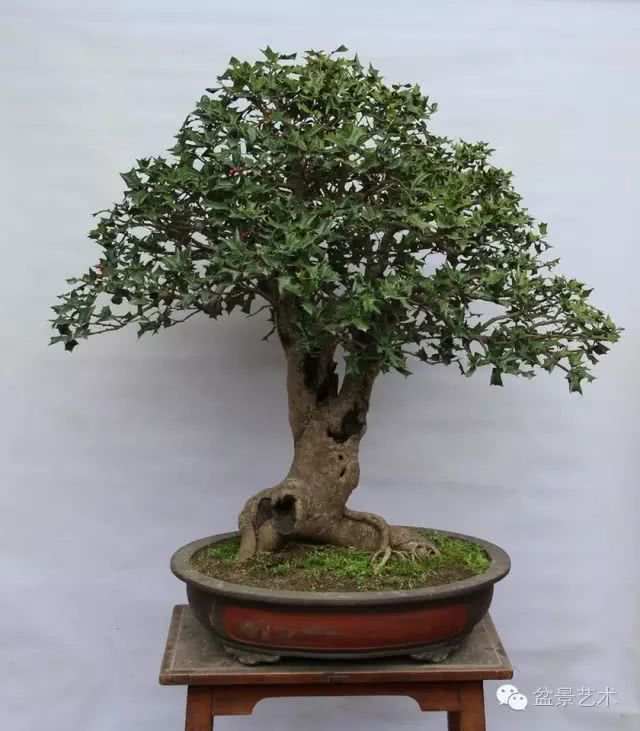
(1) Material selection
The tree material for holly is mainly sourced from seed propagation, but cutting or division propagation can also be used; wild collection can also be supplemented. Seed propagation is often carried out from March to April, with a sowing depth of 2 to 3 cm, and a row spacing of 15 to 20 cm for drilling. After sowing, cover with grass or a grass curtain, and germination and emergence will occur in about 20 to 25 days. After emergence, remove the grass and set up a shade shed, then enter normal seedbed management - watering, fertilizing, weeding, etc., and transplant and divide after 2 to 3 years. Cuttings are often taken during the plum rain season, using semi-lignified branches of the current year as cuttings, 10 to 15 cm long, retaining 4 to 6 leaves, inserted to a depth of 1/2 to 2/3 of the cutting. After insertion, shade them and keep the soil moist; they will root in about 60 days. After staying in the bed for 1 to 2 years, transplant in spring. Root division propagation can also be carried out by digging up the roots. Along mountain ditches in the middle and lower reaches of the Yangtze River, there are often some wild old stumps. After digging them back, trim the main roots, carefully cultivate the material, and then pot and process it, which can quickly produce a simple and elegant foliage bonsai.
(2) Potting
Pot selection: Glazed pottery or purple clay pottery pots are often used for making holly bonsai, and carved stone pots can also be used; the pot color can be purple, blue, light yellow, or gray-brown; dark green should not be used, because it is similar to the leaf color and cannot provide contrast through color difference. Pot shapes are preferably rectangular, square, waist-round, or drum-round.
Soil: Holly is suitable for fertile, loose, well-drained, slightly acidic soil. The potting soil can be made from leaf mold, garden soil, and sand.
Planting: Transplanting is often carried out after autumn or before spring germination. Because holly has fewer main roots and well-developed lateral roots, it should be transplanted with a soil ball to protect the fibrous roots. At the same time, properly prune the branches and leaves on the upper part of the pot.
(3) Styling
Holly branches and trunks are hard and brittle, so processing is usually carried out during the plum rain season, when sap flow is vigorous. Because its leaves are large and hard, brown silk binding is generally preferred, and metal wire binding should not be used, otherwise branches and leaves are easily broken or damaged. Holly leaves are hard and have sharp spines. During styling, unnecessary branches and leaves can be cut off first, and the remaining branches and trunks can be bound and pruned. The tree shape of holly can be made into upright trunk style, slanting trunk style, curved trunk style, and cliff style, etc. Small bonsai are best in natural style, while large bonsai can have branches and leaves bound into cloud-layer shapes, and old stump specimens can appear with the beautiful postures of exposed-root style and twisted-trunk style.