Hidden in the mountains is a treasure that is half insect pupa and half flower, with nutrition comparable to Chinese caterpillar fungus
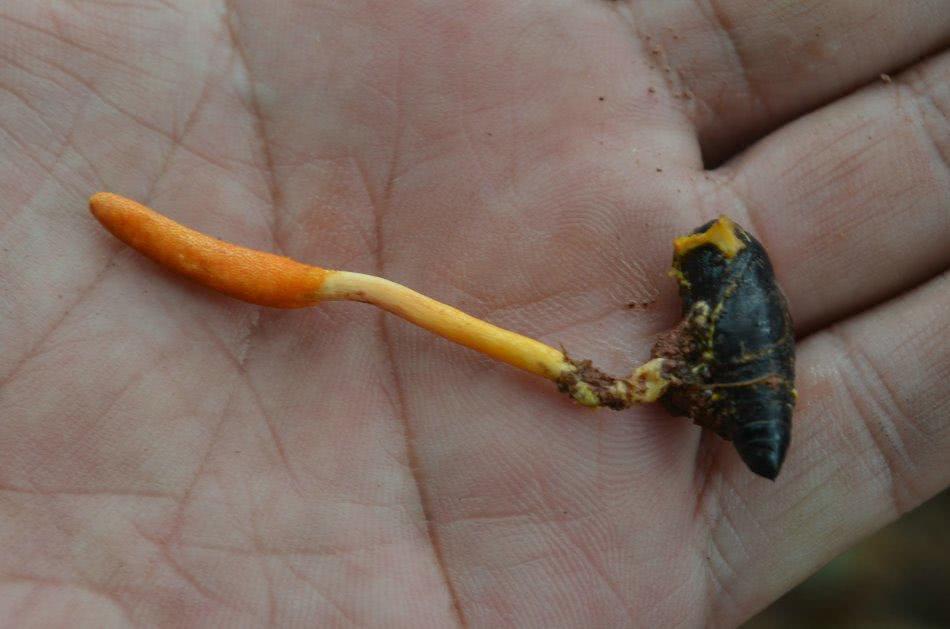
Our country has a vast territory and numerous mountain ranges. In some remote mountains rarely visited by people, many little-known treasures are hidden. In the late 1950s, people first discovered in Jilin City, China, a kind of "grass" that seemed neither animal nor plant. Its underground part was an insect pupa, and its aboveground part was an orange-yellow flower, meaning half was insect pupa and half was flower, very unique. Later, after identification, it was found that this "grass" was a kind of cordyceps, similar to Chinese caterpillar fungus, so it was named "Cordyceps militaris." To distinguish it from Chinese caterpillar fungus, people also call it "northern cordyceps."
The formation of northern cordyceps is similar to that of Chinese caterpillar fungus. Both are a kind of fungus that grows after mycelium invades the young body of an insect and absorbs the insect's nutrients. The difference is that the mycelium of Chinese caterpillar fungus invades the larvae of the cordyceps bat moth, while the mycelium of northern cordyceps invades the pupae of Lepidoptera insects. Chinese caterpillar fungus currently has almost no artificially cultivated form, while northern cordyceps is now mostly artificially cultivated, which is an advantage over Chinese caterpillar fungus. So its price is somewhat cheaper, but it is only cheap relative to Chinese caterpillar fungus. For ordinary people, it is still quite expensive, with a price of around 1,000 yuan per jin.
There is also a reason northern cordyceps can sell for such a high price on the market. It contains cordycepin and cordyceps polysaccharides, has relatively good health benefits, can enhance human immunity, improve disease resistance, and has adjunctive therapeutic effects on many chronic diseases in humans, with medicinal effects comparable to cordyceps. Moreover, because artificially cultivated Cordyceps militaris has better cultivation conditions than the wild natural environment, its quality is very high, and its content of protein, amino acids, vitamins, and other nutrients can rival Chinese caterpillar fungus. It is also a very popular medicinal and edible tonic on the market.
The usual way to consume northern cordyceps is to soak it in water and drink it. After soaking, the water takes on a bright yellow color. If it is fake, it is generally rather cloudy. However, the insect body of northern cordyceps is relatively large, and many people cannot accept its appearance, so they also choose to grind it into powder and soak that in water. It can also be used to make infused liquor, stew soup, and so on, and has certain dietary therapeutic effects. Traditional Chinese medicine believes that cordyceps can tonify kidney yang and also nourish lung yin, balance the body's yin and yang, and regulate the body, making it a top-grade Chinese medicine.
Dear readers, do you recognize this peculiar northern cordyceps?