What is the charm of Sempervivum that makes her, a succulent grower of 8 years, so devoted to them?
BGM: Hikoshi Hashimoto - Randall
Editor's note:
Jasmin Ya Jian De Henis a very special succulent enthusiast. She keeps cats and dogs, and when it comes to succulents she takes an unconventional path. Although she also has plump Echeveria succulents, she is more devoted to Sempervivum - those unique characters.
Let's hear her story~
Thanks to the author [Jasmin Ya Jian De Hen] for the original authorized sharing
Edited and compiled by: Succulent Lover
Location: Switzerland
I had always been growing succulents in the Crassulaceae or Cactaceae families. So far I have been growing them for about 7 or 8 years, and have collected several hundred varieties over time.
I started collecting Sempervivum along the way. Currently, according to an incomplete count at home,I have nearly 200 species of Sempervivum。
At first I was not into Sempervivum at all. Perhaps because most of my succulent knowledge came from within China, and back then during the domestic succulent boom, Sempervivum was almost a blank slate - no literature, no photos, and no growers specializing in Sempervivum.
Our understanding of Sempervivum only went as far as varieties like Guanyin Lotus, Juanjuan, and Cobweb, all either green and glossy or dark and dull.
Guanyin Lotus: truly green and glossy
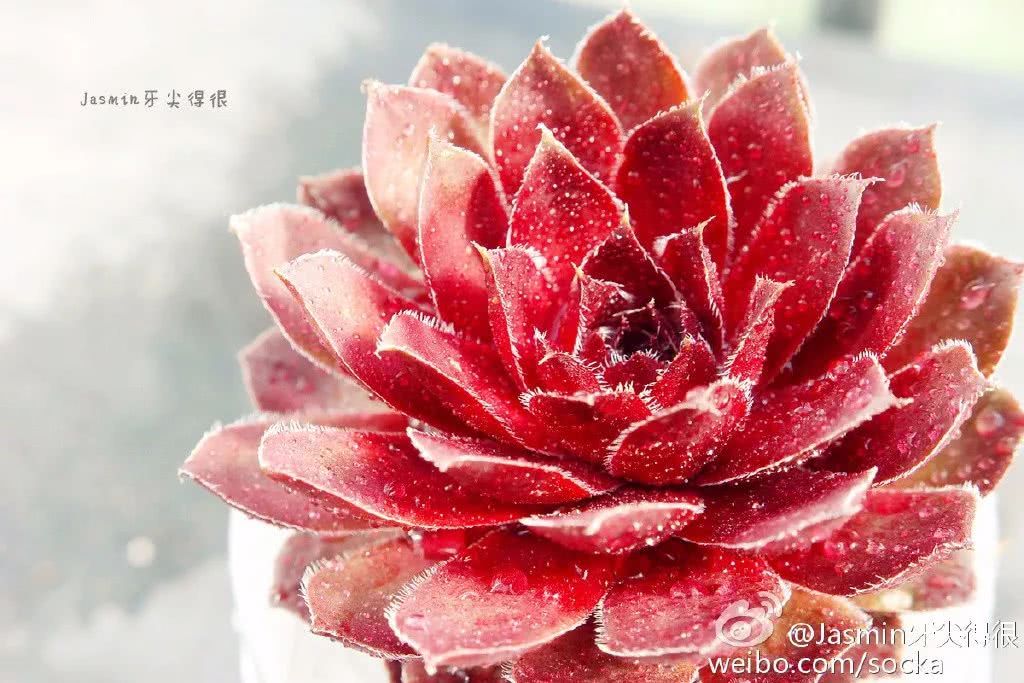
If you think Sempervivum are all those dark green plants, you are very much mistaken~
Sempervivum is a separate genus under Crassulaceae, called Sempervivum or Houseleek.
This family is native to Eurasia. Many wild Sempervivum species have been found on various mountain ranges, and currently most are concentrated in Europe. The domestic market is poor.
The literal meaning of the scientific name Sempervivum is - eternal, everlasting flower. Indeed, the plants of this familypossess extremely tenacious vitality, growing year-round on plateaus, in rock crevices, on stony ground... anywhere you can think of,utterly barrenplaces!
Now let me share my personal planting and care experience~
-Soil-
Sempervivum can adapt to almost any soil, various granular stones, gravel, horticultural humus soil, and they do not even need soil - drop a honeycomb stone, dig a hole, stuff them in and they will still grow.
Super tenacious vitality, right!
But to grow them well, you still need to differentiate:
1. Northeastern regions, western regions: horticultural soil : granules : gravel ratio = 1:2:1, with ceramsite at the bottom of the pot for separation.
2. Southern regions: horticultural soil : granules : gravel = 1:3:1
-Characteristics-
Not heat-tolerant, so in the hot and humid southern regions summer is quite dangerous. Chongqing? Sichuan? Amitabha (what isn't dangerous to grow in southern summers, seriously)
Really afraid of heat
Super cold-hardy (can tolerate lows of minus 25!)
Very suitable for outdoor growing! (except southern summers)
Super prolific at producing pups (No. 1 at making babies)
-Pot selection-
In cheat-mode regions (northwestern regions) anything goes,
In the south, shallower ceramic pots are recommended.
For the advanced version you can use coarse ceramic, or red clay painted,
compared with plain unglazed ceramic potsslightly more water-retentive。
painted ceramic pots
Taboos:
Avoid plastic foam pots, very deep pots, overly deep saucers, and anything that blocks drainage and heat dissipation at the roots
-Watering-
Coarse ceramic or small plastic potsonce every 10-15 days,
For larger sizes, once a month.
German small black square pots
When the temperature is above 30 degrees or below 10 degrees,
watering frequency should be reduced or even cut off entirely.
A few more words: many people misunderstand Sempervivum, thinking that if grown poorly they stay green forever. In fact, many Sempervivum are colorful all year round and will not lose their color~
PS: Jasmin the master's Sempervivum are basically not available for sale in China (basically only seeds), so the names above are all in Latin and are not labeled.
- Review of last issue's highlights -