Dig up a wildflower from the field and take it home, and it is a hundred times more beautiful than a bought flower.
Recently I looked at some old photos: the stringy stonecrop in the yard back home was in full bloom, and it was so beautiful. Huahua grew up in the countryside and has seen many wildflowers and wild grasses, and many of them are actually very beautiful, no worse than the flowers in the flower market. Surely among flower lovers there are also many who know a thing or two about wildflowers and wild grasses. Collect a few and plant them in pots or in the yard, and they actually look very good too!
“
Wildflowers and wild grasses
”
Good friends in the yard
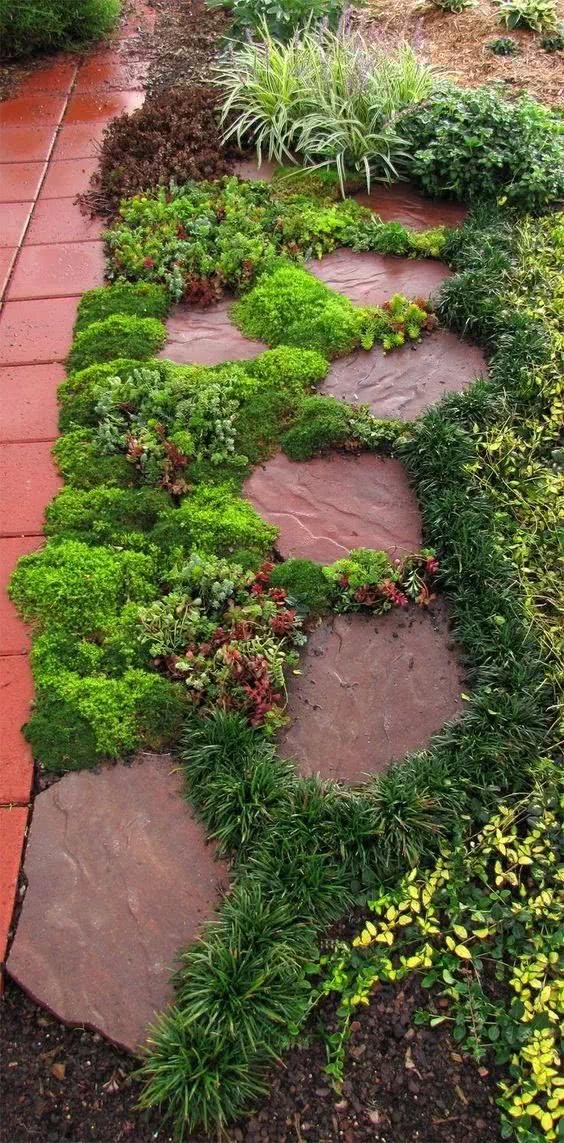
Some little wildflowers and wild grasses look unremarkable out in the wild, but if you have a yard, you might as well plant a few among the flower beds and along the paths; they are especially pleasing to the eye. Most of them are soft in texture, like a green velvet carpet. They bloom with small white flowers and yellow flowers, bright and glossy in color, like pearls scattered on the ground; in early autumn they sometimes turn red, and the garden path comes alive, and the whole garden becomes bright and colorful because of it.
Persian speedwell
Persian speedwell is a common wild grass in the south, often seen in fields. Planted together and blooming with small blue flowers, it is quite beautiful too.
(Huaba H101588)
Stringy stonecrop
Stringy stonecrop is a perennial herbaceous succulent plant in the genus Sedum of the family Crassulaceae. In many places in both the north and the south, you can see it growing wild in patches. Stringy stonecrop is also a traditional Chinese medicine, with effects of draining dampness and reducing jaundice, and clearing heat and detoxifying. It also clears damp-heat. Some flower lovers also plant it in the yard or on the roof for greening, and it is also the kind that spreads into a whole patch once tossed down.
Stringy stonecrop has a fluffy texture and blooms with pale yellow small flowers that shimmer with a golden glow in the sunlight. It likes a warm, humid, semi-shaded environment, has strong adaptability, is relatively drought-tolerant and cold-tolerant, is not picky about soil, and grows better in loose sandy loam. It is not strict about light, is generally suitable for growing under medium light conditions, and also tolerates weak light. The optimum growth temperature is 15-25°C, and the overwintering temperature is 5°C.
Thyme
The whole thyme plant has a fragrant scent. Very early on it appeared in people's lives as a spice vegetable and honey-source plant, and it is one of the natural seasoning spices that humans have used from ancient times to the present.
As early as the Yuan Dynasty, China had records of using thyme as a seasoning spice. When cooking seafood, meat, fish and other foods, a little thyme powder can be added to remove fishiness and increase the flavor of the dish.
Thyme plants are relatively low and generally grow along the ground surface. Thyme has abundant flowers, a long flowering period, and plants that grow in clusters and carry fragrance, so many households use it as a ground cover plant, and it is also the most common garden herb plant in the West. It can also be potted and placed indoors to purify and fragrance the air, create a indoor environment, and for ornamental purposes.
Lysimachia nummularia 'Aurea'
Lysimachia nummularia 'Aurea' belongs to the Primulaceae family and is a perennial herbaceous creeping plant, also known as loosestrife. Its beautiful yellow-green leaves gradually deepen in color in winter and are especially beautiful.
Baby's tears
Baby's tears is an ideal plant for the base color of potted flowers, and remains evergreen all year round under frost-free climate conditions. Baby's tears has emerald-green, crystalline leaves, small and exquisite, with round, inverted soft-shaped leaf forms, as lovable as a baby's tears.
Baby's tears is not only often used in rockeries or courtyards; more and more designers use baby's tears for plant walls. Its form is graceful, the leaves are small and delicate, and the effect is very good.
Besides these small flowers and grasses, there are also some larger wildflowers that are very beautiful too. Besides planting them in the yard, they are also very beautiful as individual potted plants.
Viola philippica
Viola philippica is also known as wild violet, smooth-petaled violet, and so on. It belongs to the Violaceae family and is a perennial herb. The flowers are medium-sized, violet-purple or pale purple, rarely white, with the throat lighter in color and bearing purple stripes. The flowering period is early and concentrated, the growth is neat, and the plant clumps are compact, making it easy to replace and transplant for arrangements, so it is suitable for use in flower beds or in the composition of early spring carpet flower beds.
Viola philippica is suitable as a flower border or to form flower clusters with other early spring flowers. It can also be used for indoor arrangements such as windowsills, desks, and stands, and can also be made into bonsai.
Viola philippica likes light and humid environments, tolerates shade and cold, is not picky about soil, has extremely strong adaptability, is easy to propagate, and can be directly sown. It generally sprouts in early March, blooms from mid-March to mid-May, with the full bloom period lasting about 25 days, a single flower lasting 6 days, and 30 days from flowering to seed maturity. From April to mid-May there are a large number of cleistogamous flowers that can form a large number of seeds, and in late September a small number of flowers appear again.
(Huaba H101588)
Iris
Also called butterfly flower, it grows on shaded and humid hillside grasslands, under sparse forests, or in forest-edge grasslands. It is distributed in China and Japan. It is a folk herbal medicine, used to clear heat and detoxify, dissolve stasis and expel water, and to treat fever in children, coughing blood from lung disease, sore throat, traumatic blood stasis, and so on. It has relatively high horticultural value.
(19Lou Forum Irene_6)
Iris speculatrix is a plant in the genus Iris of the family Iridaceae, and is endemic to China. Its rhizome is used for food stagnation and abdominal distension, abdominal masses and accumulations, traumatic injuries, hemorrhoids and fistula, and carbuncles and sores. As a flower, it has the characteristics of beautiful leaf color and upright flower stems, and can be used in flower groups, flower clusters, and flower borders.
(19Lou Forum Irene_6)
Iris ruthenica var. nana is a variety of Iris ruthenica in the genus Iris of the family Iridaceae, also known as purple stone iris. It is cultivated for ornamental purposes and is a common garden ornamental flower.
Iris lactea is a perennial herbaceous rhizomatous plant in the genus Iris of the family Iridaceae, a variety of Iris lactea var. chinensis, and a perennial densely clumping herb. Its rhizomes and leaves are robust, and its fibrous roots are dense and well developed, with a length that can reach more than 1 m, distributed in an umbrella shape.
Iris likes humid but well-drained sandy loam or light clay rich in humus, and has a certain tolerance to salinity and alkalinity. It can grow normally in mildly saline-alkaline soil with a pH value of 8.7 and a salt content of 0.2%. It likes light and is also relatively shade-tolerant, and can grow normally in a semi-shaded environment. It likes a cool climate and has strong cold resistance.
Buttercup
Buttercup is a perennial herbaceous plant in the genus Ranunculus of the family Ranunculaceae, with most of its fibrous roots clustered. It likes a warm and humid climate, and grows best when the daytime temperature is 25°C. It likes to grow in fields, wetlands, riverbanks, ditch edges, and damp shaded grass. During the growth period it needs appropriate light, avoids dry soil, and is not suitable for cultivation in heavy clay soil.
(Dami Hongzao Huaba)
Water hyacinth
Water hyacinth, also called water hyacinth, is native to Brazil. Its reproductive capacity is especially strong. Originally many countries introduced it to treat water quality, but because of its strong reproductive capacity and the lack of natural enemies, it ended up reproducing excessively, blocking waterways and affecting transportation. It has been listed as one of the world's 100 worst invasive alien species.
Water hyacinth can be used as feed for livestock and poultry, and its tender leaves and leaf stalks can be used as vegetables. The whole plant can also be used medicinally, with effects such as cooling and detoxifying, removing dampness and dispelling wind-heat, and external application for heat sores.
Water hyacinth has an extremely short stem, and its flowers are light blue, in a multi-angled trumpet shape, with the upper petals relatively large; in the center of the petal there is an obvious bright yellow spot, shaped like a phoenix eye, and also like the flower spot at the tail end of a peacock feather, very pleasing to the eye and beautiful. Planted in a corner of a small pond and enclosed with bamboo, it has a quiet rustic charm.
Hollyhock
Hollyhock can be found along roadsides in many places, and it blooms very vigorously every year in May and June. Hollyhock also comes in many colors, white, red, and also black; both single-petaled and double-petaled ones are very beautiful, and especially a string of red flowers is particularly eye-catching. Hollyhock is very easy to keep alive, and both sowing and cuttings are easy ways to propagate it.
Hollyhock has few diseases, and you can sow some in front of and behind the house; when the flowers bloom they look very good!
Double-petaled hollyhock
Hollyhock likes a cool climate, avoids heat and frost, likes light, and is slightly shade-tolerant; it is suitable for soil with deep, fertile layers and good drainage.
During the flowering period, hollyhock should be watered appropriately to encourage a long flowering period and good blooming, all the way to the top of the stem. In summer, watering in the morning and evening is generally more suitable. For topdressing, phosphorus and potassium fertilizers are better. After one transplanting, sown seedlings can be planted out in November. During the seedling growth period, apply liquid fertilizer 2-3 times, mainly nitrogen fertilizer. At the same time, loosen the soil and weed frequently to help the plants grow robustly. It is recommended to replace it every year or every other year, and at the same time occasionally loosen the soil to let it breathe.
Columbine
Columbine is a relatively common wildflower in the north, and counts as a very beautiful variety among wildflowers. Its flower posture is delicate and exquisite, its flower colors are bright, and its adaptability is strong. It is suitable for planting in patches on lawns and under dense forests. It is also suitable as ground cover in wet places such as low-lying areas and stream sides. For naturalistic planting, flower borders, flower beds, and rock gardens. As an excellent garden flower, with peculiar leaves and beautiful flowers, it is suitable for arranging flower beds, flower paths, and so on, and its flower stems can be used as cut flowers.
Columbine also has many foreign horticultural varieties, and some flower lovers grow them.
(Huaba Dingdingzhe Lantian_)
February orchid
February orchid, also called February blue, is called Zhuge cai in many places. It is said that this is because Prime Minister Zhuge ate it as a vegetable during military marches, and from then on it was called Zhuge cai. It mainly grows in the northern regions of China, and in the second month of the lunar calendar in spring it blooms with purple flowers, making it a relatively early-flowering plant.
February orchid is a delicious wild vegetable that can be eaten cold-dressed. Soak the collected February orchid in clean water for fifteen minutes, wash it, blanch it in boiling water, take it out and rinse in cold water, then cut it into sections, add edible salt, vinegar, sesame oil and other seasonings, and mix well.
February orchid does not have high soil requirements; ordinary garden soil can generally grow it, and it can also adapt to neutral or weakly alkaline soil. It grows robustly in a fertile, humid, sunny environment, and also shows good traits in a damp shaded environment.
Plant a patch in the yard or in a flower pot
It is actually very beautiful too!
Show it quickly to the flower lovers who need it~