The method for setting up a small under-gravel sand filter tank is simple and easy to learn; men, women, the young and the old can all put it together themselves.
Can a small ready-made tank only keep a few goldfish? No, no, people are fickle, and nobody can guarantee that in the days to come they won't take a fancy to other fish out there. But what can you do when your humble room can't accommodate other fish? Set up a small under-gravel sand filter tank and put it on your office desk, and keeping tropical fish is so easy. The small ready-made tank on your desk has only one tiny compartment for filtration, so keeping tropical fish or slightly larger fish is a bit difficult, and you worry about the fish all day long. But today, the editor will teach everyone how to use an ordinary glass tank with an under-gravel sand filter to keep tropical fish.
This square glass tank is half the price of an ordinary ready-made glass tank of the same specifications. You can also go to a glass shop and have the staff glue one together for you, which will save quite a bit of cost. Prepare water pipes of the corresponding specifications, pipe cutters, a water pump, filter media for the under-gravel sand, and cotton. A separation net is optional, along with several tee and two-way connectors.
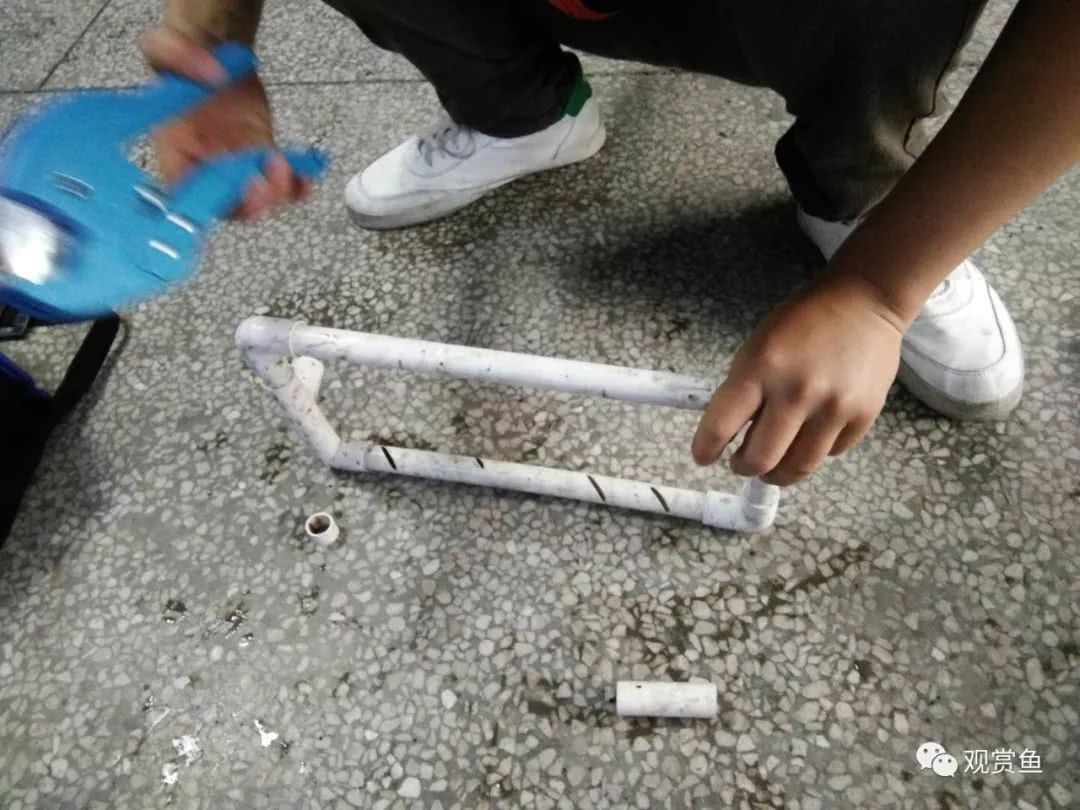
Use the pipe cutters to cut toothpick-thin slits in the water pipe, as shown in the picture below; connect the middle pipe to a tee connector for placing the water pump.
Place the separation plate on top (optional).
Lay filter cotton on it; the technician laid two layers of cotton in this tank.
Add coral sand for biological filtration; you can also substitute other stone-based filter media, depending on the actual situation. A layer about 3cm thick is enough (if you want it to look nice, you can lay a layer of ornamental stone on top).
Install the aquarium fitting on the tee connector pipe. At the time, the water pump's pipe opening was a bit small, but that was no challenge for our technician: one wrap of electrical tape and it wouldn't budge even if you tried to pry it off.
The state before water was added.
After adding water, don't rush to turn on the water pump; let it settle for a few hours first.
The fish tank after settling overnight, with the water pump turned on for circulating filtration.
During the water-culturing period, add half a bottle cap of nitrifying bacteria to the fish tank every day, which can speed up the cultivation of nitrifying bacteria in the tank. You can also put a small fish or shrimp into the tank; as long as there are fish in the tank, the bacteria will have food, and adding food can promote the reproduction of the bacteria.
Added yellow powder salt once; the new tank had not yet been cleaned and disinfected, and adding a bit of salt can play a role in sterilization and disinfection.
Test the water quality after three days. For the water quality test, the technician tested only three things: the nitrite content, the pH value, and residual chlorine. The water was cultivated well, and nothing problematic was detected, so there are no pictures.
A test fish was added to test the water. I suggest that after culturing the water, you shouldn't first add any beloved or precious fish; to be safe, it's best to put in a test fish for a few days to try out the water quality, and only add fish officially if there are no major problems. The test fish was kept for about ten days; it doesn't have to be ten days, there are no such hard-and-fast time limits, 3-5 days is fine too. The main reason was that the editor hadn't decided what fish to keep, so the test fish was kept for about ten days.
A small angelfish named Little Red was added. When Little Red first entered the tank, it kept hiding by the water pipe and didn't dare swim. Sometimes when the editor wanted to take a look at it, I had to pretend to glance casually, and I didn't dare press my face against the tank to look, let alone stare at it. Gradually, Little Red began to swim around near the water pipe and even learned to pick up stones to play with. So here the editor would like to address fishkeepers who report that new fish huddle at the bottom of the tank: aside from the issue of the fish itself being sick, fish need time to adapt, and they also need the cooperation of their keeper. Don't let your excitement over buying the fish make you unable to resist getting close to watch it; during the adaptation period you need to stay away from it, and don't feed it either. If it hasn't adapted in three to five days, then give it 10 days, 15 days; even a young bride brought through the door has to adapt to her new status and new environment.
In the example, the glass fish tank is 38cm long, 23cm wide, and 25cm high; the water pump is 15w, 800L/H.
The tank layout is a bit ugly because the editor feels that no matter how painstakingly you arrange it, there will definitely be someone who says it's ugly; after all, tastes differ, so just let it be a bit ugly and there will be no arguing. My focus is on the fish; as for the scenery, just do it casually.
Thanks to Master Jiang above for the technical and physical support.