Corn poppies bloom in full glory, turning the hillside into a sea of flowers
The hillside where corn poppies bloom
The hillside where corn poppies bloom - that name sounds quite familiar, doesn't it? That's the title of a famous animated film by the renowned Japanese animation master Hayao Miyazaki. By chance, I was drawn to this film title, not only because of my admiration and respect for Mr. Miyazaki, but also for a more important reason - those three characters: corn poppy. For someone like me, a flower-obsessed fanatic, hearing "the hillside where corn poppies bloom" immediately conjured up images of slender, swaying, romantic corn poppies. So I couldn't wait to find the film and watch it right away.
To be honest, the film's plot didn't move me all that much, but the scene of corn poppies blooming among the lush greenery at the home of the protagonist, Xiaohai, who lives on a hillside, left an unforgettable impression on me.
I already loved corn poppies, and after watching the film I loved them even more. No, I couldn't wait any longer - I had to grow my own seedlings. So I happily sowed seeds and raised seedlings. The seedlings did come up and grew quite vigorously, but a three-day family trip ruined my little seedlings. During those days the weather turned unusually dry with strong winds and high temperatures, and before leaving I forgot to move the seedlings to a shaded, moisture-retaining spot. My seedlings died.
For me, aside from regret, summarizing the lessons learned is very important. Gardening is a process of continuous learning and practice. In this process, there is success and failure, joy and disappointment - isn't life the same?
Learning from past experience, this year's seedlings all grew very well. Unfortunately, I had no corn poppy seeds left, and many of my other seedlings had already been transplanted into the flower borders. Just when I was anxious about not having corn poppy seeds, a friend helped me find corn poppy seedlings. I was so excited - my garden finally had corn poppies too
My friend and I in a sea of corn poppies
After being transplanted into my garden, the seedlings didn't grow vigorously. During this period, besides watering and applying some light fertilizer, I cut off all the less lively leaves. After about twenty-some days, the transplant recovery period finally ended, and what followed was the vigorous growth of the corn poppies and a continuous blooming period.
The blooming corn poppies are incredibly beautiful, with slender stems supporting petals with a silky, satin-like texture, looking gorgeous in the sunlight. On a windless, clear day, a corn poppy flower is like a quiet listener, listening to whatever you have to say. In a gentle breeze, it nods and sways like a mischievous child. In a strong wind, it becomes like a fearless warrior, letting the wild wind blow without ever bowing its head.
There are many kinds of corn poppies. The one I grow is the Iceland poppy, also called Iceland poppy (scientific name Papaver nudicaule 'Iceland Poppy Flower'), in the same family as the opium poppy. Don't be fooled by it being in the same family as the opium poppy - its morphological characteristics and chemical composition are completely different from the opium poppy used to extract drugs. It belongs to ornamental garden plants.
There were once reports online about people reporting opium poppy cultivation, when it was actually corn poppies. In appearance, the Iceland poppy is slender and short, with plants 30-60 cm tall, while the opium poppy is thick and tall, with plants reaching up to one meter. The Iceland poppy is an ornamental garden plant, while the opium poppy - what we commonly call the big fireworks flower - is a plant whose cultivation is prohibited in our country.
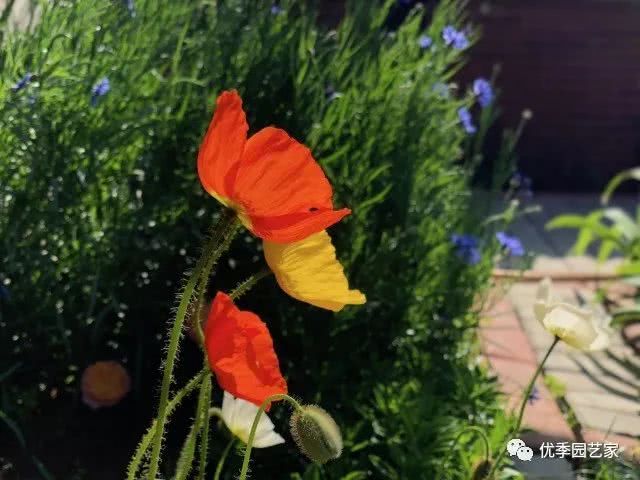
The Iceland poppy is also different from the kind of corn poppy we often saw as children (scientific namePapaverrhoeas L.),That kind is usually an annual herbaceous flower, while the Iceland poppy, despite its name, is not native to Iceland but to the cold regions of Siberia, so it is very cold-hardy and is a perennial herbaceous flower, very popular among garden growers. The main way to distinguish the Iceland poppy from the annual corn poppy is by looking at the stems. The Iceland poppy has brown bristles on its stems, the upright stems have no leaves, and the leaves all grow from the base, while the annual corn poppy has white bristles on its stems, and the stems have leaves.
Let's compare with pictures - the corn poppy image queried online from Flora of China and my garden's Iceland poppy.
Corn poppy image queried online from Flora of China
My garden's Iceland poppy
To extend the blooming period of the Iceland poppy, after the flowers fade I promptly cut off the post-bloom stems, otherwise they will set seed, and nutrients consumed for seed production will inevitably affect the blooming period. The post-bloom stems are also very pretty - they won't go to waste. They can be used in flower arrangements. Take a look at my arrangement using Iceland poppy post-bloom stems with cornflowers.
Iceland poppy post-bloom stems and flower buds about to open
Welcome to like and share to Moments, thank you
-
We advocate the philosophy of balance between beauty and practicality within limited gardening space,
Natural farming in the garden following the solar terms;
Emphasizing the philosophy of pairing plants together.
We share knowledge, pass on and research aesthetics, and revere nature.