Organic Agriculture Promotion Act Passes Third Reading; Tsai Pei-hui Urges Development of Subtropical Organic Farming Methods and Building Production-Marketing Linkages
The "Organic Agriculture Promotion Act" was officially declared passed on third reading yesterday (the 8th). DPP Legislator Tsai Pei-hui described it as "an epoch-making day" marking a milestone for Taiwan's organic agriculture; the Council of Agriculture also reaffirmed that the currently certified organic agriculture area in the country has reached more than 7,700 hectares, and the registered area for eco-friendly farming has reached more than 1,300 hectares. Now that the promotion act has passed, the Council of Agriculture has an even greater responsibility to raise the share of organic agriculture. Council of Agriculture Deputy Minister Chen Chi-chung said, "We hope to move toward 15,000 hectares as soon as possible."
Tsai Pei-hui: It Explicitly Stipulates That Guidance Measures Should Be Taken for Organic Agriculture
Tsai Pei-hui stated that Taiwan is located in a subtropical environment, "Producing organically in a subtropical climate requires special farming methods, and (the government) should work hard to make breakthroughs." Related breeding and improvements to farming facilities all require government support. She also stressed that many stages in the organic agricultural production process need breakthroughs and will require the government's full assistance in the future. Otherwise, "Taiwan's organic agriculture accounts for only 0.8% of the total farming area. Compared with 5% to 8% in advanced countries, we still have a lot of room for effort."
Tsai Pei-hui stressed that a healthy, eco-friendly production linkage should be established from the land to the consumer. In response, the Council of Agriculture said that the "Organic Agriculture Promotion Act" explicitly stipulates that the competent authorities should adopt guidance measures for organic agriculture. Among these, the central competent authority should establish a task force and propose an organic agriculture promotion plan every 4 years, encourage the establishment of organic agriculture promotion zones, and assist in providing organic production and marketing technology, equipment, and materials; it should also encourage schools and the military to prioritize purchasing local organic agricultural products, thereby gradually expanding organic agriculture.
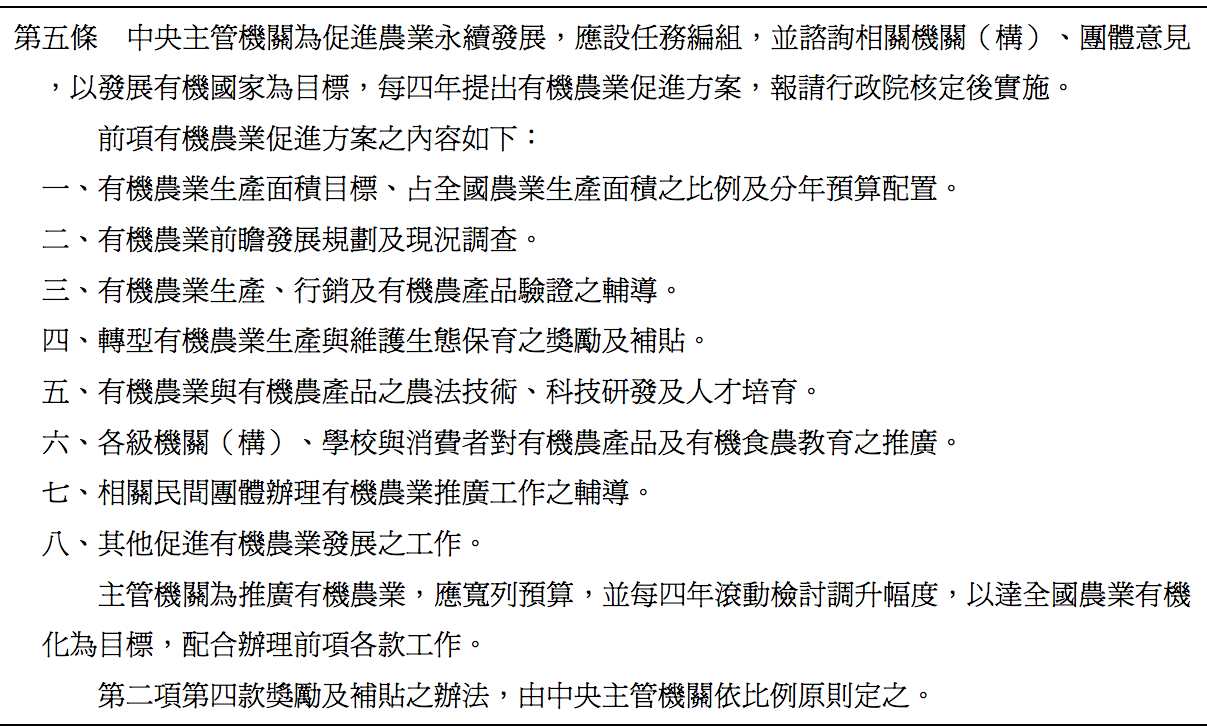
However, how should the policy goals of the above-mentioned Organic Agriculture Promotion Act be concretely implemented? How much funding will the Council of Agriculture inject into it in the future? Chen Chi-chung said that this year about 1.8 billion has been invested in organic agriculture, with green direct payments accounting for the largest share, along with related subsidies for organic materials, organic certification fees, and so on. "In the future (funding) will be even more."
And how will the increased budget be further invested in organic agricultural production? Chen Chi-chung further explained that the first step is that the Council of Agriculture is actively handling the organic label, and the voting process will be completed this year. To further expand the area of organic agriculture, organic certification fees will be lowered further in the future. "The Agriculture and Food Agency has already planned the scale of the reduction." The actual reduction results will be publicly announced at a later date. Chen Chi-chung said that in the future, results will be reviewed once every four years and explained to the public.
Chen Chi-chung: Align with International Standards, Review Promotion Progress Every Four Years
Chen Chi-chung further revealed that after the passage of the "Organic Agriculture Promotion Act," the Council of Agriculture's biggest policy goal is to align with international standards and obtain organic equivalence.
Chen said that organic agricultural products also involve import and export trade, but Taiwan has not yet obtained organic equivalence recognition from other countries, so the export of domestic organic agricultural products faces the difficulty of being "unable to be sold under the name organic." At present, the Council of Agriculture is in talks with the European Union, India, the United States and other countries, hoping that domestic organic regulatory standards can align with international standards as soon as possible. "It must be negotiated within two years."
The Council of Agriculture stressed that the "Organic Agriculture Promotion Act" is truly a special law tailor-made for the development of domestic organic agriculture. In the future, it will review the progress of organic agriculture promotion every four years and will actively expand the organic agriculture farming area.
Organic Farmers: Worried That There Are "More Sticks Than Carrots"
However, the rapid finalization of the "Organic Agriculture Promotion Act" on third reading, once the news reached the organic agriculture sector, sparked widespread discussion. Organic farmers affirmed the good intentions of the promotion act, but after examining the content of the legal provisions in detail, they could not help worrying that there are "more sticks than carrots." In a promotion act framework that constantly emphasizes "management" and "penalties," the effect of "promoting organic agriculture" may be limited.
A farmer surnamed Chang, an organic farmer, said bluntly that judging from the current legal provisions, many budgets are allocated for investment in organic agricultural production, "but in reality, organic agriculture is agriculture with moderate input, or even low input." It cannot be operated according to the thinking that the more input, the more harvest; on the contrary, only by reducing unnecessary facilities and lowering management intensity is it possible to achieve this. "Now a lot of budget is being forcibly invested in guidance, inspection, and education, yet it is of little significance to actual organic agricultural production." It may become merely icing on the cake.
Chang further lamented that in this law, one can clearly see that both the vision for organic agriculture and management penalties have been strengthened, "but the vision is vague while the penalties are clear." To organic farmers' ears, this feels extremely powerless.
A farmer surnamed Tseng further approached the issue from the perspective of "promoting and popularizing" organic agriculture, pointing out that organic farmers' imagination of the "Organic Agriculture Promotion Act" is that it can fundamentally improve problems such as contamination from neighboring fields and yields in organic agriculture. Only then would it be of substantive help to organic farmers; and only by taking farmers' production needs into account is there a chance to go further and discuss promotion and facilitation.
Tseng said that in terms of policy direction, the aim might be to expand the organic agriculture farming area, but judging from the current regulations, the role separation between organic and eco-friendly agriculture remains vague, and there may even be a crowding-out effect. Therefore, Tseng wondered whether it might be possible to use eco-friendly subsidies to incentivize neighboring fields around organic plots to gradually adopt eco-friendly farming methods as well, and even possibly gradually convert into organic plots in the future. Operating in this way could not only reduce the production risks of organic agriculture, but also increase the organic farming area in one stroke. That is what so-called "promotion" means.
Chen Chieh-ting: The Antagonistic Atmosphere Between Organic and Non-Organic Should Be Improved
Chen Chieh-ting, associate research fellow at the Agricultural Policy Research Center, pointed out directly that looking at the entire set of regulations, "the added part lies in penalties, while the meaning of promotion cannot be seen." In the future, with increased penalties, the risks of investing in organic agriculture will increase, and the risk costs farmers must bear will also increase. Moreover, under the regulatory mindset of "strengthening management," it does not help alleviate organic farmers' sense of grievance at being blocked and penalized for violations; all of this is far removed from the "promotion" currently being discussed.
"If we really want to promote it, the antagonism should be improved." Chen Chieh-ting believes that the Organic Agriculture Promotion Act should have a way to improve the past antagonistic relationship between organic and non-organic, and even from the macro perspective of agricultural development, what role organic agriculture actually plays within it should also be carefully considered.
The organic farming community and promoters of organic agriculture had mostly held expectations for the "Organic Agriculture Promotion Act," hoping it could open a new path for organic agriculture. But now that the promotion act has passed on third reading, Chen Chieh-ting said helplessly, "Since the parent law has passed, we can only accept its approach for now." He hopes that the subsequent subsidiary laws and enforcement rules can respond to the doubts currently held across various sectors.