Gerbera: mystery, mutual respect and love, perseverance, fearlessness of hardship, eternal happiness, and a love of pursuing a rich life
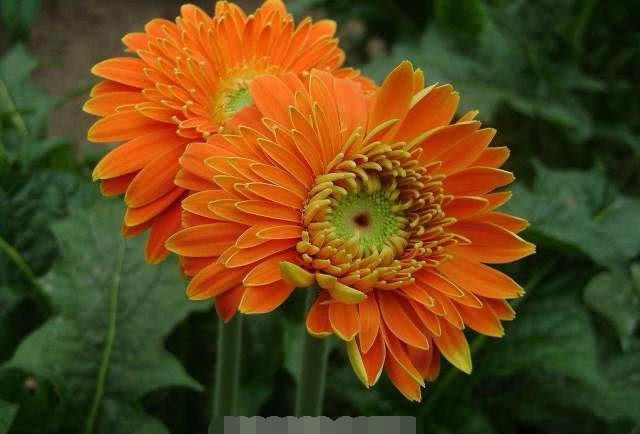
Gerbera is a perennial herbaceous plant in the Asteraceae family, genus Gerbera. The leaves are basal, arranged in a rosette, with blades oblong-elliptic to oblong, and the reticulate veins are slightly prominent; the petioles have thick longitudinal ridges and are covered with hairs. The scape is solitary, or rarely several clustered together, the receptacle is flat and honeycomb-like, and the outer corolla is ligulate, with ligules pale red to purplish red, or white and yellow, oblong. The achene is cylindrical, densely covered with short white pubescence. It is dirty white when fresh and tinged with light brown when dry. The flowering period is from November to April of the following year.
Gerbera
Distribution range:
Native to Mpumalanga, Gauteng and Limpopo provinces of South Africa, and Eswatini. Introduced regions and countries include Cameroon, Costa Rica, Java, Jamaica, Cuba, Hispaniola, Nicaragua, Panama, Mexico, Trinidad and Tobago, Fiji, Australia, Tubuai, Mauritius, Reunion, Ethiopia, Eritrea, Myanmar, India, Estonia, Vietnam, South Korea, and China.
Gerbera
Propagation methods:
Sowing: Each gerbera flower can usually produce 20-30 seeds, which can be sown in spring or autumn. Spring sowing is in March and May, and autumn sowing is in September and October. The germination rate of gerbera seeds is relatively low, only about 50%. After sowing, cover with paper to prevent direct sunlight, keep the temperature at 20-25°C, and germination occurs within about two weeks. Sixty to seventy days after sowing, when the seedlings have three or four true leaves, transplant them into flower pots or set them out in the open ground. With proper cultivation, flowering can be seen in two to three months.
Division: Gerbera division propagation is mostly carried out in March and April. First dig up the mother plant and divide it into several daughter plants. The daughter plants must have buds and roots, and should not be divided too small. When potted, they should not be planted too deep. It is best to plant them in holes in groups of two, which helps increase the number of flowers.
Gerbera
Main value:
This species has bright colors and a beautiful form, and is one of the more popular ornamental flowers internationally. Gerbera can be used for cut flowers and potted plants, and can also be arranged in large quantities in courtyard landscaping. When used as a cut flower, the fresh flowers last about 14 days. Garden varieties of gerbera with shorter plant forms are also often used for tabletop decoration. When used as an indoor potted plant, this species can effectively purify the air. Research by NASA has demonstrated that gerbera can absorb carbon dioxide and release oxygen throughout the night, helping people sleep.