How much do you really know about the rose you received on Valentine's Day?
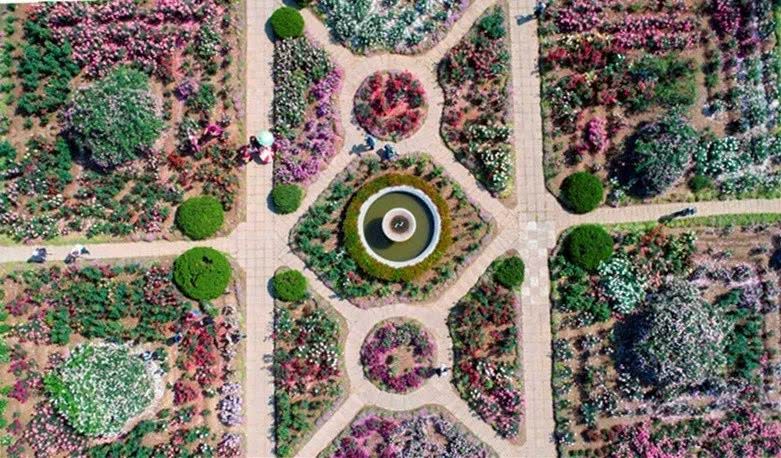
Nanjing Zhongshan Botanical Garden
May 3
the Rose Garden and the Bulb and Perennial Flower Garden of Nanjing Zhongshan Botanical Garden
welcomed the best time of the year
Chinese rose、rose、corn poppyand other summer flowers are in full bloom
visitors stroll through the garden
the sea of flowers has also become lively
However, admiring flowers is one thing, but when you look closely, many people are ruled by "face blindness" -pointing at a Chinese rose and calling it a rose, while the real rose is mistaken for a Chinese rose, and the corn poppy also gets caught in the crossfire, mistaken for an opium poppy.
Are these "sister" flowers really so hard to tell apart?
This time, the reporter will help you get to know them properly.
Interviewed expert
Li Mei, PhD in floriculture at Nanjing Zhongshan Botanical Garden
They all have thorns!
The real rose is not "romantic"
“Chinese roses bloom in all four seasons, so they are also called 'monthly red',But roses are different, they bloom only once in summer." Li Mei, PhD in floriculture at Zhongshan Botanical Garden, told the reporter that therefore, under natural conditions, Chinese roses and roses only "look alike" during the summer season.
But how should they be identified when they are both in full bloom? Li Mei offers a tip: first look at the leaves. "The leaflets of the Chinese rose are broadly ovate to ovate-oblong, with sharp serrations along the edges, nearly hairless on both sides, and look glossy; the leaflets of the rose are elliptic or oblong-elliptic to obovate, with blunt serrations along the edges, green and hairless and lusterless on the surface, with sunken veins and a wrinkled appearance."Simply put, rose leaves look wrinkled, but Chinese rose leaves look as if they have been smoothed with "moisturizer," much smoother than those of roses.
▲Rose (photo by Liu Chenghe)
▼Chinese rose (photo by Liu Chenghe)
Next, look at the thorns. "The characteristics of the stem thorns of the two are very distinct. Roses have more thorns, dense and slender and pointed, while the thorns of Chinese roses are short, thick, hook-shaped prickles, relatively larger, sparse, and flat." Li Mei told the reporter that rose thorns are the "strong type," and if you want to pick one, even if you are very careful, you may still hurt your hand.
Then look at the flowers and fruit. Li Mei introduced thatChinese rose flowers are relatively large, with petals double to semi-double, in diverse colors, with each color having light and dark shades, one could say colorful, and the fruit is spherical;as for the rose, the flowers are relatively small, with petals double to semi-double, generally pink, purplish red, and white, etc., and the fruit is oblate, brick red, fleshy, smooth, with persistent sepals, "Obviously, from an ornamental point of view, Chinese rose flowers are more valuable."
▲Chinese rose (photo by Liu Chenghe)
Finally, smell the fragrance again. The reporter found thatthe fragrance of Chinese roses is relatively light, while the fragrance of roses is different, more intense, and smells of a very distinct "rose essential oil". In fact, compared with ornamental value, indeed, extracting rose oil is the main value of roses.
Are they all poisonous?
You may really have eaten poppy seed oil
"The corn poppy and the opium poppy both belong to the Papaveraceae family, so they naturally look very similar, but in fact there are still great differences." Li Mei introduced that when observing, the main thing to look at is one point -the whole corn poppy plant has obvious coarse hairs, with many slender branches, relatively thin leaves, and an overall delicate appearance; the whole opium poppy plant is smooth and "covered" with a white powder, with thick stems, few branches, and thick leaves.
Of course, if you look carefully, the flowers are also different. Li Mei pointed out, "corn poppy flowers are relatively small, with extremely thin petals and a delicate texture; opium poppy flowers are relatively large, with petals of a thicker texture and very glossy.”
▲Corn poppy (photo by Qin Yalong)
▲Opium poppy
It is understood that when the opium poppy fruit is not yet ripe, cutting its skin will release a white milky sap. After the sap dries, it becomes a black gel-like substance. This substance is the source of various sedatives such as morphine, thebaine, and codeine, and has a certain effect in treating diseases,but at the same time it is also rich in toxic alkaloids, and is an extremely harmful drug and drug raw material. Therefore, illegally cultivating opium poppies up to a certain quantity constitutes the crime of illegally cultivating original drug plants.Although the corn poppy closely resembles the opium poppy in appearance, it cannot be used to make drugs and is a proper ornamental flower.
However, the opium poppy is regarded as a poison, and in fact it is also quite "wronged" - because plants cannot move,when facing damage from bacteria, fungi, insects, and large herbivores, they cannot escape and can only cultivate themselves into "masters of poisoning", defending themselves by synthesizing large amounts of toxic natural products, and alkaloids are one of their important weapons for defending against the outside world. Li Mei introduced, "Many people think that the opium poppy is poisonous all over, but in fact, its seedsare not only non-toxic, but also rich in oil. Because they have a special flavor, opium poppy seeds are also used to press oil, or after baking, used as a seasoning, and are widely used in salads around the world."
▲Opium poppy
Text: Shi Hongyan
Photos: Liu Chenghe, Qin Yalong
Editor: Zhu Yayun