Variety Introduction to the Pink Echeveria 'Tai Ge' Succulent
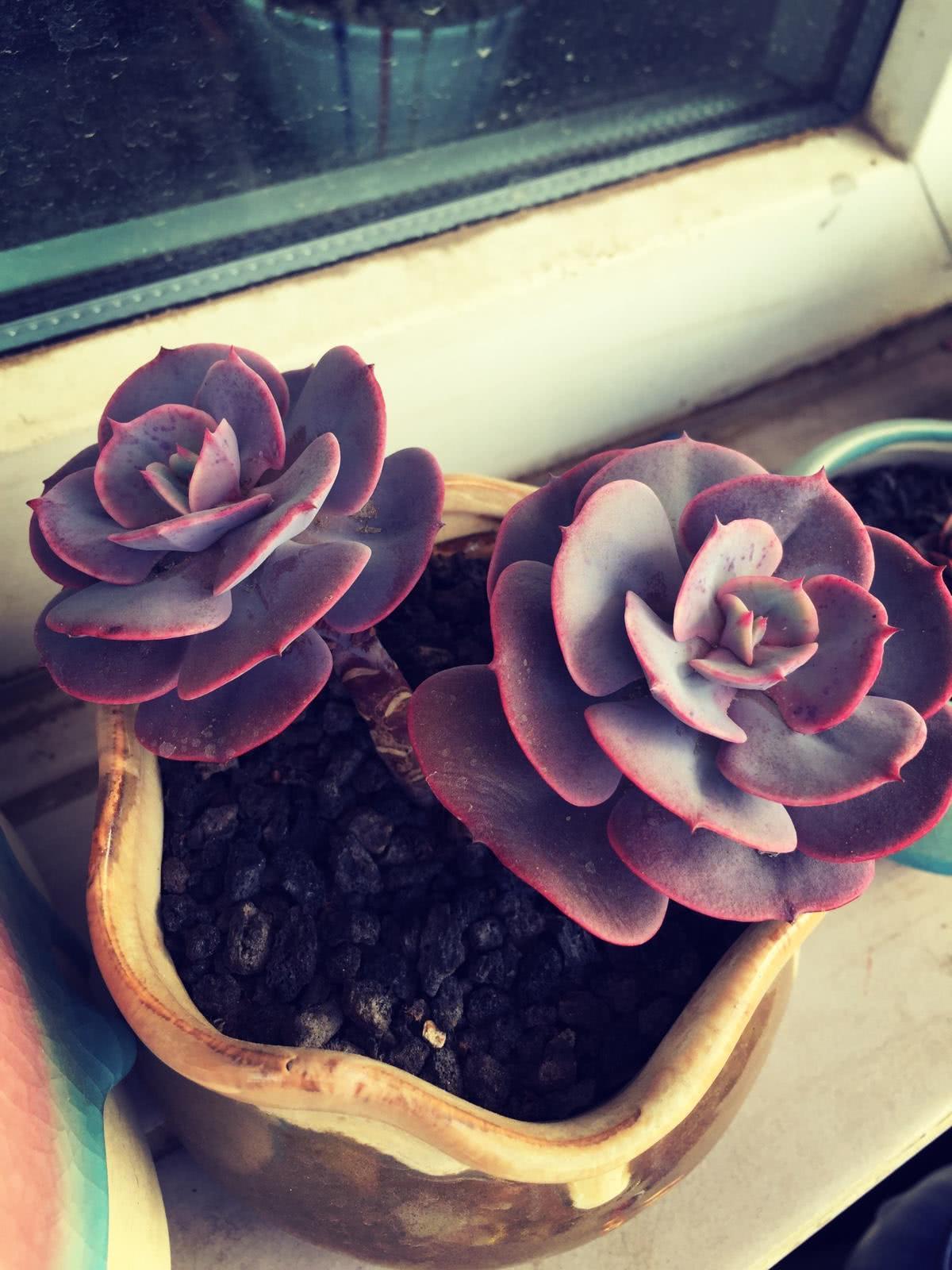
Pink Tai Ge is a perennial plant and succulent in the Crassulaceae family, Echeveria genus. Its leaves are a hazy, dreamy pink-purple, and its rosette form is neat and dignified, making it an outstanding Echeveria.
The stem is thick and will slowly elongate as it grows. The leaves are arranged in a rosette, and the plant diameter can reach more than 10cm. The leaves are spoon-shaped, narrower at the base than at the tip, with a sunken line running down the middle of the leaf from the tip to the base. The leaf tips turn red under sufficient sunlight; new leaves are lighter in color and tend toward blue-white, while older leaves are darker and tend toward purple-red, occasionally with deep red spots, and the leaves change color from the edges toward the base. The leaves are covered with a thin layer of white farina; once wiped off, the leaves appear gray-green. Under strong light and large day-night temperature differences, or during low temperatures in winter, the leaf color becomes deep red, while under weak light the leaf color becomes light blue-green and the leaves spread open. It blooms in summer, and the scorpioid cyme can reach more than 20cm in length. It produces bell-shaped flowers that are pink on the outside and orange-yellow on the inside.
Pink Tai Ge
Pink Tai Ge needs sufficient sunlight for the leaf color to be vivid, for the plant shape to be more compact and attractive, and for the leaves to be thick and plump. With too little sunlight, the leaf color is pale, the leaves are loosely arranged, and the leaves become thin.
Generally, the medium should be watered only after it dries out. When grown outdoors, once the temperature rises above 35 degrees, the plant should be moved to bright indirect light and the watering frequency gradually reduced, eventually stopping watering altogether (for example, under a ventilated glass roof). If grown outdoors, it must be protected from heavy rainstorms. During the dormant period throughout summer, water little or not at all. After the temperature drops in mid-September, gradually begin to resume the normal watering frequency. Pink Tai Ge that has adapted to outdoor conditions can still grow normally in summer, and its dormancy is not very pronounced.
Pink Tai Ge
In winter, if the temperature can stay above 0 degrees, it can still be watered; below 0 degrees, watering should be stopped and the plant moved to a warm indoor space or greenhouse, otherwise the plant will suffer frost damage or even die. Although winter is cold, it does not mean watering must stop for the entire winter; when the temperature is suitable (above 5 degrees), a very small amount of water can be lightly given at the base of the plant, but never spray or water heavily. After temperatures rise in spring, normal watering can gradually be resumed. If water drips into the center of the leaves and stays there too long, it may cause rot.
Pink Tai Ge