Do one extra thing when watering succulents in summer to effectively prevent sunburn
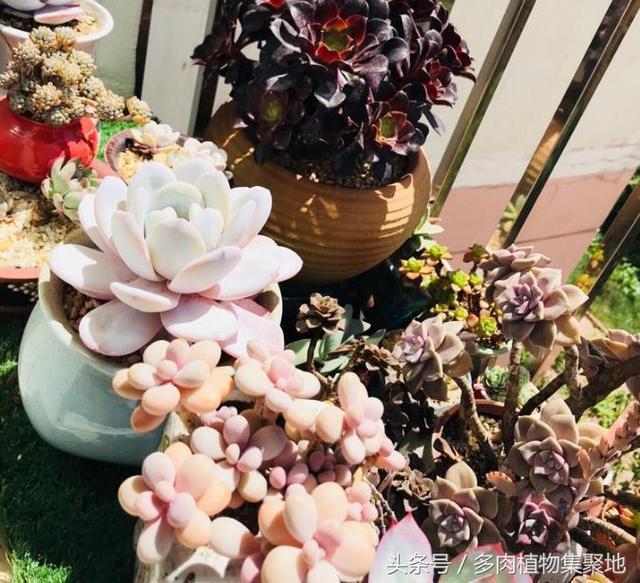
Succulents that usually get little light are themselves rather delicate, and even in spring when the light is not yet very strong, sunburn can still occur. The same logic applies to leggy succulents: legginess is caused by too little light, but if the light suddenly increases too much, they are very likely to collapse from the sun. So for succulents that are not in good condition, if you want to increase light to improve their condition, you must increase light intensity and duration slowly. Never rush it, otherwise you may get the opposite of what you want.
How do you prevent succulents from getting sunburned? These situations must be avoided: succulents kept indoors for a long time suddenly moved outdoors, especially leggy ones and flat, spread-out ones; seedlings that have just sprouted being rushed outdoors for open-air growing; and semi-shade plants such as Haworthia cooperi in the Haworthia genus. When watering succulents, do one extra thing: do not pour water on the leaves. If they get rained on in summer, promptly clear the water off the leaves before the sun comes out. Generally, if summer temperatures exceed 30 degrees, it is recommended to use a shade net, and ventilation must be good.
If a succulent gets sunburned, you can move it to a ventilated, shady spot to cool off and mist it with a little water. Misting is to increase air humidity. If the sunburn is severe, and the succulent turns black or scorched, then just cut it off directly. This process is truly a painful one. If the sunburn causes the leaves to turn to mush, then the same applies: remove all the mushy leaves.
If a succulent gets sunburned to the point of turning to mush and black rot, it is lucky to survive at all. If it develops sunspots, these are generally permanent, though sometimes the marks fade over time. If there are mushy leaves, remove them. If there is still time to save it from black rot, dig out the black rotten parts. For leaf tips that have already turned scorched and black, you can just cut them off directly. If intense sun causes the leaves to turn to mush, then pull off the mushy leaves. For plants that can be propagated by leaf cuttings, you can use the method of beheading and leaf propagation.
Why do succulents in the wild not get sunburned easily, while the succulents we grow do? Because succulents in the wild have no burden of a pot, so they dissipate heat faster. Gardeners usually have a considerable number of succulents, and at this point ventilation becomes even more important, yet one thing is often overlooked: the closer the pots are placed to one another, the worse the ventilation. When a plant cannot dissipate heat fast enough, it easily gets sunburned. It can also easily lead to turning to mush and black rot.
Succulents like an environment with plenty of light, but this plant is still on the weaker side, so it absolutely must not be exposed to intense sun. Especially now that summer is approaching, succulents need to be placed in a relatively shady spot to avoid intense sun. However, many people do not care for succulents according to their habits when growing them, and even carelessly leave them in the sun to bake, not realizing that too much sun can also sunburn succulents, causing the leaves to scorch, and in severe cases even turn to mush.
This is a gathering place for succulent lovers, sharing succulent care tips. Welcome to follow and connect.