Potted amaryllis only grows leaves but won't bloom? Master these few tricks and bud after bud will keep coming
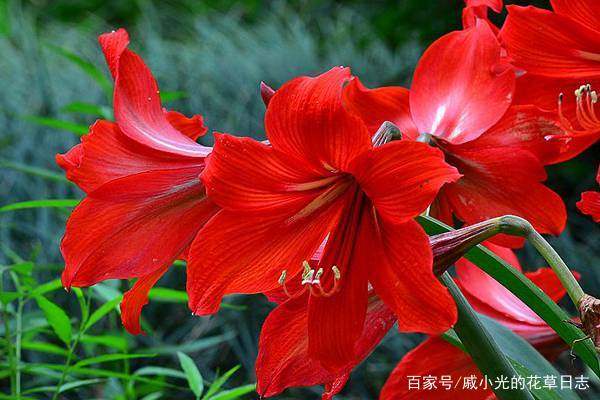
Potted amaryllis, as the name suggests, is a red flower that blooms at the top of the flower stalk. It also has many lovely alternative names, such as Huazhou orchid, solitary lily, and pair red, and is a perennial herbaceous bulb plant of the Amaryllidaceae family. And at the turn of spring and summer each year, the one blooming most vibrantly and standing out alone on the balcony is this amaryllis.
The potted amaryllis has flowers as large as four morning glories and shaped like lily flowers, and against the backdrop of green leaves it looks especially enchanting. Its flower color is even more bright red yet soft, full of red charm, a typical "Chinese red" implying fortune arriving at the door and a sense of festivity and good luck, making people feel joyful.
The potted amaryllis belongs to the bulb-type plants, and its stem grows from a root block that looks like an onion. The leaves are generally opposite, and each year's growth is divided into 2 stages. Starting from the first year in spring, it will form buds and bloom, and then produce 4 to 6 opposite leaves.
The small flower stalk will quickly grow taller and become noticeably thicker. At the top of the flower stalk, a huge flower bud will grow, containing two to four flower buds inside. When it comes to flowering, the question flower lovers ask most is why the amaryllis at home has been grown for many years and only grows leaves without blooming.
Many potted amaryllis bought from flower markets are blooming, but after being cultivated at home for a period of time, they no longer bloom, and the longer they grow, the smaller the bulb becomes. This shows that there is a problem with the potting soil of your pot of amaryllis: it is too compacted and the salinity-alkalinity is too high, so it needs repotting and soil replacement.
There is another situation: the plant's leaves are very dark green, the bulb is also very good, and it even grows small offset bulbs, but it just will not bloom well. This situation shows that your care environment is too good and too favorable, forming a relatively constant environment, while lacking a process of flower bud differentiation, which causes it not to form buds or bloom.
When entering the hot midsummer period, when the temperature difference between day and night shrinks to less than 10 degrees, the amaryllis will enter a semi-dormant state. At this time, be sure to control watering and stop all fertilizing. In summer, when they should be dormant, let them be dormant. In summer, attention should also be paid to shading, to avoid leaf wilting, scorching yellow and falling off, or causing the bulb to wilt and dry in layers, which affects the accumulation of nutrients.