The process of creating a literati-style bonsai, demonstrated by Zhao Qingquan
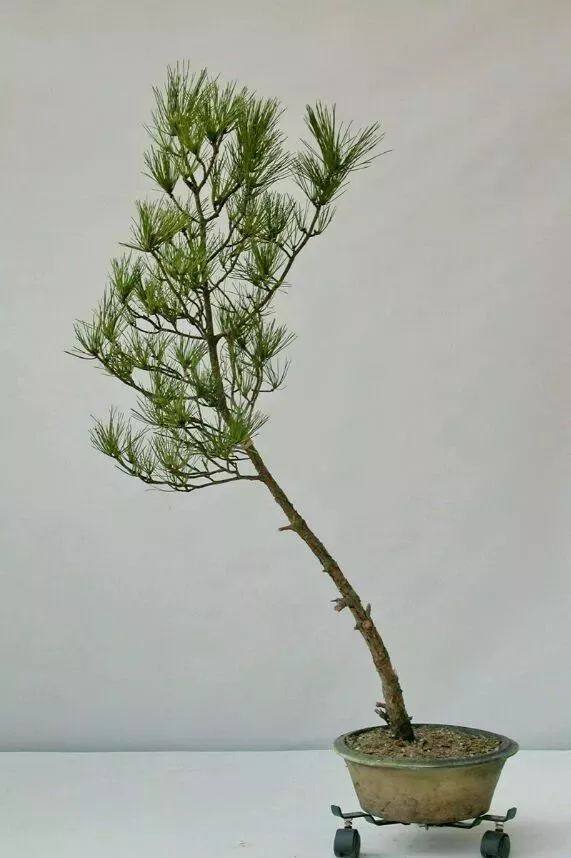
Bonsai name: Chu Chen Species: Japanese black pine (Pinus thunbergii) Height: 106 cm Age: 25 years Author: Zhao Qingquan The creation of "Chu Chen" began in early 2004. The material was a mountain-collected Japanese black pine (Figures 1 and 2). Before starting work, I examined it repeatedly, and finally chose the front and back sides (Figure 1, Figure 2). The main principles for choosing the front and back sides were: viewed from the front, the trunk does not lean forward; the exposed roots and main branches extend longer to both sides and shorter to the front and back; if the trunk has a curve, the main branches should emerge from the convex side of the curve, never from the inner side of the curve. Figure 1. The front side of the selected material
Figure 2. The back side of the selected material
When starting work, first cut off some branches that are definitely unwanted, such as opposite branches, overlapping branches and other undesirable branches, as well as overly dense branches (Figure 3). Branches whose retention or removal cannot yet be decided can be kept temporarily and dealt with later.
Figure 3. Making the preliminary pruning
To make shaping easier, two thick metal wires are placed close against the trunk, and then the trunk is wrapped with hemp cloth to protect the bark from damage during shaping (Figures 4 and 5). Figure 4. Wrapping the trunk with hemp cloth, with thick metal wires underneath
Figure 5. After completing the hemp cloth wrapping Then a turnbuckle and a wooden stick are used to adjust and bend the lower part of the trunk so that it reaches a slight curve (Figure 6).
Figure 6. Using a turnbuckle and a wooden stick to bend the lower part of the trunk Finally, metal wire is used to bend the upper part of the trunk, curving it moderately and making the side branches emerge as much as possible from the convex side of the curve (Figure 7).
Figure 7. Bending the upper part of the trunk After cultivation, by the end of 2005 the branches and trunk had initially taken shape, and the foliage was beginning to fill out (Figure 8).
Figure 8. At the end of 2005, the branches and trunk had initially taken shape The following year, two large branches in the middle of the trunk were cut off, and metal wire was used again for bending, and the literati-style bonsai form began to emerge (Figure 9).
Figure 9. Bending again, the literati-style bonsai form begins to emerge Because the work still felt insufficiently distinctive in character, in 2011 the top branches were cut off, making the position of the largest weeping branch relatively higher, so that the tree appeared more solitary and lofty. Only one small branch was kept on the middle-lower part of the trunk, to serve as a link between the upper and lower parts (Figure 10). Figure 10. Cutting off the top branches In 2014 the styling was basically completed, and it was repotted into an irregular-shaped ceramic pot (Figures 11 and 12).
Figure 11. Photographed in June 2014
Figure 12. The back side of the work During the creation of "Chu Chen", while cultivation methods were used to make it fuller, the branches and foliage were also constantly reduced, until no more could be removed. Not only did the middle-lower part of the trunk produce very few branches, even the top was kept as sparse as possible, and finally the apex branch was removed, in pursuit of a feeling of being "unstained by a single speck of dust". This pursuit of beauty through extreme simplicity is in fact consistent with the Daoist idea that "the greatest way is the simplest" and the Buddhist saying "one flower, one world; one leaf, one bodhi". An incomplete form can often express the inner spirit more fully. "Enter the world with composure, rise above the dust with serenity", and the heart finds its own peace.