How do you make a tree bonsai? A master teaches you the method
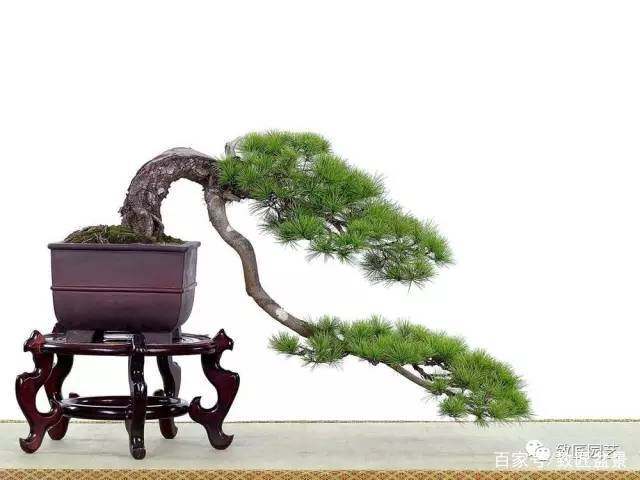
What a bonsai expresses is a certain partial scene of nature; at its smallest it can be reduced to a single tree or a single piece of stone, and at its largest it can encompass a whole world, which is its spiritual world. People often say that bonsai artistic creation has only a starting point, no end point. The exploration of the bonsai's spiritual world is the excavation of its deeper cultural connotations.
Basic characteristics of tree bonsai
Tree bonsai is the main content of Chinese bonsai. It uses trees as the main material, takes the divine bearing and elegance of ancient large trees in nature as its model, and uses the expressive techniques of bonsai art as its method to carry out shaping and creation - a living work of art.
A tree bonsai work must possess a beautiful and moving artistic image. Its creation, under the guiding ideology of combining natural beauty with artistic beauty, carries out material-appropriate artistry based on the ornamental characteristics of the tree's roots, trunk, branches, leaves, flowers and fruit, fully bringing out the individuality of the material.
A tree bonsai work must also be able to convey emotion through scenery, with vivid spirit and charm, possessing artistic conception, connotation and style.
Besides the main material, tree bonsai also has the flower pot and the display stand. Only when scenery, pot and stand are properly coordinated with one another can it count as a complete, good work in which the three are integrated as one.
The shaping of tree bonsai is the foundation for the shaping of all other types of bonsai. So-called tree-and-stone bonsai, water-and-dry bonsai and the like are in essence still mainly trees, with stone only playing a supporting and accenting role. Although landscape bonsai is mainly stone, it cannot do without trees either; only with the support and accent of trees can the work show a greater vitality. If your foundational skill in tree bonsai shaping is solid, then you will be more at ease, better coordinated and less likely to deviate from the standard in shaping all other types of bonsai; if your foundation is shallow, then situations such as disordered tree structure, a tree posture that does not match its environment, or a disproportionate ratio between tree and rock are very likely to appear, and it will be impossible to give people aesthetic enjoyment.
Tree bonsai, like all other types of bonsai shaping, requires a proficient command of the basic principles of bonsai shaping and of the application of the artistic dialectics of unity in diversity. Only in this way can practice make perfect and everything be handled with ease, and only then can the artistry of the work be fully embodied.
In tree bonsai, except that rock-clinging bonsai sometimes needs rocks added because of defects in the root plate area of the tree material, generally one strives for the coordination of all parts of the tree body to be natural and tacit, earnestly seeking the tree body's own balance and stability so as to reach a degree of completeness or perfection, rather than relying on the arrangement of rocks or other accessories. Only such a work can count as an excellent piece. You should know that a single material that can accomplish its own perfect shaping on its own is the most concise, the most restrained and also the most thought-provoking. The space it leaves for people's imagination is the broadest.
If in a tree bonsai work a few rocks or a few ornaments can be arranged and this makes people feel it looks a bit better, it shows that the bonsai may have: an unstable tree-body shape that has lost balance; an unsuitable pot choice, making the pot opening too large and making people feel it is too empty; or, when the tree-body shape cannot fully reflect the theme, a wish to use rocks and ornaments to bring out the theme.
This approach is not very ideal and easily causes confusion with other bonsai forms. But a forest-style bonsai uses a shallow pot, and it is also possible, in order to make the landscape vast, to bury a few rocks among the trees to increase the undulating variation of the pot surface. But it is still the forest style within tree bonsai, and not another type of bonsai form.
Classification and forms of tree bonsai
In the past, our country customarily divided tree bonsai into two major categories: natural-style bonsai and rule-style bonsai. Existing research holds that rule-style bonsai should belong to the category of folk art and forms its own tradition, and is not within the scope of our discussion and study. The following introduces only natural-style bonsai.
1. By tree species
Tree bonsai can generally be divided by different tree species into the pine and cypress category, the miscellaneous wood category and the flower and fruit category.
(1) Pine and cypress category: its material uses trees of the pine and cypress family, which are evergreen coniferous species, such as five-needle pine, black pine, masson pine, Huangshan pine, Chinese juniper, sabina, Chinese prickly juniper, plus some trees of the yew family such as Buddhist pine.
(2) Miscellaneous wood category: its material generally refers to broadleaf tree species that can be used to make bonsai; these can be evergreen species, but more often they are deciduous or semi-deciduous species. Common ones include banyan, boxwood, orange jasmine, Chinese elm, Japanese bush cherry, Chinese hackberry and maples.
(3) Flower and fruit category: any bonsai whose main ornamental object is the flowers and fruit of trees belongs to the flower and fruit category, such as plum blossom bonsai, camellia bonsai, azalea bonsai, hawthorn bonsai, firethorn bonsai, apple bonsai and so on.
2. By specification: tree bonsai divided by specification includes large bonsai, medium bonsai, small bonsai and miniature bonsai.
Successive bonsai exhibitions and evaluations in our country have set the following regulations for the specifications of tree bonsai.
Large bonsai: 0.80-1.20 m;
Medium bonsai: 0.40-0.79 m;
Small bonsai: 0.10-0.39 m;
Miniature bonsai: below 0.10 m.
The display of miniature bonsai must use a curio rack combination, appreciating both the beauty of the individual shape and the harmony and variation of the overall arrangement. A miniature bonsai group may include tree bonsai, landscape bonsai, viewing stones or a small amount of handicrafts, but tree bonsai predominates.
Specification is calculated based on scenery height (tree height), generally from the root collar to the highest point of the crown (including deadwood branches). There are also some special cases: for example, rock-clinging bonsai should be calculated from the point where the rock meets the pot soil, not from the tree's roots. So the actual meaning of tree height is scenery height. Another example is literati trees, whose trunks are tall and thin; by height they already exceed the limit, but by volume they fall far short. The specification calculation for literati trees can be appropriately relaxed.
3. By number of plants
Tree bonsai generally consists of one tree per pot, but there are also cases where two, three or more plants in one pot form a scene. Therefore it can be classified by number of plants into two categories: single-planted style and group-planted style.
(1) Single-planted style: one tree per pot. There are relatively strict requirements for each part of the tree, pursuing completeness and harmony, with "emphasizing posture" and "being suitable for painting" as the most important factors.
(2) Group-planted style: two or more trees can be planted in one pot. Its shaping is relatively complex and the difficulty is also greater. When shaping, emphasize that trees have height and primary-secondary order, and that branches have density and yielding-contending; when planting, pay attention to density and concealment-revelation, upright and slanting echoing each other, and so on, fully applying artistic dialectics well so as to make it a work that is unified and harmonious and full of poetic and pictorial charm.
Group-planted bonsai generally uses one tree species, but multiple tree species can also be planted together, regardless of evergreen or deciduous trees. But note that the variation in leaf shape and size should be similar, to facilitate unity and harmony; the yin-yang and dry-wet nature of the trees should also be similar, to facilitate maintenance and management.
4. Several main forms
Because trees in nature grow in different environments, their postural changes are endless, and reflected in the forms of tree bonsai they are even more infinitely varied. From the perspective of shaping, the forms of tree bonsai take the changes in the posture of the tree's main trunk and the number of plants as the main basis for division, and can be divided into 8 forms: upright style, curved-trunk style, slanting-trunk style, cascade style, double-trunk style, forest style, rock-clinging style and literati tree.
The forms of bonsai artistic works should not be divided too finely; it is better to keep them simple and reasonable. Those with similar shaping techniques and ornamental effects should be merged together; for example, the lying-trunk style and the waterside style can be merged into one form, and the forest style, the one-tree-multiple-trunk style and the bridge style can be merged into one form, and so on.